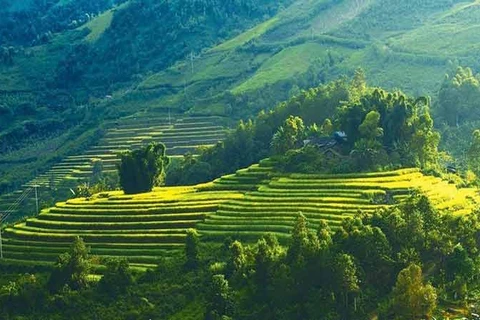
 In the afternoon, in Lap Mong village in Mu Cang Chai, clouds come down to meet the old mossy roofs in the middle of a vast rice field. (Photo: Xuan Mai/Vietnam +)
 Mu Cang Chai is a must visit-destination for any tourist, if just to see its vast, beautiful, terraced rice fields, that stretch across the area during wet season. Here’s a list of beautiful places you cannot miss when visiting Mu Cang Chai:
Tu Le commune
Tu Le commune is a stop on your journey to the highland district of Mu Cang Chai, located close to Khau Pha pass. It belongs to Van Chan district of Yen Bai province.
Before conquering one of the four great mountain passes in the North, tourists like to stop here because they are infatuated with Tu Le's aromatic scent, and because they are absorbed in the peaceful beauty of the streams and the fields.
 Don’t forget to enjoy the young sticky rice dish in Mu Cang Chai. (Photo: Tran Giap)
 Considered a tourist destination not to be missed when traveling to Mu Cang Chai, Tu Le is often compared to a girl who is beautiful, charming and equally mysterious in the Northwest mountains.
Coming here, visitors will admire the terraced fields of beautiful yellow green. We sure to visit Lap Thai village, Lam Mong village about 3km away and see the houses on stilts on both sides of the road.
Khau Pha Pass
The pass is located in the border area between Van Chan district and Mu Cang Chai district of Yen Bai province. Khau Pha pass passes through many famous landmarks such as La Pan Tan, Mu Cang Chai, Tu Le and Che Cu Nha.
 Pilots fly at Khau Pha pass. (Photo: The Duyet / VNA)
 Located 1,200m to 1,500m above sea level, the pass passes the top of Khau Pha mountain, the highest mountain in Mu Cang Chai. The name of this mountain in Thai language means "Horn of Heaven", because the peaks often protrude among the surrounding sea of clouds like a horn.
The weather in Khau Pha is cool all year round like Da Lat plateau. One day in Khau Pha has four seasons: Spring, Summer, Autumn, Winter. Khau Pha is often cloudy and some years ice and snow cover the top of the pass.
The view from Khau Pha Pass is most beautiful in the ripe rice season, around September, October, when the rice on the foot of Tu Le's terraced fields ripens in the morning mist.
This is also the time when many adventurous tourists conquer the pass to enjoy the scenery.
Rainy season around June in Khau Pha Pass is also a captivating time. The scene appears brown from the land, mixed with the colour of water and the sun, with the green of young seedlings interwoven to create a mesmerising picture on the terraced fields in the Khau Pha valley.
Terraced fields in La Pan Tan
This is the place with the most terraced fields in Mu Cang Chai with 700 ha of terraced fields. There are cascading, layered terraces spreading throughout the hill, with famous golden raspberry fields, which often attract tourists to visit and take photos.
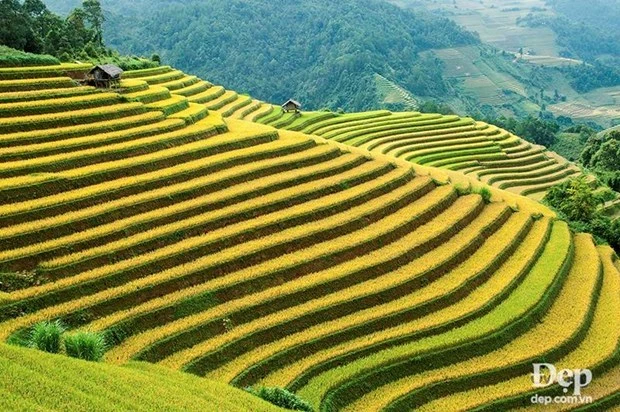
 Terraced fields in Mu Cang Chai during the rice ripening season. (Source: Dep Magazine / Vietnam +)
 Mu Cang Chai terraced fields are like "golden waves" winding around the hillside, layer after layer, endlessly spreading over an area of about 3,500 ha. 500ha is distributed in 3 communes La Pan Tan, Che Cu Nha, Di Xu Phinh (Mu Cang Chai district, Yen Bai province) and have been recognised as a National Scenic Monument since 2007.
The "golden raspberries" and "green raspberries" appear magnificent in the midst of mountains and forests in the Northwest as if to rise to heaven and earth, and show the prosperous life of the people.
Mo Mu Cang Chai Waterfall
Not only famous for the captivating beauty of the terraced fields, Mu Cang Chai is also home to countless unique places waiting for you to explore. One of them is Mo Mu Cang Chai Waterfall, where tourists can admire the grandeur of a natural masterpiece created in the middle of the Northwestern mountains and forests.
 Mo Mu Cang Chai Waterfall. (Source: yenbai.gov.vn)
 Located in Mo De commune, Mo Mu Cang Chai Waterfall is like a girl with long, silky hair that falls between two mountains in Na Hang A.
The waterfall has a total of four floors, tourists have to cling to a rope ladder to reach the falls. Each floor of Mo Mu Cang Chai waterfall has its own beauty, with visitors admiring the magnificent scenery between sky, clouds, water and mountains.
From the top of the waterfall, you can observe the 99 mountains surrounding the village. At this point, you will enjoy and immerse yourself in the fresh, free air, and dispel fatigue and stress after long working days.
Thai village, Mu Cang Chai
To reach Thai village in Mu Cang Chai, you have to cross the bridge in the center of the district (the direction to Che Tao), then turn left, and travel about 1 km. It is a small village nestled in the mountains, in the middle of a beautiful valley, and will give you a sense of peace the first time you arrive.
 Thai village in the centre of Mu Cang Chai district with traditional stilt houses suitable for community tourism. (Source: baoyenbai)
 Visit Thai Mu Cang Chai village, you will enjoy the specialties of the indigenous people, try bathing with tobacco water based on traditional Thai methods, experience sleeping on stilts and participating cultural exchanges and campfire.
Surely this is a place you should go to if you want to escape from a noisy and bustling life and understand more about Thai customs, habits and cultures./.