National plan to promote digital transformation

A national plan is scheduled to be issued this year so as to serve as a basis to engage state agencies, businesses and individuals in digital transformation – a leading factor in growth facilitation and digital economy development.
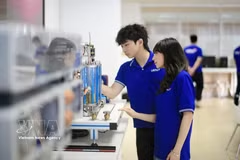
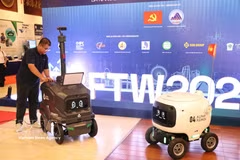
National plan to promote digital transformation ảnh 1Illustrative image (Photo: VNA)

Hanoi (VNA)
– A national plan is scheduled to beissued this year so as to serve as a basis to engage state agencies, businessesand individuals in digital transformation – a leading factor in growthfacilitation and digital economy development.

Minister of Information and CommunicationsNguyen Manh Hung said digital transformation and digital society will be afocus of Vietnam in decades to come. Digital transformation will open up greatopportunities for the country as it will bring about comprehensive changes toorganisations and businesses.

Truong Gia Binh, Chairman of the VietnamSoftware and IT Services Association (VINASA), said digital transformation willgenerate several benefits like cutting down operating expenses, accessing morecustomers and making faster and more precise decisions, thereby improvingbusinesses’ operational efficiency and organisations’ competitiveness.

According to him, in the IT era, the growth ofbusinesses will largely depend on their digital transformation, without whichthey will lag behind and be eliminated sooner or later. That means amidst theFourth Industrial Revolution (Industry 4.0), digital transformation not onlyhelps firms integrate and develop but also is decisive to their survival.

Minister Hung said the core of the digitaltransformation process in Vietnam is IT enterprises, noting that major telecomfirms will invest in basic IT projects and the Government will rent theirservices.

In the draft national digital transformationplan, Vietnam aims to emerge as one of the top four countries in ASEAN in termsof digitalisation by 2025 with 80,000 digital technology companies.

A 2018 survey of the IDC Group shows that 90percent of the companies interviewed had carried out digital transformation atdifferent stages, from study to implementation. More than 30 percent of theirleaders considered digital transformation as a matter of business survival.

As one of the leading IT groups in Vietnam, the FPThas taken the lead in digital transformation, its representative said, notingthat it has provided solutions for the Government to develop an e-cabinet and adigital economy and participated in building smart cities, transport, health careand education.

To help prepare infrastructure for nationaldigital transformation, the CMC Corporation recently debuted an openinfrastructure ecosystem named C.OPE2N to provide enterprises and organisationswith a platform for connecting with one another and sharing data in the digitalenvironment.

The CMC said in Industry 4.0, Vietnam needs moreopen infrastructure ecosystems like C.OPE2N to create digital hubs fororganisations and enterprises.

Apart from IT firms, companies in many otherfields such as Viettel, Vietcombank, VP Bank and EVN have also begun theirdigital transformation efforts.

This month, the Vietnam ICT Summit 2019 will beorganised by VINASA to give experts and businesses an occasion to discuss andshare experience in this work.-VNA
VNA

See more

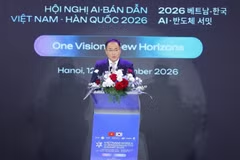
Vietnamese Deputy Minister of Science and Technology Tran Trung Tinh speaks at the event. (Photo: Published by VNA)

Vietnam, RoK seek to expand cooperation in AI and semiconductor sectors

Vietnamese Deputy Minister of Science and Technology Tran Trung Tinh stressed that the Politburo's Resolution No. 57-NQ/TW identifies science and technology, innovation and digital transformation as leading breakthroughs and key drivers of rapid and sustainable development. Semiconductors and artificial intelligence (AI) are among the strategic technologies prioritised for development.

Representatives of Cambodia’s Ministry of Education, Youth and Sport (MoEYS), the Agence Universitaire de la Francophonie (AUF) and Viettel Cambodia (Metfone) sign a tripartite agreement to strengthen cooperation and accelerate digital transformation in Cambodia’s higher education sector. (Photo: khmertimeskh.com)

Vietnamese company joins Cambodia’s digital transformation efforts

The agreement establishes a cooperation framework to modernise higher education through digital governance, digital learning, artificial intelligence (AI) applications, and capacity building through training and knowledge sharing. It also aims to expand internship, employment and scholarship opportunities for students.

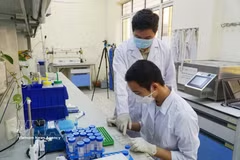
USTH students access modern equipment (Photo: VNA)

Vietnam’s AI ambition runs into talent wall

AI is becoming a foundational technology, cutting across industrial production, healthcare, education, finance, governance and public service delivery. But turning technological potential into practical value requires a workforce able to study, master and apply AI to Vietnam’s real-world problems.

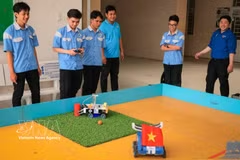
Trainees practise programming and operating robots at the Ho Chi Minh City High-Tech Park Training Centre. (Photo: VNA)

Vietnam, Malaysia hold potential for cooperation in robotics industry

Businesses from both countries should lead joint research and field-testing projects in areas such as electronic component inspection, warehouse transport, agricultural monitoring and medical logistics, said Samirul Ariff Othman, a policy, economic and business analyst at Global Asia Consulting and visiting lecturer at Universiti Teknologi PETRONAS.

Illustrative image (Photo: SGGP)

Ericsson establishes R&D capability in Vietnam

This initiative builds on Ericsson’s growing software engineering and testing capabilities in the country, and will further strengthen Vietnam’s contribution to Ericsson’s global technology development.

An AI-powered robot at the 2026 Seoul AI Conference. (Photo: VNA)

RoK’s AI robotics drive opens cooperation opportunities with Vietnam

Dao Tuan Hung, President of the Business Association of Vietnamese in Korea (BAVIK), said Vietnam should adopt a practical approach by prioritising specialised robots, including autonomous mobile robots (AMR/AGV), collaborative robots and machine vision systems, in sectors such as agro-fishery processing, textiles and garments, electronics and logistics.

Russian survey vessel Akademik M.A. Lavrentyev (Photo: VNA)

Russian survey vessel docks in Hai Phong

This is the third joint marine scientific survey in Vietnamese waters, running from November 4 - December 12, and one of the opening field activities under the Vietnam–Russia roadmap for marine scientific research cooperation for 2026-2035.

Smart products, chips and semiconductor materials are displayed at the launch ceremony of the national semiconductor chip prototyping support centre in Hanoi on June 26, 2026. (Photo: VNA)

Vietnam-Japan semiconductor cooperation paves the way for high-tech investment

The two countries are implementing five semiconductor research projects involving leading universities, with funding agreements signed in July. The projects cover three-dimensional integrated circuits, advanced semiconductor materials, secure artificial intelligence (AI) chips and power electronic components.

An exhibition space at the “Da Nang Semiconductors and High-Tech 2026” conference, organised by the Da Nang People’s Committee. (Illustrative photo: VNA)

Mobilising international resources to drive Vietnam’s technology development

Vietnam previously focused mainly on attracting overseas experts and intellectuals to work in the country over the long term, but this approach encountered certain difficulties. Cooperation methods are now shifting towards greater flexibility, allowing experts to take part in conferences and scientific seminars, contribute to addressing major national challenges, or participate in short-term training and research programmes.

Assoc. Prof. Dr. Dinh Ngoc Thach, lecturer and researcher in automatic control theory and robotics at the French National Conservatory of Arts and Crafts (Cnam) (Photo: VNA)

Core technologies key to sustainable robotics development in Vietnam: expert

Vietnam should select suitable robotic platforms and gradually build capacity in core technologies, including sensing, environmental perception, positioning, state estimation, AI, control and system integration. This will help develop technologies applicable across multiple sectors while avoiding fragmented investment and dependence on a single product category.

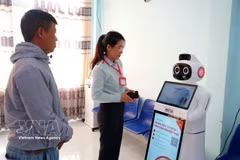
AI robots have become effective assistants in providing administrative services and reducing the workload of officials in Lam Dong province (Photo: VNA)

AI robots help streamline administrative procedures

Operating around the clock, AI robots provide information on administrative procedures, required documents, processing times, fees and relevant regulations, complementing assistance from civil servants.