Ninh Thuan to grow more new, high-quality grape

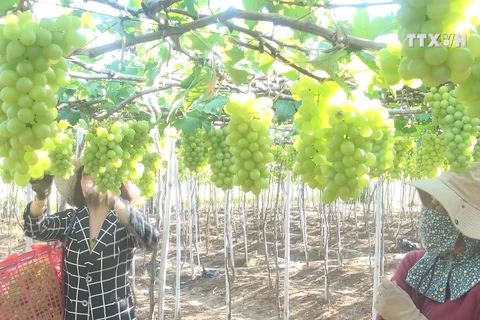
The south central province of Ninh Thuan, the country’s largest grape producer, plans to expand cultivation of NH 01-152, its new grape variety, because of its excellent quality and other outstanding characters.
Ninh Thuan to grow more new, high-quality grape ảnh 1

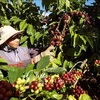
A farmer tends his grape farm in Ninh Thuan province’s Ninh Hai district. (Photo: VNA)


Ninh Thuan (VNA) -
The south centralprovince of Ninh Thuan, the country’s largest grape producer, plans to expandcultivation of NH 01-152, its new grape variety, because of its excellentquality and other outstanding characters.    

The variety, created by the Nha Ho ResearchInstitute for Cotton and Agriculture Development, has been grown on a pilotbasis but is in great demand already.

Grown for eating fresh, it is crunchy andsemi-sweet with firm flesh, a slight fragrance and just one or two seeds.

Phan Cong Kien, deputy head of the researchinstitute, said the institute is working with local agencies to transferintensive farming techniques to farmers for growing the variety, which wouldgradually replace certain degraded varieties in the province.

In the third quarter of this year the instituteand relevant authorities would seek approval from the Ministry of Agricultureand Rural Development to grow the grape commercially, and subsequentlyintroduce it to more farmers, he said.

It is now grown on nearly 6ha in major grapegrowing areas like Ninh Hai, Ninh Phuoc and Ninh Son districts, Phan Rang – ThapCham city and the neighbouring province of Binh Thuan. 

Nguyen Khac Phong, who grows the grape on his2,000sq.m farm under Vietnamese good agricultural practice (VietGAP) standardsin Ninh Hai district’s Vinh Hai commune, said he recently harvested the firstcrop, and it yielded one tonne per 1,000sq.m, fetching him an income of nearly 200million VND (8,800 USD).

The cost of growing NH 01-152 is 30-40 million VND(1,300 -1,700 USD) per 1,000 square metre, the same as other grape varieties,but the income is higher, he said.

The variety is suitable for growing in theprovince’s hot and dry weather and soil conditions and is resistant to diseases.
It yields two crops a year. Traders pay 100,000-200,000VND per kilogramme of the grape.

The provincial People’s Committee has instructedrelevant agencies to cooperate with the research institute to grow the newvariety.

The province plans to create a large-scale fieldfor planting the grape in Vinh Hai commune this year, and this is also expectedto be a tourist attraction.

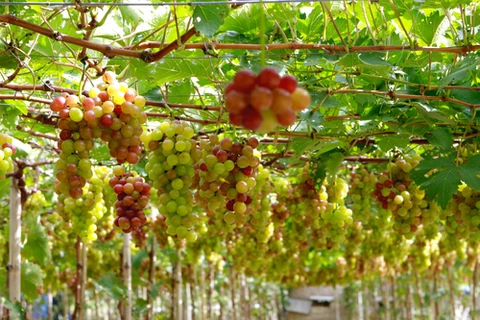
The south-central province has more than 1,300haof land under grapes, mostly the cardinal and NH01-48 varieties.-VNA
VNA
See more

Downtown area in Ho Chi Minh City. (Photo: VNA)

Vietnam's golden gateway: FDI poised for gains in 2026

More than just volume, the quality of FDI entering Vietnam has improved. The nation is evolving from a base for basic assembly and processing into a genuine contributor to hi-tech manufacturing and R&D across global value chains.

Deputy Minister of Finance Do Thanh Trung speaks at the ceremony (Photo: VNA)

Project to advance growth, innovation, leadership for enterprises kicks off

AGILE is not only a testament to the long-standing and trusted strategic partnership between Vietnam and Canada, but also an important contribution to the Vietnamese Government’s efforts to promote innovation and sustainable growth within the private sector, thereby effectively mobilising private investment to realise inclusive and sustainable development goal.

At Regza Vietnam Electronics Co., Ltd. in Dong Nai province. (Photo: VNA)

FDI disbursement in January hits five-year high

Economists said that the continued growth in realised FDI reflects foreign investors’ sustained implementation and expansion of production and business activities in Vietnam. This is seen as an encouraging signal, underscoring investors’ confidence in Vietnam’s business environment and economic prospects.

In Q1 2026, Vietnam records 16 export commodities with turnover exceeding 1 billion USD. (Photo: VNA)

Exports face stiff test in bid to hit 550 billion USD

To achieve export growth of over 15% as directed by the Government, the MoIT said it will prioritise a set of core measures in 2026, including expanding production capacity, developing new export products, increasing domestic content and value added, accelerating the shift from processing to manufacturing, and proactively addressing trade barriers and defence measures.

Illustrative photo (Photo: VNA)

January CPI rises on stronger Tet holiday demand

CPI in January 2026 rose 0.05% month-on-month, with urban areas up 0.02% and rural areas up 0.09%. Of the 11 major commodity and service groups, nine recorded price hikes while two saw declines.

Vietnam is currently Cambodia’s third-largest trading partner worldwide, after China and the US, and its largest trading partner within ASEAN. (Photo: Ministry of Industry and Trade)

Party chief’s Cambodia visit to open up new phase of deeper, closer cooperation

To further unlock the potential of bilateral economic and trade cooperation, Vietnam and Cambodia should continue reviewing and effectively implementing signed agreements, facilitating trade and border connectivity, strengthening trade promotion in complementary sectors, reforming administrative procedures, upgrading border and logistics infrastructure, and enhancing coordination in combating smuggling and trade fraud.

Investors monitor stock market movements at the HoSE trading floor. (Photo: VNA)

VNX, FTSE Russell discuss Vietnam market upgrade

During the working session, the two sides shared updates on the performance of Vietnam’s stock market in 2025, focusing on market capitalisation, index trends, developments in the equities, bond and derivatives segments, and the continued expansion of the investor base.

Vietnamese products continue to gain traction at traditional markets and supermarkets across Ho Chi Minh City (Photo: VNA)

Vietnamese goods dominate Tet market in Ho Chi Minh City

Despite still-muted purchasing power, Vietnamese products continue to gain traction at traditional markets and supermarkets across Ho Chi Minh City, as consumers increasingly prioritise locally made goods, from fresh food and fast-moving consumer items to processed products, for their stable quality, reasonable prices and transparent origins.