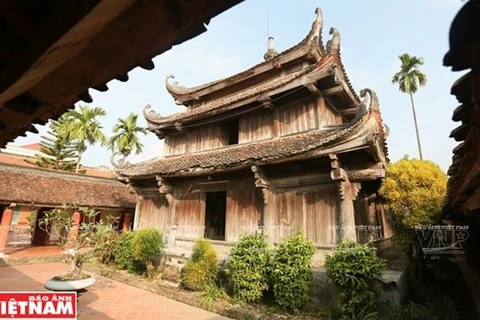
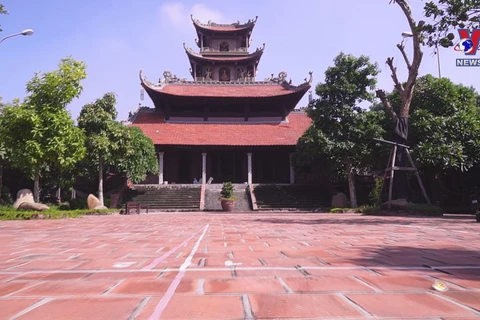
Nom Pagoda in Van Lam district of Hung Yen province (Photo: Vietnam Pictorial)
 Hung Yen (VNA) – Aside from the archaic and solemn landscape, Nom Pagoda in Van Lam district of northern Hung Yen province is also home to valuable objects which are old statues dating back centuries.
Also known as “Linh Thong Co Tu”, the pagoda is part of the relic complex of Nom village in Dai Dong commune. It is a famous Buddhist facility with many old features kept intact in the northern region.
According to the writing on the stone stele kept at the pagoda, the pagoda was re-built in 1680, but no one knew exactly when it came into being. In the late 18th century, a bell tower and two corridors were added to the construction, which later continued to be repaired during the Nguyen Dynasty (1802 - 1945).
Undergoing numerous ups and downs in history as well as natural impacts, the pagoda is still standing today and preserving some of the oldest statues in the Red River Delta. It is also associated with many legends that have added to its attractiveness to visitors from far and wide.
The local elderly said once upon a time, a Buddhist monk while sleeping at Dau Pagoda suddenly woke up at midnight and saw bright light in the south. He followed the light to a pine forest where this light became an aureole. Believing that this was a good omen from the Buddha, the monk built a pagoda there and named it “Linh Thong Co Tu” (Ancient pagoda of sacred pine forest).
Nom Pagoda covers an area of 15 hectares and has the “noi cong ngoai quoc” architectural structure, which means the inner parts are arranged in the shape of the Chinese character “gong” (工, called “cong” in Vietnamese) while the outer parts arranged in the shape of a square like the Chinese character “guo” (国, called “quoc” in Vietnamese).
Passing the three-door gate, visitors can see the bell and drum towers opposite to each other on the two sides of the gate. There is a crystal clear lake next to the bell tower, opening up a tranquil space for the pagoda.
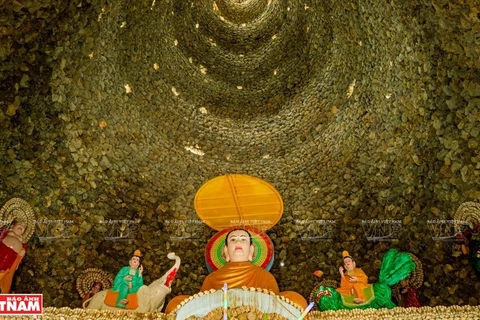
 There are nearly 100 earthen statues at Nom Pagoda, making this temple home to the largest number of terracotta statues in Vietnam (Photo: Vietnam Pictorial)
 Aside from the antique and solemn landscape, Nom Pagoda is also preserving valuable objects which are old statues dating back centuries.
Though this area often suffers from flooding, the old statues here are still maintained. Their original red lacquer trimmed with gold remains, which many historical and architectural researchers haven’t been able to explain.
Nom Pagoda is currently home to more than 100 old statues made of clay, but there hasn’t been exact information about the time and process of their creation. Some researchers believe that these statues were made during the Ly - Tran dynasties (the 11th - 13th century).
Most of the statues were made of terracotta in a meticulous manner, and each of them features different a posture and facial expression. They are considered an illustration of the development of the art of ceramic and terracotta making in Vietnam’s history.
In addition, this pagoda also boasts a garden of old three-story grave towers made from laterite stone.
Another thing that helps attract visitors to Nom Pagoda is a nine-span stone bridge with dragon head decorations built about 200 years ago over the Nguyet Duc River.
This pagoda has long been a witness to history and accompanied local residents in both wartime and peacetime. Its sacredness seems to have been deeply infused into each roof tile, wooden object, and statue.
Alongside the development and integration of the contemporary culture, Nom Pagoda and many other Buddhist ones in Vietnam have still been preserved, helping to enrich people’s spiritual life and also create momentum for the Vietnamese culture to develop./.