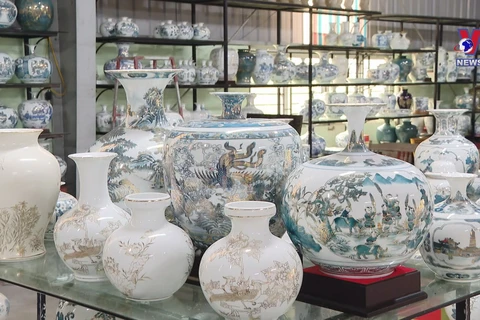
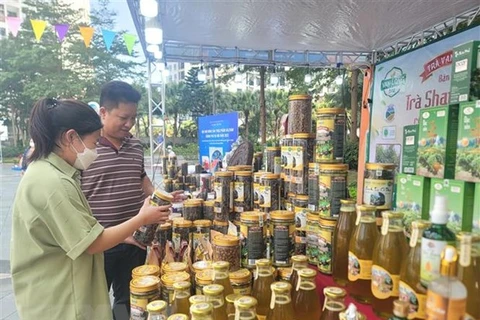
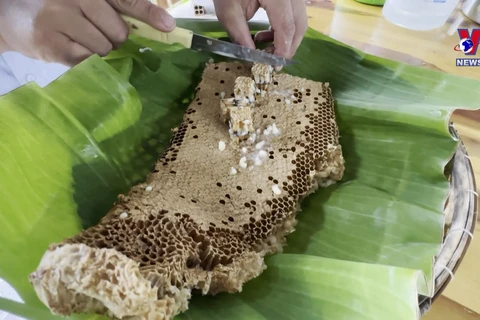
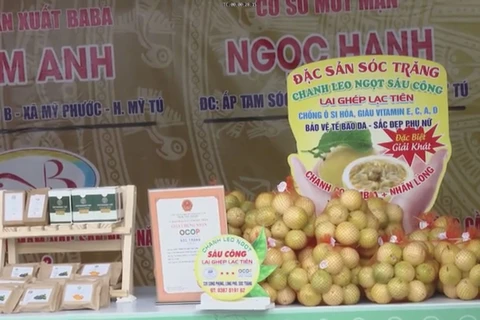
OCOP products on display at a recent workshop on sales promotion. Besides the abundance in supply, the quality of OCOP products is improved significantly together with transparent traceability. (Photo: VNA)
 OCOP was approved by Decision 490/QD-TTg dated on May 7, 2018 with three targets including developing production and business forms; restructuring the economy to improve income and living standards; and industrialising and modernising the agriculture and rural sector.
To date, all 63 provinces and cities across the country has developed a diversity of OCOP products, including 10,322 products with three-star or higher rating. Especially, 42 products are five-star rated. There are 5,361 OCOP producers.
The Hong (Red) River Delta accounts for 31.36% of the total number of OCOP products, the northern mountainous region 19.8% and the Cuu Long (Mekong) River Delta 18.4%.
At a recent workshop on promoting consumption of OCOP products, Nguyen Anh Tuan, Deputy Director of the Domestic Department under the Ministry of Industry and Trade, said that market development is an important solution to encourage participation in developing OCOP products.
“Vietnamese consumers have formed the habit of choosing reputable brands. Therefore, it is necessary to build and expand sale points to promote OCOP products, which plays an important role in bringing OCOP products closer to consumers,” Tuan said.
Besides the abundance in supply, the quality of OCOP products is improved significantly together with transparent traceability. Many products with eye-catching designs are successful in promoting the advantages of indigenous resources and traditional culture, and with quality highly appreciated by consumers.
OCOP gradually affirms their value and reputation in the market with growing revenue even in the difficult times due to the COVID-19 pandemic, contributing to improving income and quality of life for people in urban, rural and remote areas, and ethnic minorities, he said.
However, Tuan pointed out that the sales of OCOP products face certain difficulties as there are only few processed products, production scale remains small and scattered, coupled with low governance capacity of producers as well as limited research and development capacity.
“With limited competitiveness, the implementation results of the OCOP programmes are still below their potential. The competitive advantages of provinces and cities, especially the promotion of OCOP products, have not been fully exploited, especially in the post-pandemic context of weak domestic purchasing power,” Tuan said.
Pointing out difficulties in developing OCOP products, Dang Quy Nhan, Deputy Manager of OCOP Programme under the Central Coordination Office on New Rural Development, the Ministry of Agriculture and Rural Development, said that the number of OCOP products increases rapidly recently but lacks sustainability.
“Producers of OCOP products have not been proactive enough, especially in innovation and product development. The results are still limited compared to the potential,” Nhan said.
“The trade promotion is still fragmented, lacks uniformity and fails to create highlights or build originality for products.”
Another problem is related to the management and supervision of OCOP products after recognition. OCOP producers’ access to science and technology is limited. Thus, it is difficult for them to promote sales via e-commerce platforms, to shopping centres and supermarkets, Nhan said.
“If you want to sell OCOP products in big cities, you must have e-commerce channels and social networks to introduce products,” he said.
The Government should provide support in training to enhance the capacity of OCOP producers, thereby promoting innovation to create unique products which meet consumers’ requirements, he said. “It will take time, but it is a must-do,” he stressed.
It is vital to provide support to OCOP producers in accessing e-commerce platforms in the context of booming e-commerce, Nhan said, urging e-commerce platforms to join with the Government to provide support to farmers through training which would facilitate the creation of new products with better quality and originality.
“I hope that management agencies, local authorities and enterprises will cooperate to provide support to farmers through creating a separate mechanism and playground for OCOP products. Specifically, there should be separate areas designated for displaying OCOP products at supermarkets, shopping centres and e-commerce platforms to promote products,” Nhan said.
The aim is that everyone will benefit, including producers, distributors and consumers, from the development and quality of OCOP products, he said.
With regard to solutions to promote sales of OCOP products, Bui Nguyen Anh Tuan, Deputy Director of the Domestic Department under the Ministry of Industry and Trade, said that it is necessary to maintain and develop existing distribution channels and promote omni-channel sales.
Along with that, the sales of OCOP products should be associated with tourism, cuisine and culture.
“Improving awareness of digital transformation and promoting the application of information technology and e-commerce are important to bring products closer to consumers and boost production and consumption,” Tuan said. “Besides, the development of OCOP products contributes significantly to socio-economic development and increasing local people’s income,” he affirmed.
Tuan said that the communication and promotion of OCOP products need to be strengthened with the focus on enhancing market watch and brand protection for these products./.
VNA