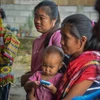
As many as 25 percent of the population of the Philippines lived below the poverty line in 2012, slightly better than the 2009 rate of 26.3 percent.
The poverty statistics announced by the Philippines’ National Statistical Coordination Board (NSCB) on December 9 indicate that poverty is a serious challenge despite the country rapid economic growth.
NSCB said 19.7 percent of the nation’s households lived below the poverty line in 2012, lower than the 20.5 percent three years before, despite the 6.8 percent expansion of the national economy, which was one of the fastest growth rates in Asia.
The economic officials have acknowledged that the pace of poverty reduction has remained slow, leading to the Philippines being one of the few countries to miss its Millennium Development Goals ( MDG ) which requires each country to cut by half its poverty rate by 2015 compared to 1990. In order to meet the goal, the Philippines must bring the rate down to 17.2 percent.
However, the Philippine government declared they will continue to strive for this goal.
The Philippines is vulnerable from natural disasters and disease, making it more difficult to reduce the poverty rate. Most recently, super typhoon Haiyan hit the island nation on November 8, killing 5,796 people, injured 27,000 others and left 1,800 missing, according to statistics on Dec. 7. Only weeks earlier, a 7.1-magnitude earthquake struck the central islands of Cebu and Bohol on October 15 and took the lives of more than 220 people.-VNA
The poverty statistics announced by the Philippines’ National Statistical Coordination Board (NSCB) on December 9 indicate that poverty is a serious challenge despite the country rapid economic growth.
NSCB said 19.7 percent of the nation’s households lived below the poverty line in 2012, lower than the 20.5 percent three years before, despite the 6.8 percent expansion of the national economy, which was one of the fastest growth rates in Asia.
The economic officials have acknowledged that the pace of poverty reduction has remained slow, leading to the Philippines being one of the few countries to miss its Millennium Development Goals ( MDG ) which requires each country to cut by half its poverty rate by 2015 compared to 1990. In order to meet the goal, the Philippines must bring the rate down to 17.2 percent.
However, the Philippine government declared they will continue to strive for this goal.
The Philippines is vulnerable from natural disasters and disease, making it more difficult to reduce the poverty rate. Most recently, super typhoon Haiyan hit the island nation on November 8, killing 5,796 people, injured 27,000 others and left 1,800 missing, according to statistics on Dec. 7. Only weeks earlier, a 7.1-magnitude earthquake struck the central islands of Cebu and Bohol on October 15 and took the lives of more than 220 people.-VNA