Online discussion seeks to bring into play Quoc Tu Giam’s cultural values

An online discussion was held on September 26 to look into way to capitalise on values of the cultural space of Quoc Tu Giam in the Van Mieu - Quoc Tu Giam (Temple of Literature - Imperial Academy) complex in Hanoi.
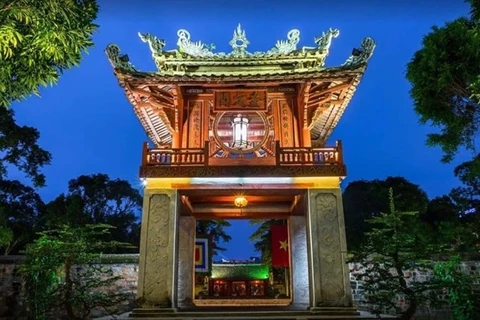
Online discussion seeks to bring into play Quoc Tu Giam’s cultural values ảnh 1Khue Van Cac (Literature Pavilion) at the Van Mieu - Quoc Tu Giam relic site is one of the symbolic icon of Hanoi (Photo: vanmieu.gov.vn)
Hanoi (VNA) – An onlinediscussion was held on September 26 to look into way to capitalise on values ofthe cultural space of Quoc Tu Giam in the Van Mieu - Quoc Tu Giam (Temple ofLiterature - Imperial Academy) complex in Hanoi.

A special national relic site, Van Mieu - Quoc Tu Giam was founded in the 11th century and consideredthe first university of Vietnam. It has also been a place for honouring thefondness for learning for centuries.

However, how to turn it into a vivid cultural space, not merely a tourist attraction, so as todisseminate the fine cultural values of not only this site but also Vietnam isnot a simple issue.

Le Xuan Kieu, Director of the VanMieu - Quoc Tu Giam Centre for Cultural and Scientific Activities, said thecentre has applied new technology to studying and bringing into play the relicsite’s values and developing new products to serve visitors once the place isre-opened.

Notably, the centre is seeking new waysto bring traditional values closer to visitors to help them understand more andhave appropriate behaviours toward the relic site, he added.

At the discussion, researchers andexperts suggested many measures to transform the relic into a livelycultural space.

In early September, the Van Mieu -Quoc Tu Giam Centre for Cultural and Scientific Activities, the GavistoDiplomat non-profit cultural and educational project, and relevant agenciesdebuted the Cultural Space of Quoc Tu Giam project which aims to develop thisrelic site into an open space for heritage-related ideas.

In less than a month, this projecthas recorded interactions of 1,500 people. Posts about history, culture, andthe fondness for learning have also attracted great attention./.
VNA
See more

A ritual at Hue Nam Temple Festival (Photo: VNA)

Hue Nam Temple Festival: From imperial relic to distinctive cultural celebration in Hue

Historically known as Ngoc Tran Son Tu, the temple was renamed Hue Nam during the reign of King Dong Khanh in the late 19th century, symbolising royal gratitude to the Mother Goddess. It is also the only temple in Hue that harmoniously combines royal ceremonial elements with folk religious practices, creating a distinctive blend of court ritual and popular belief.

Participants in the 20th Cong hien (Devotion) Awards presentation ceremony in Hanoi on April 15 (Photo: VNA)

Devotion Awards mark two decades of honouring excellence in music, sports

Nguyen Thien Thuat, Editor-in-Chief of the The Thao & Van Hoa newspaper and Head of the organising board of the awards, said, noting that their achievements reflect the spirit of the Politburo’s Resolution No. 80, which emphasises preserving national cultural values while selectively absorbing the essence of world culture.

Artisans and students take part in cultural activities and exchanges in the Xoan singing performance space at Hung Lo ancient communal house in Phu Tho province (Photo: VNA)

Ancestral legends revived through contemporary performance

Beyond cultural value, well-organised festival programmes linked with tourism and media can contribute to the development of cultural industries and enhance Vietnam’s cultural soft power, positioning heritage-based events as distinctive national cultural brands in the international arena.

Khue Van Cac (Khue Van Pavilion) stands as a defining cultural symbol of Hanoi, closely associated with Vietnam’s long-standing tradition of valuing education and honouring knowledge. (Photo: VNA)

Greater efforts needed for heritage to shape Hanoi’s identity

As suggested by UNESCO experts, heritage should be approached as an integrated system encompassing space, people and everyday life. This perspective can inform urban planning, cultural tourism development and the creation of clear economic drivers.

Participants at the gathering (Photo: VNA)

Lao, Cambodian students welcome traditional New Year in Ho Chi Minh City

In his speech, Vice Chairman of the municipal People’s Committee Nguyen Manh Cuong said the municipal Party organisation, authorities and people always value the close ties and solidarity among Vietnam, Laos and Cambodia. He described the three nations’ longstanding ties, forged through shared hardships, as an invaluable spiritual asset and a bedrock for sustainable development.

Vietnamese kickboxers win 32 gold medals at the Kickboxing World Cup 2026. (Photo: Vietnam Kickboxing Federation)

Vietnam finish third at Kickboxing World Cup 2026

According to Vu Duc Thinh, President of the Vietnam Kickboxing Federation, the strong results reflected careful preparation by local training centres and the determination of Vietnamese fighters. The team’s participation, funded largely through socialised and local resources, also demonstrated growing support for the development of kickboxing in Vietnam.

Politburo member, Secretary of the Party Central Committee and Head of the Party Central Committee’s Commission for Information, Education and Mass Mobilisation Trinh Van Quyet speaks at the event (Photo: VNA)

National Radio Festival opens in Quang Ninh

The opening night was combined with an artistic programme titled “sounds of the new era,” drawing around 50,000 spectators. The programme was structured in three chapters: Origins of Sound, Heritage Sound, and Sound of the New Era.

Vietnamese puppetry faces pressure to adapt to modern lifestyles, particularly amid growing competition from diverse entertainment forms (Photo: VNA)

Vietnamese puppetry seeks renewal amid preservation challenges

People’s Artist Nguyen Hoang Tuan, Chairman of the Hanoi Theatre Association, noted that while northern Vietnam had 27 puppetry guilds in 1986, only 14 remain today. Many traditional plays and original scripts have been lost, hurting restoration and preservation efforts.