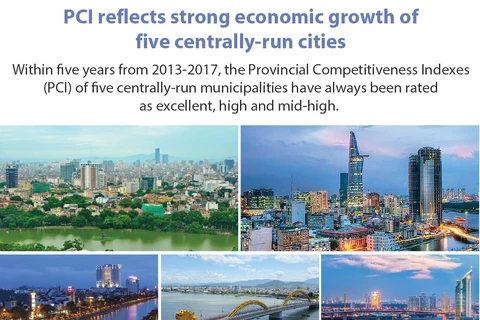
Hanoi (VNA) – The Provincial Competitiveness Index (PCI) 2018 report shows a score improvement of the provinces at the bottom of the rankings, but there have been signs of stagnation in the performance of those at the top of the list. The question is that whether or not the institutional ceiling in reforms has been hit.
“Although the overall confidence index is high, up to 8.3 percent of the interviewed businesses plan to reduce their size or shut down, a slight increase from the 8.2 percent in 2017. However, this figure is the third highest since the first PCI survey was conducted, only lower than that in 2012 and 2014 when the Vietnamese economy was in hardships.”
[Video: PCI 2018 sees positive changes]
The fact was pointed out by Dau Anh Tuan, Director of the Legal Department at the Vietnam Chamber of Commerce and Industry (VCCI), at the event to unveil the PCI 2018 rankings.
Quang Ninh wins top place for two consecutive years
The report shows that there aren’t many changes in the positions of the top five localities compared to the 2017 rankings. In particular, Quang Ninh province took the lead for the second straight year with 70.36 points. It was followed by Dong Thap province, which set its new record of 70.19 points, marking the 11th straight year it has been in the top five. The third and fourth places belong to Long An province (68.09 points) and Ben Tre province (67.67 points).
Other localities in the top 10 are Da Nang city (67.65 points), Binh Duong province (66.09 points), Quang Nam province (65.85 points), Vinh Long province (65.53 points), Hanoi (65.39 points), and Ho Chi Minh City (65.34 points).
According to the report, the PCI score of the locality in the middle of the rankings reached the highest-ever level, 61.76 points, since the first survey, demonstrating considerable improvements in the quality of economic governance.
Besides, the gap between the localities at the top and the bottom of the rankings was narrowed. Those at the bottom have an advantage that is they can refer to effective practices of localities with higher positions to improve their local business environment.
However, there have been signs of stagnation in the leading localities, which Tuan described as a worrying issue as after carrying out many initiatives in the aspects that are easy to be reformed like business registration, they seem to have “hit the institutional ceiling”, so it is difficult for them to implement more initiatives to accelerate reforms.
 The event to release the PCI 2018 rankings on March 28 (Photo: VNA)
 Unofficial fees reduced strongly
A noteworthy point in this year’s report is that petty corruption, which implies small payments businesses have to pay to apply for licenses – a long-lasting problem in the previous years, have been improved strongly. The sub-index on unofficial fees rose 0.73 points.
Particularly, only 54.8 percent of the questioned firms said they had had to pay unofficial fees – a five-year low; and 58.2 percent reported bureaucracy when civil servant of local state agencies handled procedures for businesses, which is also a decline from last year.
The amount of unofficial fees has also tended to drop as only 7.1 percent of the businesses said they had had to pay over 10 percent of their revenue for these fees.
Regarding “grand corruption”, the PCI 2018 report also pointed out a decrease when only 30.8 percent of the respondents said they had paid unofficial fees to speed up the settlement of land-related procedures, down from the 32 percent last year.
It is impressive that there was a sharp fall in the percentage of businesses reporting unofficial payments for cadres conducting inspections and examination, 39.3 percent, compared to 51.9 percent in 2017 and 65.6 percent in 2014.
Although those results indicate the progress in reforms, with such reports by enterprises, much still needs to be done to better the business environment of Vietnam in the time ahead.
“Those figures reflect the fact that unofficial fees remain popular, requesting more persistent efforts by State agencies as well as the engagement of the business community. Enterprises themselves also need to improve their governance capacity, better grasp and comply with laws, and concurrently promote integrity in their production and business activities,” Tuan emphasised.
Numerous difficulties in entering the market
While reforms in business registration procedures have harvested impressive results, the PCI 2018 report also points out that the “post-business registration” burden is currently a big problem for many companies.
In particular, 15.8 percent of the questioned enterprises said they had had to wait for more than one month to have all the necessary papers, except for the business registration certificate, completed so that they could officially begin operations.
Tuan said: “The rate of businesses reporting difficulties to apply for licenses is at a worryingly high level.”
It is a concern that this figure has tended to increase over the last five years. As many as 34 percent of the respondents said they had encountered difficulties when applying for documents certifying their eligibility for doing conditional business lines. Meanwhile, 30 percent said they had to wait for a long time to receive the fire safety certificate, and 29 percent reported obstacles in seeking papers certifying the satisfaction of technical standards or other types of certificates.
Additionally, there hasn’t been observable improvement in information transparency as businesses still complain about difficulties in accessing planning information. In the scale from 1 to 5 (unable to very easy), enterprises’ access to documents on planning was rated at only 2.38 points, roughly equivalent to the scores in 2015 and 2016, but much lower than the 2.63 points in 2006./.