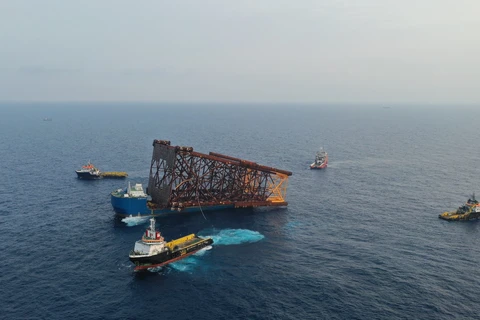
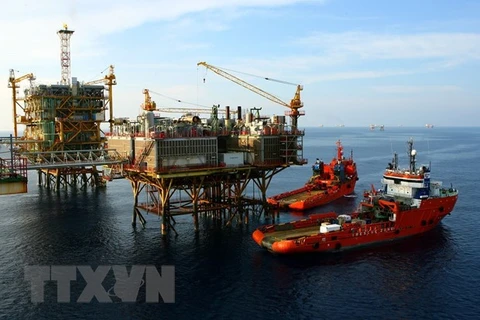
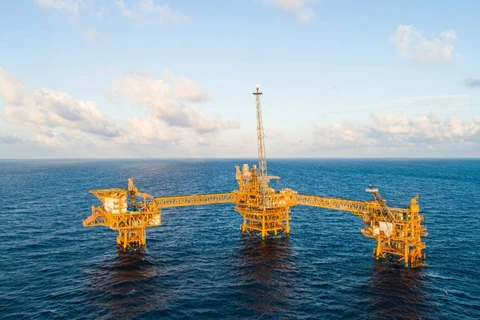
An oil rig of Petrovietnam (Photo: VietnamPlus)
 Hanoi (VNA) – Forty-eight years since its establishment, the Vietnam Oil and Gas Group (Petrovietnam) has become a multi-billion-dollar enterprise and made breakthrough and comprehensive development strides.
Petrovietnam was set up on September 3, 1975 with the goal of helping guarantee national energy security and serving as a pillar of economic support for national development.
Shortly after the date of national reunification (April 30, 1975), on September 3 the same year, the Vietnam General Department of Oil and Gas, the predecessor of Petrovietnam, was established under the Council of Government in efforts to realise late President Ho Chi Minh’s aspiration to develop an oil and gas industry of the country.
Nearly half a century has passed, Petrovietnam has managed to master the most cutting-edge technologies and build a complete oil and gas industry.
From 1986 to 2022, it posted more than 400 billion USD in total revenue. During the 2006 - 2015 period, it contributed to an average of 20 - 25% of the total State budget collection and 18 - 25% of the gross domestic product (GDP).
Since 2015, braving global economic uncertainties and numerous challenges, the group has still contributed to about 10% of the total State budget revenue (including 5 - 6% from crude oil) and 10 - 13% of the GDP.
In 2020, Petrovietnam succeeded in surmounting the twin crises of the COVID-19 pandemic and the nosedived oil prices, and later regained growth in 2021. By taking various production, business, and risk management measures, it hit a record of over 930 trillion VND (38.1 billion USD) in revenue and contributed 170.6 trillion VND to the state budget, equivalent to 9.6% of the total budget collection last year, statistics showed.
In Vietnam, guaranteeing energy security was identified as a consistent target of the national energy development strategy. Prime Minister Pham Minh Chinh has repeatedly affirmed that Petrovietnam has made important contributions to ensuring national energy security.
 Employees shape numbers on the Hai Thanh - Moc Tinh rig complex to mark the founding anniversary of Petrovietnam (September 3). (Photo: Petrovietnam)
 The group has worked to fulfill this role as seen in its recently inaugurated key thermal power plants such as Song Hau 1 and Thai Binh 2, helping turn Vietnam into one of the best-performing ASEAN countries in ensuring sufficient power supply for economic activities and consumption.
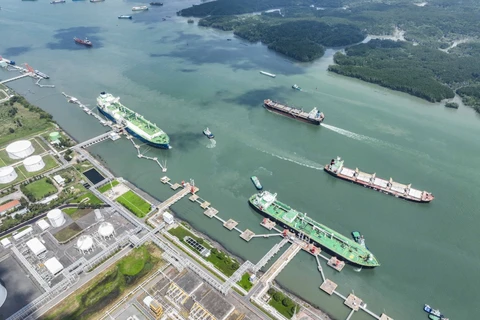
Meanwhile, amid the oil and gas price surge and limited fuel supply in the world, the building and management of the value chain in the oil and gas industry have become even more important to energy security. Thanks to the coordination among Petrovietnam subsidiaries from the initial to last production steps, the Dung Quat refinery has always been provided with adequate crude oil to maintain constant, safe, and effective operations at 100 - 110% of its capacity, meeting over 30% of the domestic petrol and oil demand.
In addition, as energy transition is taking place strongly around the globe, leaders of Petrovietnam also set up orientations early for renewable energy development in the long term. The group has been making preparations for expanding its operations to renewable energy in an appropriate and effective manner.
Petrovietnam is currently a major enterprise with its consolidated assets valued at almost 43 billion USD, the owner’s consolidated capital at 22.5 billion USD, and more than 50,000 employees working in all fields of the oil and gas value chains. It has made considerable contributions to national industrialisation and modernisation, energy security, the State budget, socio-economic development, Vietnam’s economic integration into the world, along with the safeguarding of the country’s maritime sovereignty.
Talking about the group’s development targets, Petrovietnam General Director Le Manh Hung said that weathering all difficulties, it has successfully performed all the tasks assigned by the Party and State. The core targets it is aiming at are developing Petrovietnam into a leading energy group in the country and the region, and holding the core role in safeguarding national energy security./.