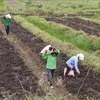
The island district of Phu Quoc in southern Kien Giang province has defined black pepper as a key economic strength and a local speciality, helping islanders develop the local economy, according to its 2020 socio-economic plan.
With a favourable climate and good soil, the island plans to focus on developing its century-long famous black pepper through improving the quality and increasing the economic value of the product.
Phu Quoc now has 385 hectares of black pepper farmland, mainly in the two communes of Cua Duong and Cua Can, with average productivity of 2-3 tonnes per hectare. The island produces approximately 1,000 tonnes of pepper each year with the market price ranging from 140,000 VND to 180,000 VND (approximately 7-9 USD) per kilogram.
The island district plans to expand the cultivation area to 500 hectares by 2015 and 1,000 hectares by 2020, increasing productivity to 3 tonnes per hectare as well as improving food safety to meet domestic and export demand.
As many as 43,600 hectares in the locality are favourable for pepper cultivation, promising the potential for highly lucrative pepper business for islanders.
The island is determined to cultivate the crop to the international standard GlobalGAP (Global Good Agricultural Practice), developing a safe, sustainable and environmentally-friendly production process. The locality will also focus on guiding farmers on pepper cultivation techniques.
Huynh Quang Hung, Vice Chairman of the Phu Quoc district People’s Committee, affirmed that a GlobalGAP-standard pepper farm is appropriate to its direction to make the island an ecological tourism site with resorts and international and national high-quality entertainment services, following the Government’s guidance and Vietnam’s 2020 Sea Strategy.
The Vice Chairman said the district will invest in infrastructure, create conditions for farmers to access loans and expand the product’s market. Hung added that GlobalGAP farms will help attract more foreign and domestic visitors to the island and make Phu Quoc Black Pepper a famous brand capable of penetrating the global market.
In 2011, Phu Quoc Black Pepper was granted collective brand status by Vietnam’s National Office of Intellectual Property, demonstrating the local pepper’s traditional values and quality as well as creating favourable conditions for the product to compete in price and quality in the international market.-VNA
With a favourable climate and good soil, the island plans to focus on developing its century-long famous black pepper through improving the quality and increasing the economic value of the product.
Phu Quoc now has 385 hectares of black pepper farmland, mainly in the two communes of Cua Duong and Cua Can, with average productivity of 2-3 tonnes per hectare. The island produces approximately 1,000 tonnes of pepper each year with the market price ranging from 140,000 VND to 180,000 VND (approximately 7-9 USD) per kilogram.
The island district plans to expand the cultivation area to 500 hectares by 2015 and 1,000 hectares by 2020, increasing productivity to 3 tonnes per hectare as well as improving food safety to meet domestic and export demand.
As many as 43,600 hectares in the locality are favourable for pepper cultivation, promising the potential for highly lucrative pepper business for islanders.
The island is determined to cultivate the crop to the international standard GlobalGAP (Global Good Agricultural Practice), developing a safe, sustainable and environmentally-friendly production process. The locality will also focus on guiding farmers on pepper cultivation techniques.
Huynh Quang Hung, Vice Chairman of the Phu Quoc district People’s Committee, affirmed that a GlobalGAP-standard pepper farm is appropriate to its direction to make the island an ecological tourism site with resorts and international and national high-quality entertainment services, following the Government’s guidance and Vietnam’s 2020 Sea Strategy.
The Vice Chairman said the district will invest in infrastructure, create conditions for farmers to access loans and expand the product’s market. Hung added that GlobalGAP farms will help attract more foreign and domestic visitors to the island and make Phu Quoc Black Pepper a famous brand capable of penetrating the global market.
In 2011, Phu Quoc Black Pepper was granted collective brand status by Vietnam’s National Office of Intellectual Property, demonstrating the local pepper’s traditional values and quality as well as creating favourable conditions for the product to compete in price and quality in the international market.-VNA