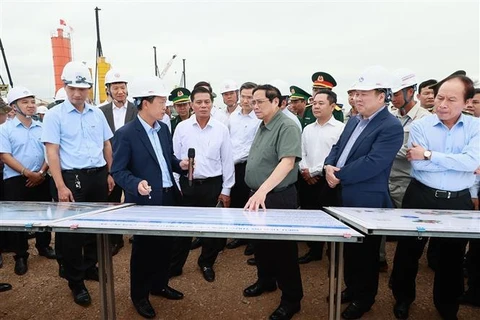
Prime Minister Pham Minh Chinh speaks at the meeting of Coordinating Council for Red River Delta Region in Hanoi on July 20 (Photo: VNA)
 The meeting was held right after the PM decided to establish the coordinating councils for the northern and coastal central region, the southeastern region, the Red River Delta region, and the Central Highlands region.
According to the plan of the Red River Delta region in the 2021- 2030 period, with a vision to 2050, it is oriented to become a fast and sustainable developing region with a well-structured economy imbued with national cultural identity.
The council is an inter-sectoral bodies helping the PM with considering, directing, coordinating, and handling important and inter-sectoral issues on regional connectivity and sustainable development.
 Participants at the meeting (Photo: VNA)
 PM Chinh stressed that the Party and the State, and key leaders always pay special attention to the implementation of the 13th Party Congress's Resolution on six socio-economic regions in the country, including the Red River Delta.
He underlined the region’s development potential, saying that it is an important strategic area, the northern gateway of the country and ASEAN in economic and trade connection with China, and a vital bridge connecting international economic and cultural exchange.
However, the region’s development has not been commensurate with its potential, advantage and location, he noted.
The establishment of the Coordinating Council for Red River Delta Region aims to overcome existing limitations and promote rapid and sustainable economic development in accordance with the 13th Party Congress’s Resolution and Resolutions of the Politburo, the National Assembly and the Government, he said.
According to the PM, regional connectivity should focus on realising the goals of stabilising the macro economy, controlling inflation, promoting growth, and ensuring major balances of its economy.
He emphasised the need to focus on promoting strategic infrastructure connectivity, training high-quality human resources, accelerating administrative reform and improving investment and business environment, and perfecting institutions.
The leader requested provinces and cities in the region to urgently implement tasks set by the Council and affiliated organisations and urgently complete provincial and regional planning, especially Hanoi, underlining the necessity to develop projects to protect the environment and combat climate change in association with promoting green growth in Hanoi and the whole region.
The PM suggested forming cooperation mechanisms in sharing experience in Party and political system building and anti-corruption work, and a regional infrastructure development fund, as well as organising scientific seminars on digital transformation, green transformation, circular economy, sharing economy, and disaster and climate change response.
At the session, representatives from ministries, sectors, localities, experts and scientists discussed and proposed coordination programmes and solutions for developing the Red River Delta region, easing environmental pollution, and promoting green and sustainable development.
They also proposed measures to develop the region into a centre of science, technology and innovation and to develop urban, service and tourism centres, modern and high-tech industries, marine economic centres and seaport systems in the region in association with building a modern warehouse and logistics system linking with industrial parks and coastal economic zones.
Delegates proposed specific mechanisms for the region to effectively mobilise resources from all economic sectors to invest in developing regional infrastructure, especially in the field of transport./.
VNA