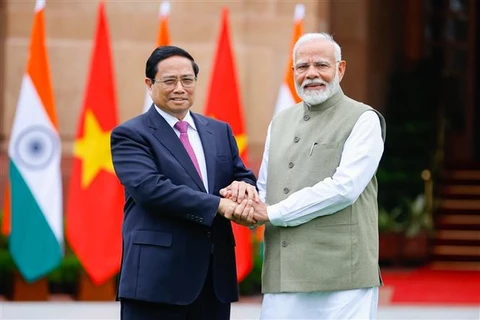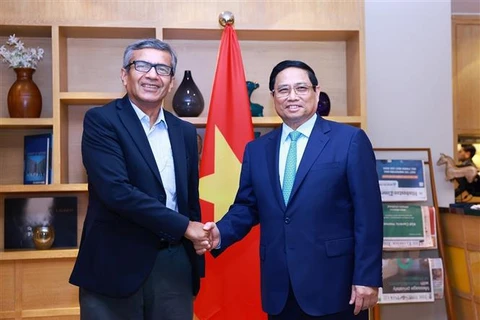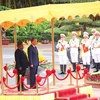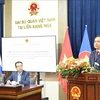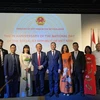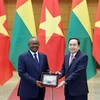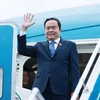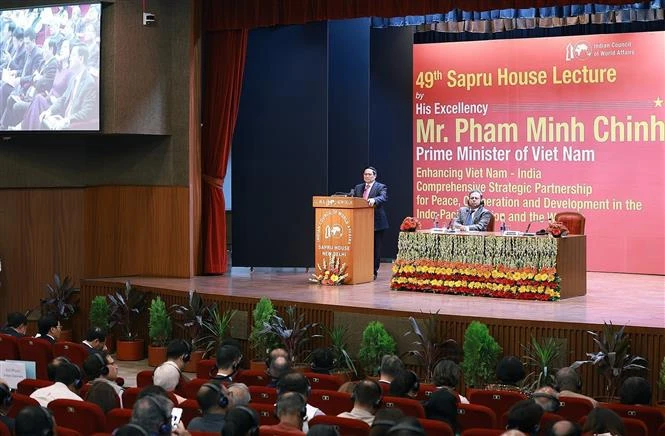
New Delhi (VNA) – As part of his state visit to India, Prime Minister Pham Minh Chinh delivered a policy speech at the Indian Council of World Affairs (ICWA) on August 1 in the presence of numerous Indian politicians, professors, researchers, scholars, and students.
PM Chinh one again expressed sincere gratitude to Indian leaders and people for their for deep sympathy to the Party, State, Government, and people of Vietnam over the passing of Party General Secretary Nguyen Phu Trong, a close friend of the Indian people. He stressed that this is a manifestation of the strong solidarity and profound friendship between the two countries and their people.
He expressed his impression of the great achievements of the Ganges civilisation and the remarkable development of India today.
He recalled the historic visit to India by President Ho Chi Minh 66 years ago, stressing the late leader affirmed that India is an independent and powerful country that has made many valuable contributions to peace in Asia and the world, and that India's success in national construction is a great source of inspiration for Vietnam.
These observations remain true today as India is playing an increasingly significant role in promoting peace, stability, and prosperity in the Indian Ocean-Asia-Pacific region and globally, PM Chinh said, adding that India continues to be a powerful source of inspiration for countries, including Vietnam, on their development path.
Regarding the global situation, the Vietnamese leader noted that the world still witnesses increasing complexities and uncertainties with many unprecedented issues emerging.
According to the PM, the rapid and complex fluctuations in today's global situation are reflected in four major aspects. Firstly, the uncertainty and instability of the global security environment stay at the high level, with increasing complexity in local conflicts and the trend towards enhanced militarisation. Secondly, the global economy has entered a new development cycle but still faces many risks. Thirdly, multilateralism continues to play a crucial role, yet its effectiveness is seriously challenged. Fourthly, the 21st century is the one of the Indian Ocean-Asia-Pacific region, which, however, also faces significant risks and challenges from hot spots, local conflicts, and competition among powers.
He said that the above-mentioned global issues require a comprehensive mindset, requiring all countries and multilateral institutions to persist in dialogue and cooperation more than ever in the spirit of solidarity and unity in diversity to find effective, inclusive, and global solutions.
He emphasised that the solidarity, cooperation, and friendship between Vietnam and India must be continuously strengthened and developed, becoming a positive factor contributing to the peace, stability, cooperation, and development in the region and the world.
Regarding the situation in Vietnam, PM Chinh stated that after nearly 40 years of renewal (Doi moi) process, Vietnam has developed a theoretical framework for its reform path, which represents the crystallisation of the awareness, will, and aspirations of the Communist Party of Vietnam (CPV) and the Vietnamese people regarding socialism and the path towards socialism.
The PM affirmed that the achievements in reality have testified to the correctness of Vietnam's policies and viewpoints, which are based on three main pillars: socialist democracy, a socialist rule-of-law state, and a socialist-oriented market economy, with the cornerstone stance on maintaining political and social stability, taking people the core, the subjects, the targets, the driving force and the most important resource of development, and not sacrificing progress, social equity, and environmental protection for mere economic growth.
Updating the ICWA on Vietnam's six key policies regarding external affairs, national defence, economic development, social welfare, cultural development, and Party building, he affirmed that from a country under siege and embargo, Vietnam now has diplomatic relations with 193 countries, including over 30 comprehensive partners, strategic partners. Vietnam is also an active and responsible member of nearly 70 global and regional organisations.
From a poor and backward country devastated by war, Vietnam is now a developing country with middle income, one of the 35 economies with the largest GDP sizes in the world, one of the top 20 countries in terms of trade and among the 46 leading countries in innovation index. The country's per capita income was 4,300 USD in 2023, rising nearly 60 times from the level at the beginning of Doi Moi (renewal) process.
With the goal of transforming Vietnam into a developing country with modern industry and upper middle income by 2030 and a high-income developed nation in 2045, he said Vietnam is focusing on maintaining macro-economic stability, managing inflation, promoting growth, and ensuring major economic balances; stepping up industrialisation and modernisation and restructuring the economy; renewing traditional growth engines and fostering new ones; optimising the use of both internal and external resources; ensuring social welfare, environment protection and climate change adaptation; strengthening national defence-security and promoting external relations and global integration to create an environment conducive for national development.
Amid current rapid and complicated developments in the world, Vietnam and India should strongly uphold their tradition of friendship and solidarity, and enhance their effective cooperation to achieve new strategic goals together.
Chinh said during this visit, he and PM Modi have adopted a joint statement on strengthening the Vietnam-India comprehensive strategic partnership in the direction of the "Five Mores", including higher political-strategic trust, deeper national defence-security cooperation, more substantive and effective economic, trade, and investment ties; broader joint work in sci-tech and innovation, and closer cultural and people-to-people exchanges.
Expressing hope for expanded cooperation between the ICWA, Indian research institutions, and their Vietnamese partners, the PM noted his firm belief in the bright prospects of the Vietnam-India relationship, contributing to peace, cooperation and sustainable development in the Indian Ocean - Asia-Pacific region, and globally.
Established in 1943, the ICWA is considered a pioneering institution in shaping India's foreign policy vision. Over the past more than seven decades, many foreign policy initiatives and ideas of India have been launched at the council, contributing significantly to peace and cooperation in the region and the world. Notably, the council witnessed many significant historical events, including the first Asian Relations Conference in 1947, which laid the foundation for the later establishment of the Non-Aligned Movement (NAM)./.