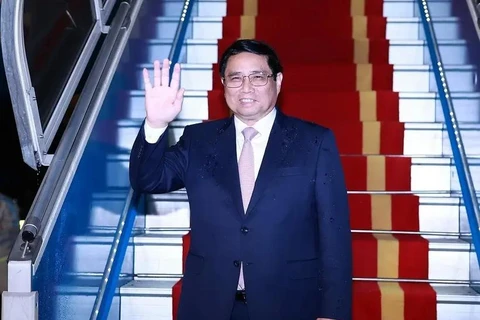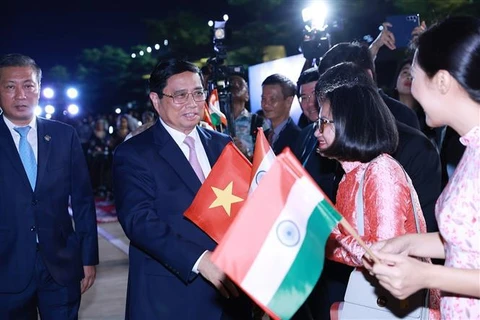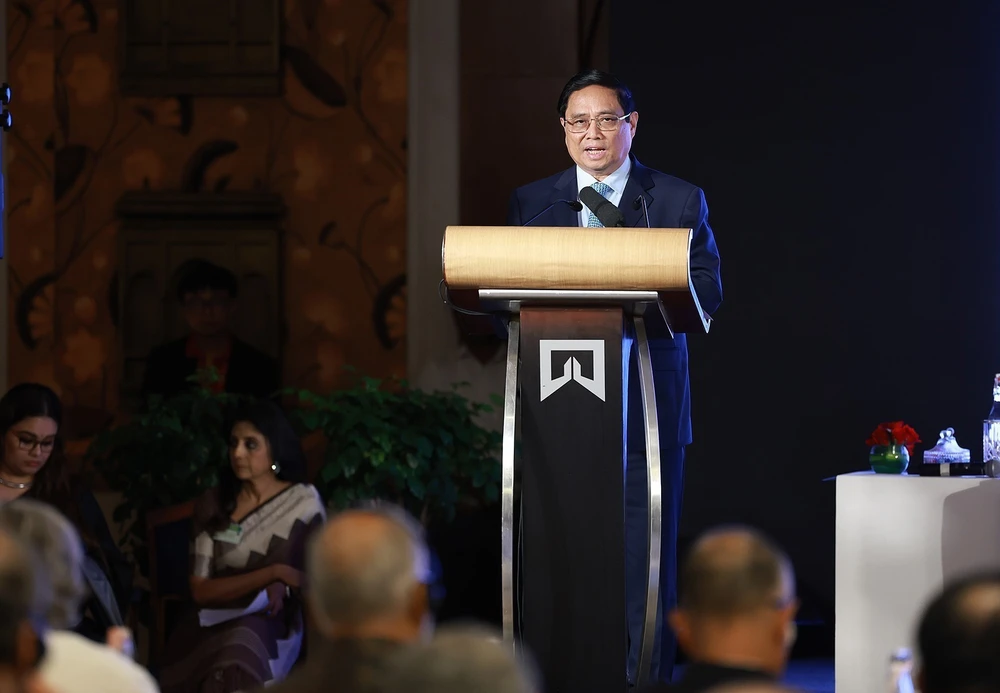
New Delhi (VNA) – Prime Minister Pham Minh Chinh attended the Vietnam-India Business Forum in New Delhi on July 31, as part of his state visit to India, during which he proposed the two sides work together to raise two-way trade to 20 billion USD in the coming time.
Trade between Vietnam and India expanded from 200 million USD in 2000 to nearly 15 billion USD last year, of which 8.5 billion USD came from Vietnam’s exports.
Indian currently has 410 valid investment projects totaling 1.03 billion USD in Vietnam, ranking 25th out of the 146 nations and territories pouring capital into the Southeast Asian country, while there are 16 Vietnamese-invested projects in India with a total capital of over 14 million USD, excluding Vingroup’s investments.
PM Chinh emphasised that the five basic factors for successful and effective cooperation between the two countries’ businesses are the fine traditional bilateral relations and friendship; high political trust; an open market; similar culture, civilisation, and history, and shared ideas; and mutual aspirations to build a powerful, prosperous nation with rapid and sustainable economic development.
He told the participants that after nearly 40 years of ‘Doi moi’ (Renewal), Vietnam has become one of the 40 largest economies in the world, ranks among the top 20 trading nations, and the 32nd in the global top 100 for national brand value. Additionally, Vietnam has signed 16 free trade agreements (FTAs) with over 60 countries.
Regarding Vietnam’s socio-economic situation and investment environment, Chinh stated that the country’s investment and business climate is continuously improving. The United Nations Conference on Trade and Development (UNCTAD) has ranked Vietnam among the world’s top 20 host economies for foreign direct investment (FDI). Many reputable international organisations and experts continue to highly assess the results and outlooks of its economy.
Affirming that Vietnam identifies the foreign-invested sector as playing an important role, Chinh said the Government always encourages Indian businesses to expand investment cooperation in areas where India has strengths and Vietnam has high demand and priority, such as high technology, electronics, science and technology, artificial intelligence (AI), infrastructure development, renewable energy, new energies like hydrogen, biotechnology, innovation, high-tech agriculture, and pharmaceuticals.
Noting that the bilateral economic cooperation has yet to match its potential, the Vietnamese Government leader suggested Indian ministries, associations, and organisations support and promote dialogue and investment connections; act as a bridge between the governments and business communities of both countries; support Vietnamese businesses to expand their investment and operate effectively in India; and create favourable conditions for more Vietnamese goods to access the Indian market.
The Prime Minister also requested Vietnamese ministries, sectors, and localities to increase dialogue to address difficulties and obstacles faced by Indian investors in Vietnam; review and reform administrative procedures; reduce and simplify unnecessary ones; increase the use of digital technology; intensify decentralisation; lower compliance and input costs for citizens and businesses; and well prepare conditions and infrastructure to attract investment.
Based on the principles of "harmonious benefits and shared risks" and "what is said must be done, what is committed must be executed, and what is executed must yield measurable results", the Vietnamese Government is committed to listening to, supporting, and creating all favourable conditions for foreign investors in general and Indians in particular, ensuring that their investments and business operations in Vietnam are smooth, effective, and sustainable, affirmed Chinh.
At the forum, in the witness of PM Chinh, the two countries’ enterprises exchanged six cooperation agreements in the fields of aviation, tourism, culture, and pharmaceuticals.
On this occasion, Vietnam’s carrier Vietjet Air announced the launch of its new route from the central city of Da Nang to Ahmedabad (India) and welcomed its 200 millionth passenger.
The new route will start serving passengers from October. With this move, Vietjet now holds the most direct flights between Vietnam and India, with 56 flights per week through seven routes./.