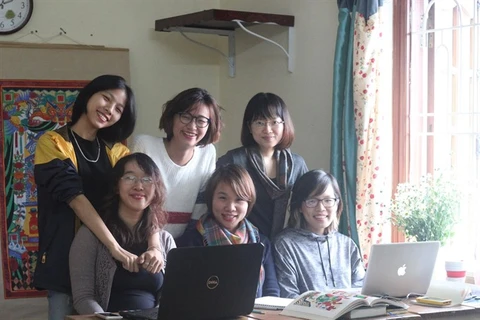
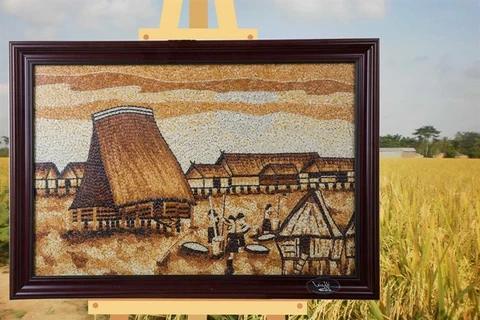
Artist Dao Dinh Trung performs his brush stroke on a Kim Hoang painting at Hanoi Centre for Cultural Exchange, 50 Dao Duy Tu Street, Hanoi (Photo VNA)
 Hanoi (VNA) - The Red River Delta civilisation, original home of the Viet people, has developed strong cultural aspects, such as Bac Ninh province’s Dong Ho folk paintings of babies and farm animals, and Hanoi’s Hang Trong woodcuts of heroic figures, such as Tran Hung Dao repelling the Mongols. However, much of the skills have been lost, largely because younger people show less interest in the rural and historic past.
But there is one national artistic treasure which is on the path to restoration, Kim Hoang painting. Kim Hoang (golden-made) painting is a common name given to folk painting invented in the second half of the 18th century and strongly developed since the 19th century at Kim Hoang village, Van Canh commune, in Hanoi’s suburban district of Hoai Duc. It can be said to be a blend of both old styles.
The subjects in Kim Hoang paintings are taken from the plain and ordinary lives of the citizens of the Red River Delta, so they easily win people’s hearts. Each painting has familiar sights of animals as swell as depicting local daily life, Lunar New Year holidays and worship of the Kitchen Gods.
According to Sach Do Hoa Co Vietnam (The Ancient Graphic Arts of Vietnam), ancient Kim Hoang village comprises mostly residents who migrated from the central province of Thanh Hoa to the North in the early 1700s. They united the two villages of Kim Bang and Hoang Bang.
Aware that the modern Hang Trong and Dong Ho paintings were mostly sold at markets in Hanoi, Bac Giang, Bac Ninh and Hai Duong, and were then not favoured by farmers because of their high price, the residents of Kim Hoang were determined to create a new style, which combined the techniques and fine arts of the two styles.
The Nguyen Sy and Nguyen The families were pioneers in Kim Hoang painting, which flourished in the 19th century. But a flood in 1915 inundated all the villages of ancient Phung town (now rural district of Hanoi’s Dan Phuong) to Cau Giay district, washing away printing blocks. Only a few original paintings survive, such as Phuc Man Duong (All of Good Fortune Come to the House), Rooster and Pig. They are at the Vietnam Fine Arts Museum.
While Kim Hoang combines the best of two kinds of paintings, it has more delicate, detailed lines than Dong Ho paintings, and the colours are as bright as that of Hang Trong paintings.
In addition, Kim Hoang has a special folk poem written on the left of the painting. While Dong Ho uses paper covered with seashell powder and Hang Trong uses poonah paper, Kim Hoang is known as the "Red painting" for its use of red, pink or yellow paper.
The most noticeable trait of Kim Hoang is that craftsmen use only one woodblock to print the black outline onto the paper, while the rest of the colour is filled in by the craftsman, making each painting a unique work of art.
What is left at Kim Hoang Village, the birthplace of the painting, are memories of elders. Nguyen The Nhuan, 92, chief of the Kim Hoang communal house relic managing board, said that after the flood, only a few artists were left. The tough life forced people to forget the joy of collecting and hanging the paintings.
According to collector Nguyen Thi Thu Hoa, director of Hanoi’s private pottery and porcelain museum, and whose private collection has 60 Kim Hoang paintings, she is joining hands with artists Nguyen Duc Hoa and Tran Nguyen Dan to restore the carvings and folk paintings.
“If we fail to revive the paintings, there will be no traits of them left for posterity. Those who can remember them well are already 80 and 90 years old. The last time I came back to the village, I verified how to print the paintings and their colours. Luckily, a book by Maurice Durand, a French man, featuring many Vietnamese folk paintings, was reprinted, and I was able to successfully restore some of them,” said Hoa.
At present, the painting style has only one heir, artist Dao Dinh Trung, 38, who was born in Kim Hoang Village. Hoa noted his ability with folk painting and persuaded him to help her efforts. Lately, he has invented a new style of Kim Hoang painting, using as his subject the flamboyant Nghe (kylin).
According to Hoa, the restoration project consists of three parts. “What makes this painting unique is its childish but vivid brush strokes. Firstly, we will restore 50 old samples (with reference to the document from the book Imagerie Populaire Vietnamienne by Durand reprinted in 2011),” she said.
Describing the paintings, Hoa said that the contents of the 50 existing Kim Hoang paintings were mostly stories of human life, with only four paintings of chickens and pigs. All of them are printed on paper with a typical red-orange background, using simple and delicate strokes and often with three more colours: white, light green and purple. Kim Hoang is also called the Red painting. Red is the colour of Tet (Lunar New Year).
There were various ways to print the paintings in the past. But now they are printed with the woodblocks lying with the engraving surface upward. The lines are printed and colours are added by hand.
Hoa designed 10 samples whose images relate to those carved on the Kim Hoang communal house, and painter Dan has produced 10 samples based on boat themes, Hanoi and Hoi An.
"Another task is finding a plot of land in the village for our studio. The city’s culture and trade authorities have been asked to help with finance. This year, we hope to publish 25 folk paintings as a method to reserve this unique cultural legacy,” Hoa said. - VNA
VNA