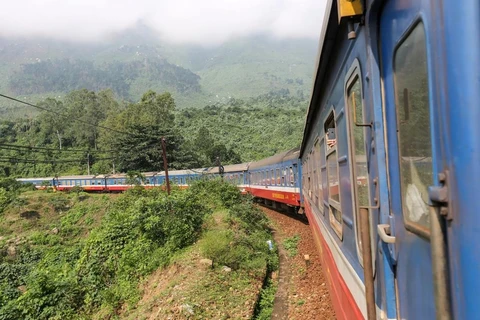
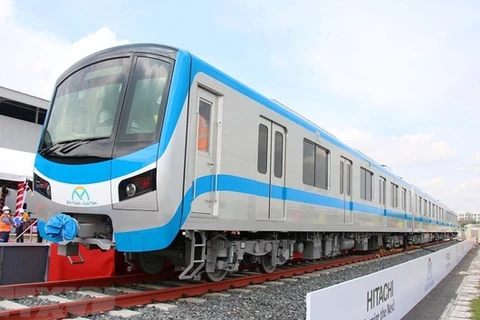
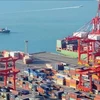
The Vietnam Railways Corporation is implementing strict measures on pandemic prevention and control to maintain international freight trains. (Photo: baochinhphu.vn)
 Hanoi (VNS/VNA) - Heavily impacted by the COVID-19 pandemic, the Vietnam Railways Corporation (VNR) has made great efforts to reduce losses by actively targeting cargo transport instead of just passenger transport.
According to the corporation, due to the impact of the pandemic, revenue from passenger transport in the first five months of this year dropped by 48.6 percent compared to the same period in 2020.
The corporation transported only 1.15 million passengers in the period, down 35.4 percent against the same period in 2020, with revenue of more than 400 billion VND, down 48.6 percent. Especially in May, when the latest outbreak of the pandemic hit Vietnam, there were only 132,300 railway passengers, down 51.6 percent.
On the holiday of April 30 and May 1, VNR said 11,383 tickets worth nearly 4 billion VND were returned. The corporation had to cease the operation of 393 passenger trains last month.
A representative of VNR said the COVID-19 pandemic had caused rail transport businesses to struggle and many workers in the industry had lost their jobs. VNR alone had to temporarily suspend 1,169 workers.
VNR’s two largest transport subsidiaries – Hanoi Railway Transport Joint Stock Company and Saigon Railway Transport Joint Stock Company – estimated losses of nearly 193 billion VND and more than 227 billion VND, respectively, the representative said.
The main cause of the loss is due to the impacts of the COVID-19 pandemic as people have limited their travel, causing the number of passengers to drop.
Heavily pandemic-affected cities and provinces such as Bac Ninh, Bac Giang, Hanoi and HCM City have implemented social distancing measures according to Directives 15 and 16 of the Prime Minister.
Many cities and provinces have restricted the pick-up and drop-off of passengers from pandemic-affected localities, and people returning from pandemic areas must be isolated for 14-21 days.
Nguyen Chinh Nam, head of VNR’s Business Planning Department, said to minimise difficulties, VNR had focused on transport cargo instead of just passenger transport as previously. Until now, the growth of freight transport has helped VNR to compensate partly for the loss.
Specifically, VNR’s cargo transport volume reached 2.42 million tonnes in the first five months of the year, up 26.9 percent over the same period last year. Revenue from the transport segment reached 713.5 billion VND, up 21.8 percent over the same period of 2020.
Besides actively seeking new cargo transport orders in the domestic market, VNR was continually implementing strict measures on pandemic prevention and control to maintain international freight trains as well as clearing bottlenecks in border policies with Chinese partners to boost transport on the route.
In addition, VNR’s subsidiary – Hanoi Railway Transport Joint Stock Company – was also promoting freight transport through developing warehouse-to-warehouse and door-to-door transport services of goods and luggage through online ordering./.
According to the corporation, due to the impact of the pandemic, revenue from passenger transport in the first five months of this year dropped by 48.6 percent compared to the same period in 2020.
The corporation transported only 1.15 million passengers in the period, down 35.4 percent against the same period in 2020, with revenue of more than 400 billion VND, down 48.6 percent. Especially in May, when the latest outbreak of the pandemic hit Vietnam, there were only 132,300 railway passengers, down 51.6 percent.
On the holiday of April 30 and May 1, VNR said 11,383 tickets worth nearly 4 billion VND were returned. The corporation had to cease the operation of 393 passenger trains last month.
A representative of VNR said the COVID-19 pandemic had caused rail transport businesses to struggle and many workers in the industry had lost their jobs. VNR alone had to temporarily suspend 1,169 workers.
VNR’s two largest transport subsidiaries – Hanoi Railway Transport Joint Stock Company and Saigon Railway Transport Joint Stock Company – estimated losses of nearly 193 billion VND and more than 227 billion VND, respectively, the representative said.
The main cause of the loss is due to the impacts of the COVID-19 pandemic as people have limited their travel, causing the number of passengers to drop.
Heavily pandemic-affected cities and provinces such as Bac Ninh, Bac Giang, Hanoi and HCM City have implemented social distancing measures according to Directives 15 and 16 of the Prime Minister.
Many cities and provinces have restricted the pick-up and drop-off of passengers from pandemic-affected localities, and people returning from pandemic areas must be isolated for 14-21 days.
Nguyen Chinh Nam, head of VNR’s Business Planning Department, said to minimise difficulties, VNR had focused on transport cargo instead of just passenger transport as previously. Until now, the growth of freight transport has helped VNR to compensate partly for the loss.
Specifically, VNR’s cargo transport volume reached 2.42 million tonnes in the first five months of the year, up 26.9 percent over the same period last year. Revenue from the transport segment reached 713.5 billion VND, up 21.8 percent over the same period of 2020.
Besides actively seeking new cargo transport orders in the domestic market, VNR was continually implementing strict measures on pandemic prevention and control to maintain international freight trains as well as clearing bottlenecks in border policies with Chinese partners to boost transport on the route.
In addition, VNR’s subsidiary – Hanoi Railway Transport Joint Stock Company – was also promoting freight transport through developing warehouse-to-warehouse and door-to-door transport services of goods and luggage through online ordering./.
VNA