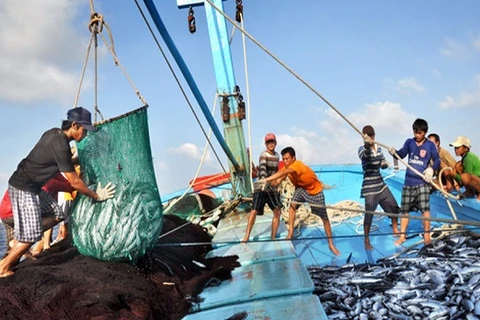
Shrimp exports have fallen since the second quarter of the year. (Photo: VNA)
 Hanoi (VNA) – The fishery sector needs to take actions to convince the European Commission (EC) to remove a “yellow card” warning on Vietnamese seafood so as to realise the set target of 9 billion USD in export turnover this year.
Although aquatic product shipments in the first eight months of 2018 rose 6.4 percent year on year to 5.5 billion USD in revenue, the Vietnam Association of Seafood Exporters and Producers (VASEP) said that tough seas are still ahead for the sector to gain 9 to 10 billion USD from exports.
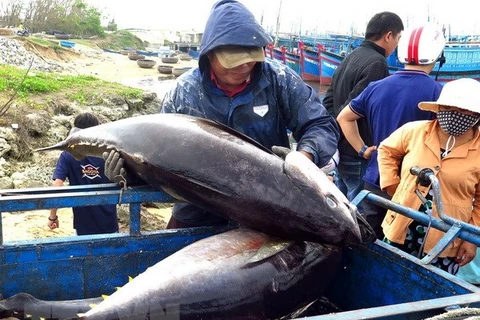
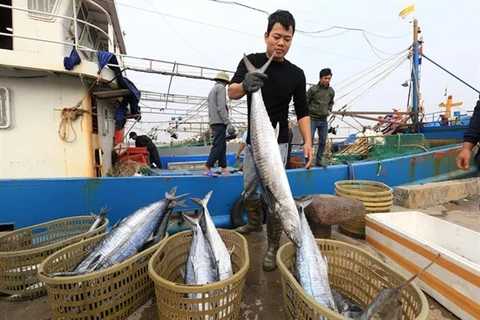
Shrimps, tra fish, and tuna are three key export staples of the sector, therefore, total export revenue will be impacted if there is a decline in shipments of one among those three products.
Shrimp exports have fallen since the second quarter of the year, with a 20 percent drop in July and 17 percent fall in August. As of the end of August, Vietnam earned 2.3 billion USD from shrimp shipments, down 3 percent from the same time last year.
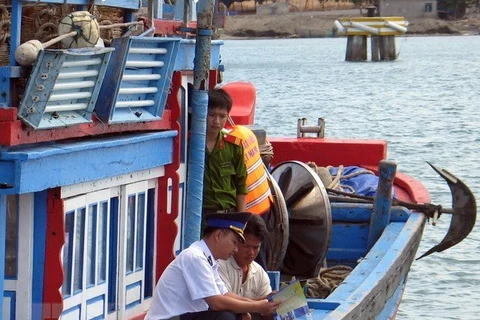
According to Cao Thi Kim Lan, Director of the Binh Dinh Fishery Joint Stock Company, the “yellow card” warning has caused critical damage to her business. The company pockets some 60 million USD from exports every year, 70 percent of which comes from the EU market.
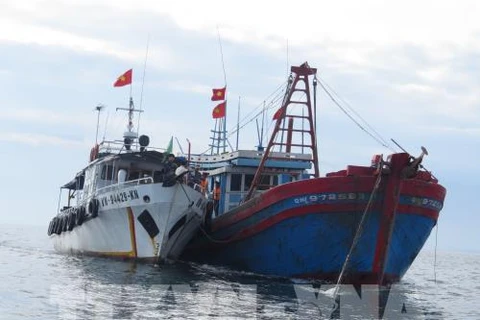
“My company has said “no” with the purchase of illegal, unreported and unregulated (IUU) fishing products. However, it takes too much time to trace origin of the materials”, she said.
At a teleconference held in Hanoi in August, Deputy Prime Minister Trinh Dinh Dung laid stress on the removal of the EC’s “yellow card” warning, saying that it is a leading political task of the Ministry of Agriculture and Rural Development, agencies, and all localities.
He said that this was also an opportunity for the fishery sector to rearrange fishing activities to meet international requirements.
Also, Dung ordered relevant ministries and agencies, and 28 coastal provinces and cities to strictly implement the Prime Minister’s Directive No.45-CT-TTg on urgent tasks and solutions following the EC’s warning.
Minister of Agriculture and Rural Development Nguyen Xuan Cuong believed that carrying out the EC’s nine recommendations related to the fight against IUU fishing was not just meant to lift the “yellow card” but build a sustainable sea-based economy.
The nine recommendations included revision of the legal framework to ensure compliance with international and regional rules applicable to the conservation and management of fishery resources, ensuring the effective implementation and enforcement of the country’s revised laws, and strengthening the effective implementation of international rules and management measures.
“The nine recommendations are positive contents, which help Vietnam build a responsible, sustainable and effective fishing sector. After rapid development, it’s time for Vietnam to shift to sustainable fishing, to improve fishermen’s livelihoods, and protect the environment”, he said.
On October 23, 2017, the EC issued a "yellow card" warning to Vietnam, after the country failed to demonstrate sufficient progress in the fight against fishing worldwide.
A working delegation of the European Commission (EC)’s Directorate-General for Maritime Affairs and Fisheries began a fact-finding trip to Vietnam on May 15 to inspect the implementation of recommendations related to the fight against IUU fishing.
The European Parliament will come to Vietnam to examine the country’s efforts in October, and the inspection team will return in January, 2019 to evaluate one more time before considering the removal of the “yellow card” on Vietnamese seafood.-VNA
VNA