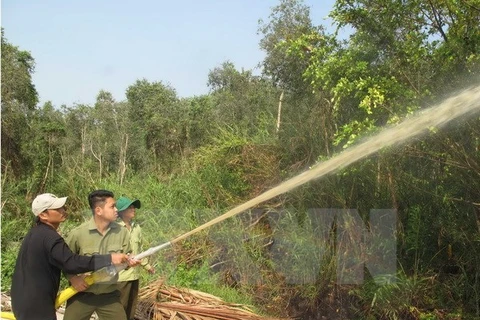
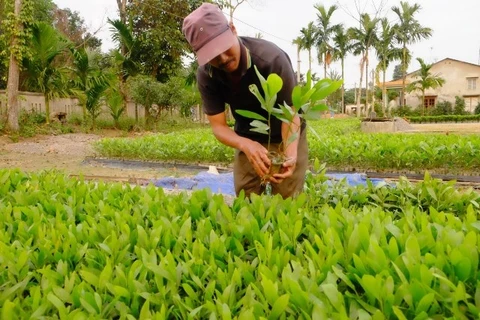
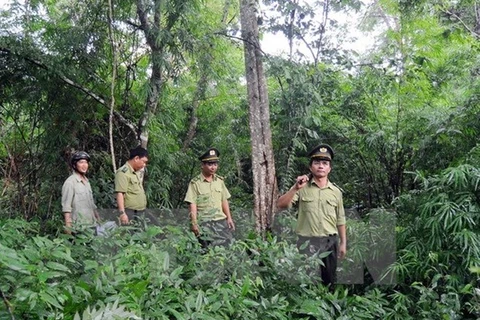
Illustrative image (Source: zing.vn)
 HCM City (VNA) - Retail companies with responsible forest product sourcing policies are seeing numerous tangible business benefits, demonstrating that sustainability makes business sense, according to a new report from the World Wide Fund for Nature (WWF).
Vietnam is the fifth largest timber product exporting country in the world, with revenues of 7 billion USD last year.
While the luxury furniture segment in Vietnam requires responsibly sourced products, only 230,000ha of forests in the country are Forest Stewardship Council certified. So Vietnam has to import around 4.5 million cu.m of timber every year, the report said.
Unable to utilise domestic timber, the country is now largely dependent on other countries, reducing the potential benefits of production.
But with responsible products still a new concept for Vietnamese, there is no market for them.
“In the next few months, under the Responsible Asia Forestry and Trade project, WWF will promote sustainable forest products in the domestic market,” said Dr Le Thien Duc, Forest Practice Lead of WWF-Vietnam.
“We aim to raise awareness among domestic consumers of responsible forest products and influence producing companies and retailers to sell responsible products in Vietnam.”
WWF-Vietnam, through the Global Forest and Trade Network (GFTN), has been working with businesses to promote processing and trading of responsible timber and supporting forest owners to achieve FSC certification.
All members of GFTN have to commit to using certified timber and adopting responsible forest management for five years.
“Deforestation and forest degradation are one of the leading environmental challenges today, and we need concerted action from across sectors to tackle this issue,” Alistair Monument, WWF’s Forest Practice Lead, said.
“Research overwhelmingly shows that retail chains are positioned to mobilise transformational impacts because of their leverage over product supply chains and influence on consumer choices. We need retailers to take the lead and understand that sustainability is no longer a niche, but the norm.”
Companies surveyed for the WWF report cited a number of benefits of responsible sourcing: Over 80 per cent reported positive impacts on risk management and brand reputation, and over 60 per cent saw positive impacts on customer satisfaction and stakeholder engagement.
More than 70 per cent said sustainability commitments had a positive impact on employee engagement, indicating potential gains from higher employee satisfaction and retention.
At Migros, one of the largest retailers in Switzerland, sales of sustainable products increased by more than 30 per cent between 2012 and 2015, demonstrating clearly that customers expect to see responsibly produced products on the shelves.
“Companies with genuinely responsible timber sourcing strategies – based on clear commitments and public reporting – have an opportunity to stand out from the crowd,” Monument said.
The WWF study surveyed more than 50 retailers in 20 countries and had in-depth interviews with select retail leaders.
The companies shared detailed information about their timber sourcing policies, and the perceived costs and benefits.-VNA
Vietnam is the fifth largest timber product exporting country in the world, with revenues of 7 billion USD last year.
While the luxury furniture segment in Vietnam requires responsibly sourced products, only 230,000ha of forests in the country are Forest Stewardship Council certified. So Vietnam has to import around 4.5 million cu.m of timber every year, the report said.
Unable to utilise domestic timber, the country is now largely dependent on other countries, reducing the potential benefits of production.
But with responsible products still a new concept for Vietnamese, there is no market for them.
“In the next few months, under the Responsible Asia Forestry and Trade project, WWF will promote sustainable forest products in the domestic market,” said Dr Le Thien Duc, Forest Practice Lead of WWF-Vietnam.
“We aim to raise awareness among domestic consumers of responsible forest products and influence producing companies and retailers to sell responsible products in Vietnam.”
WWF-Vietnam, through the Global Forest and Trade Network (GFTN), has been working with businesses to promote processing and trading of responsible timber and supporting forest owners to achieve FSC certification.
All members of GFTN have to commit to using certified timber and adopting responsible forest management for five years.
“Deforestation and forest degradation are one of the leading environmental challenges today, and we need concerted action from across sectors to tackle this issue,” Alistair Monument, WWF’s Forest Practice Lead, said.
“Research overwhelmingly shows that retail chains are positioned to mobilise transformational impacts because of their leverage over product supply chains and influence on consumer choices. We need retailers to take the lead and understand that sustainability is no longer a niche, but the norm.”
Companies surveyed for the WWF report cited a number of benefits of responsible sourcing: Over 80 per cent reported positive impacts on risk management and brand reputation, and over 60 per cent saw positive impacts on customer satisfaction and stakeholder engagement.
More than 70 per cent said sustainability commitments had a positive impact on employee engagement, indicating potential gains from higher employee satisfaction and retention.
At Migros, one of the largest retailers in Switzerland, sales of sustainable products increased by more than 30 per cent between 2012 and 2015, demonstrating clearly that customers expect to see responsibly produced products on the shelves.
“Companies with genuinely responsible timber sourcing strategies – based on clear commitments and public reporting – have an opportunity to stand out from the crowd,” Monument said.
The WWF study surveyed more than 50 retailers in 20 countries and had in-depth interviews with select retail leaders.
The companies shared detailed information about their timber sourcing policies, and the perceived costs and benefits.-VNA
VNA