Sa Chau fish sauce - specialty condiment of Nam Dinh province

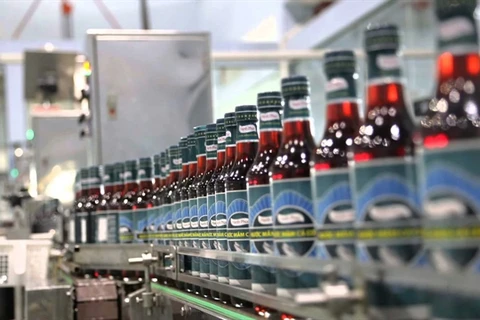
Sa Chau village of Giao Chau commune in Giao Thuy district, the northern province of Nam Dinh, has long been famous for the traditional production of fish sauce whose pungent smell can grasp any visitor’s attention before they reach the village’s gate.
Sa Chau fish sauce - specialty condiment of Nam Dinh province ảnh 1Fish is fermented with salt in vats and laid out in the sun (Photo: VNA)

Nam Dinh (VNA) – Sa Chau village of Giao Chau commune in Giao Thuy district, the northern province of Nam Dinh, has long been famous for the traditional production of fish sauce whose pungent smell can grasp any visitor’s attention before they reach the village’s gate.

Long-standing craft of fish sauce production

The production of fish sauce in Giao Chau commune dates back centuries and originates in Sa Chau village. As the condiment is completely made by hand, the production process is extremely meticulous.

Ingredients are mainly “nuc” and “cuom” fish or tiny prawn, all of which must be fresh, not frozen or decomposed. Locals divide one year into sunny and rainy seasons and they make fish sauce in the sunny season in the middle of the year while selling the product in the year’s beginning or ending months, when it rains a lot.

Not only fish but salt is also carefully selected. The salt used for making fish sauce is bought from late April through May and features dry and white flakes. In particular, salt must be kept in warehouse for more than one year to get rid of the acrid taste before use.

The production process here is also more sophisticated than that in other places. Every 10 kilogrammes of fish is marinated with about 1.2 - 1.3 kilogrammes of salt and kept for six months so that the fish completely breaks down. After that, the mixture is poured into a bamboo basket covered with coarsely homespun fabric to extract pure fish sauce.

The sauce is later contained in aluminum crocks and left in the sun until white salt appears in the surface. As the condiment must not be contaminated with water, people must cover it carefully on rainy days.

Producing fish sauce at first appears to be a leisured craft but is in fact a highly strenuous job. Only one batch of fish marinated improperly or polluted with rainwater could ruin their months of hard work.

Mai Thi Ty, an experienced maker in Sa Chau village, said the local fish sauce is laid out in the sun but not cooked so that it can soak up the “taste” of the nature. For example, if it is April, and it is not until the next March can the condiment be obtained and continue to be exposed to the sun.

She added making fish sauce is also an unstable craft as it depends on fish quality, fermenting techniques, and other skills. Each family has their own production secrets, and all throw themselves wholeheartedly into the craft or the prestige of the entire village will be eroded.

The Sa Chau fish sauce has by now become renowned far and wide and been distributed to various provinces and cities nationwide, from northern mountainous provinces such as Dien Bien and Son La to others in the south like Ho Chi Minh City and Tay Ninh province.

Concern over preservation of traditional craft

Each tonne of fish can generate 300 litres of fish sauce. There are many types of Sa Chau fish sauce. The top-quality one, laid in the sun for a long time, has stable prices while others with shorter “sunbathing” periods are cheaper.

Therefore, not many young people get involved in this job, which concerns many veteran makers.

Nguyen Van Hai, a local resident, said the Sa Chau fish sauce is completely made by hand with many different steps. The craft is also dependent on weather conditions, and a small mishandling can lead to an unqualified product. All of these factors have made the craft strenuous and discouraged the young from upholding it.

The craft is facing the risk of becoming obsolete. Most people come to know this specialty condiment via their acquaintances’ introduction. Many families have also had to do some other jobs while waiting for the fish to ferment.

Hai said the village is now in dire need of young workers, voicing her concern that though her family is known for their delicious condiment, they have yet to find out anyone to maintain the craft.

There are about 30 households making fish sauce in Sa Chau at present, including 10 with large-scale production. All have received food safety certificates granted by the sub-department for agro-forestry-fishery products of Nam Dinh province./.
VNA

See more

The “Vietnam Pavilion” at Aldea Global 2026 (Photo: VNA)

World Cup 2026: Vietnam leaves distinct mark at global cultural showcase

The “Vietnam Pavilion” at Aldea Global 2026 offers Mexican visitors and international guests an opportunity to explore the country’s rich cultural heritage, history and people through exhibitions, tourism promotion activities, traditional arts presentations and displays of representative cultural products.

Michelin Guide Vietnam recognises 11 one-Michelin star restaurants (Photo: Michelin Guide Vietnam)

Local ingredients, cultural roots propel Vietnam’s Michelin journey

One of the clearest examples is Hieu Luc, a modest fish soup eatery on Hai Ba Trung Street in Hanoi, which has been included in the Michelin Selected category for the second consecutive year. Known for its clear, delicately sweet broth made from freshwater perch and mustard greens, the restaurant serves a traditional specialty from Hung Yen province.

Delegates attending the ASEAN City Leaders Conference 2026 visit the Imperial Citadel of Thang Long on June 9. (Photo: VNA)

ASEAN city leaders explore Hanoi’s heritage sites

At the Imperial Citadel of Thang Long, delegates visited the Doan Mon Gate and learnt about the formation and development of the ancient capital through different historical periods at display spaces. They also explored the Kinh Thien Palace’s Dragon Steps (large stone steps with dragon carvings), regarded as the political and ceremonial centre of the imperial citadel during successive Vietnamese dynasties.

Ly Hoang Nam is Asia's No. 1 pickleball player. (Photo: webthethao.vn)

Ly Hoang Nam tops Asian pickleball rankings

Vietnam boasts five players in the DUPR Asian top 10, with Nam leading the rankings on 6,267 points ahead of competitors from the Philippines, India, Hong Kong (China) and Chinese Taipei.

Visitors to the booth of the Vietnamese Embassy at the Embassies Food and Culture Festival held in Prague, the Czech Republic, on June 6 (Photo: VNA)

Vietnamese culture, cuisine leave lasting impression in Czech Republic

Featuring more than 100 booths representing diverse cultures from around the world, the festival transformed the heart of Prague into a vibrant multicultural space where visitors could sample traditional dishes, enjoy folk performances, listen to traditional music and experience unique cultural showcases from different continents.

Vietnamese artists play traditional musical instruments at the festival held in Karlovy Vary city, the Czech Republic, on June 5. (Photo: VNA)

Vietnam culture, cuisine showcased in Czech Republic

The festival featured more than 20 booths offering traditional Vietnamese dishes, including "pho" and spring rolls, alongside activities promoting Ao Dai (Vietnamese traditonal long dress). One of the highlights was the presentation of complimentary Ao Dai to Czech residents and international visitors.

The Nguyen Dynasty (1802-1945) imperial throne, a recognised national treasure of Vietnam, officially returns to public display at Thai Hoa Palace in Hue Imperial Citadel on June 4 (Photo: VNA)

Nguyen Dynasty throne returns to Hue Imperial Citadel after restoration

The throne has been reinstated at its original central position inside Thai Hoa Palace, the ceremonial heart of the former imperial court. Its return has attracted significant interest from visitors and heritage enthusiasts eager to see one of Vietnam’s most important royal artefacts back on display.

People join the “Ho Van Lantern Festival Night” programme at the special national relic site of the Van Mieu–Quoc Tu Giam (Temple of Literature) in Hanoi. (Photo: VNA)

Night-time economy drives growth of Hanoi’s cultural industries

Under the Politburo’s Resolution No. 80-NQ/TW on the development of Vietnamese culture, Hanoi has been given fresh opportunities to leverage its cultural, historical, tourism and creative assets. The city’s recently approved project on developing the night-time economy for 2026–2030, with a vision to 2045, is expected to create momentum for cultural industry growth while enhancing Hanoi’s standing as a creative and modern city with a distinctive identity.