Solutions sought to boost foreign investment in government bonds

Vietnam’s Government bond market needs to be made more appealing, as recent years have seen a lack of foreign participation.
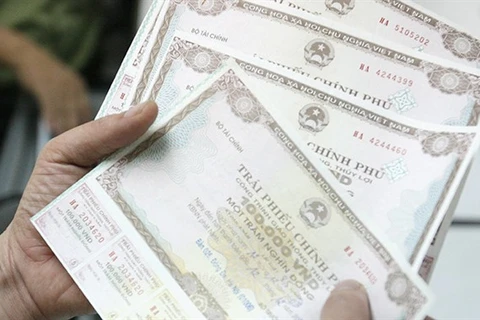
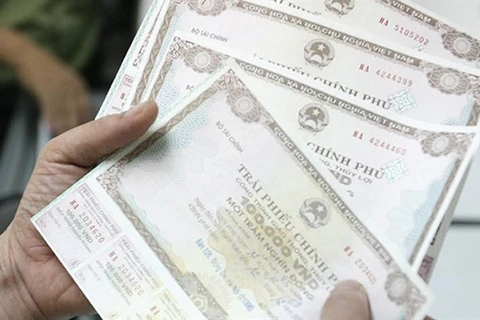
Solutions sought to boost foreign investment in government bonds ảnh 1Vietnam’s Government bond market needs to be made more appealing.(Photo: tapchitaichinh.vn)

Hanoi (VNA) – Vietnam’s Governmentbond market needs to be made more appealing, as recent years have seen a lackof foreign participation.

In the first five month of 2018, foreignersbought 1.5 trillion VND (65.9 million USD) worth of Government bonds in theprimary market and 3 trillion VND (131.85 million USD) in the secondary market.The figures were 20.8 trillion VND (914.16 million USD) and 12.6 trillion VND(553.77 million), respectively in 2016, and 10.3 trillion VND and 20.5 trillionVND in 2017.

In 2017, bond transactions involving theforeign sector accounted for less than 5.1 percent of the total value issued inthe primary market. The figure was 6.1 percent in the secondary market.

However, a positive change was recorded inthe rate of foreign ownership in the Government bond market, which increasedfrom 4.5 percent in 2015 to 5 percent in 2017.

In 2016 and 2017, the Finance Ministry forthe first time successfully issued approximately 11.5 trillion VND (507.72million USD) worth of 20-year and 30-year government bonds forfully-foreign-funded investors. The move reflected a demand for long-terminvestment from the sector.

According to Nguyen Thi Hoang Lan, DeputyDirector of the Hanoi Stock Exchange (HNX), macroeconomic indicators are whatforeign investors consider when they decide to pour their money into a nation.

That’s why Vietnam needs a stable andconsistent macroeconomic policy, particularly in public debt management, sheadded.

Lan noted the Government should also offerinvestors instruments to prevent foreign exchange risks. The State Bank ofVietnam has allowed currency forward contracts, but their subjects do notinclude non-residents.

A currency forward locks in the exchangerate for the purchase or sale of a currency on a future date, and does notinvolve any upfront payment from the parties involved.

Macroeconomic policy on exchange rate andinvestment capital management, tax structure and stability in taxation are otherfactors when it comes to boosting foreign investment in Government bonds, Lansaid.

She highlighted that the simplification andstandardisation following international criteria of administrative procedures isalso necessary.

Lean procedures facilitate both Governmentmanagement and capital flow, thus increasing the competitiveness of the market,Lan said.

Infrastructure solutions and technicalsolutions that impact bond supply and demand should be taken intoconsideration, she added.

Head of the Finance Ministry’sFinance-Banking Department Phan Thi Thu Hien said to encourage foreigninvestment, the ministry is working to complete the legal framework for Governmentbond issuance with simplified procedures and better transaction fees.

To fulfill its goal, the ministry hasstepped up cooperation with the World Bank and Asian Development Bank, shesaid.-VNA

VNA

See more

Promoting stronger foreign direct investment (FDI) inflows is considered an important solution to help drive economic growth. (Photo: VNA)

Vietnam emerges as hub for high-quality FDI

Vietnam is gradually becoming a strategic destination for high-quality global FDI. Investment flows are increasingly directed toward sectors such as high-tech manufacturing, electronics, digital infrastructure, modern logistics, and industries that are closely linked to global supply chains.

Shrimp processing for export at Huy Nam company, An Giang province. (Photo: VNA)

Fisheries sector proactively adjusts to emerging challenges

In addition to food safety regulations, the US continues to closely monitor the origin of imported seafood through the Seafood Import Monitoring Programme (SIMP) administered by the National Oceanic and Atmospheric Administration (NOAA). Requirements linked to the Marine Mammal Protection Act (MMPA) are also a major concern for businesses.

Pham Van Cong, Chairman of the Vietnam Cashew Association, speaks in a conference reviewing the industry’s 2025 performance and deploying procurement plans for 2026 in HCM City on March 13. (Photo: VNA)

Cashew sector braces for challenges in 2026 amid global uncertainties

Vietnam’s cashew industry recorded export turnover of about 5.5 billion USD in 2025, the highest level ever. He noted that the result reflects the industry’s remarkable development, dynamism and timely adaptation to complex and unpredictable challenges both domestically and globally.

An Phát Complex Industrial Park in Hai Phong City is one of the eco-friendly industrial parks. (Photo: VNA)

Green industrial parks become new magnet for FDI

Statistics show that about 80% of FDI enterprises prioritise investing in industrial parks with green energy infrastructure, reflecting a growing shift in investment preferences amid tightening global environmental standards.

Wood panel production at the Thuan An Wood JSC in Ho Chi Minh City (Photo: VNA)

Vietnamese businesses ride wave of investment in green manufacturing

Recent developments in private investment show that as confidence in the private sector has grown and is a key driver of economic development, investors are strengthening support for enterprises not only through capital but also management expertise and market connectivity.

Officers and soldiers of Son Tra Border Guard Station, Da Nang City Border Guard Command tell local fishermen about IUU fishing. (Photo: VNA)

Fishing solidarity groups help Vietnam with IUU “yellow card” warning removal

Over the years, coastal authorities in Da Nang have intensified efforts to educate fishermen about regulations, particularly the need to avoid illegal fishing in foreign waters. Local administrations and competent forces have also strengthened vessel registration and inspection procedures, installed vessel monitoring systems and ensured transparent declarations of catches at ports.