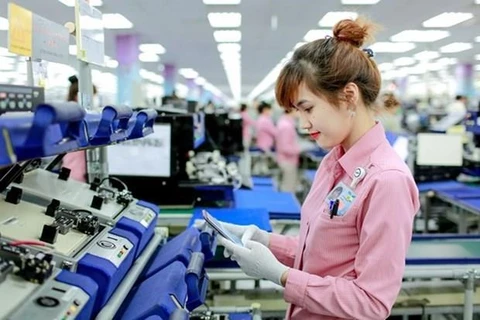
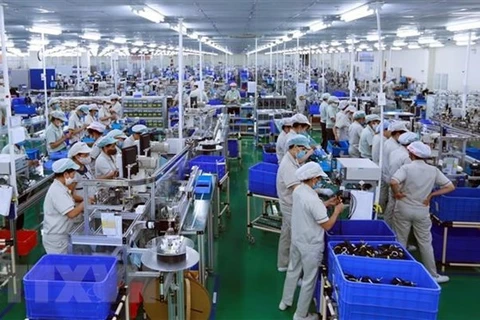
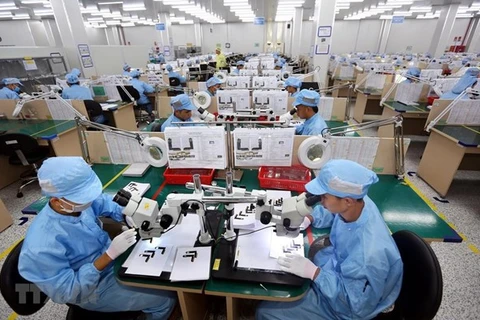
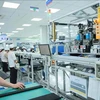
Assembling cars at Saigon Transportation Mechanical Corporation (Samco). (Photo: VNA)
 VCCI has worked out a plan to develop appropriate policies for supporting industries towards minimising reliance on imports of raw materials as well as reducing prolonged, simple and low-value-added processes, like packaging, production of manuals, and plastic components.
This will enable Vietnam to not only create more value and put the country in a better position in the global supply chain, but will create more opportunities for Vietnam in terms of free trade agreements (FTAs).
According to VCCI, high dependence on imports for supporting industries will lead to higher risks and increase the costs for enterprises.
Dau Anh Tuan, Director of VCCI’s Legal Department, said Vietnam's COVID-19 response could make it an attractive investment destination as economies seek to make their supply chains less dependent on China.
Foreign investors were considering shifting investments to Vietnam due to their trust in Vietnam's safety amid the pandemic. With a number of new generation FTAs, Vietnam would have more opportunities if the Government could offer better policies and clear targets to encourage and create favourable conditions for Vietnamese businesses and attract foreign investment into prioritised manufacturing sectors.
Deputy Minister of Industry and Trade Do Thang Hai said that from March, the ministry was asking businesses to promote production and boost the construction of large-scale energy and industrial projects to ensure sufficient electricity supply, contributing to the country’s economic growth.
The ministry also planned to conduct appropriate solutions and generate incentives for businesses relating to raw materials, production plans, processing, markets and distributions as well, he said.
Economic recovery
Vietnam’s industrial sector still grew 6.5 percent year-on-year in the first three months of 2021, with the manufacturing and processing sector expanding 9.45 percent and remaining the main engine of economic growth.
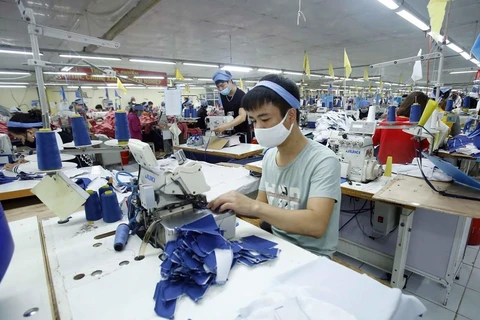
Despite the effects of COVID-19, local manufacturers have sought new ways to do business. In the first quarter of this year, textile, garment and footwear manufacturers showed more positive signals compared to the same period last year.
Le Tien Truong, CEO of Vietnam Textile and Garment Group (Vinatex), said while many firms involved in industrial production were concerned about the lack of orders due to the influence of the COVID-19 pandemic, textile and garment businesses were enjoying a surge in orders.
He said that at present, Vietnamese textile and apparel enterprises, including those of the group, had orders until the end of April 2021.
Notably, items such as knitwear and popular goods have orders until July and August of 2021.
"It is a good signal for the recovery process of Vietnam's garment and textile sector, especially when Vietnam is in a good position in the global supply chain after the COVID-19 crisis," said Truong.
Many manufacturing industries have experienced difficulties and challenges over the last year.
According to the Vietnam Steel Association, from the beginning of this year, Vietnam’s steel market has seen a low sales volume with stagnant production due to decreasing demand from construction businesses.
Nguyen Chi Sang, General Secretary of the Vietnam Association of Mechanical Industry (VAMI), said the biggest problem for enterprises was a lack of orders. /.
VNA`