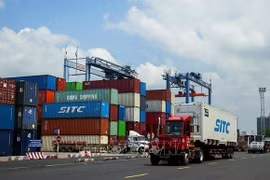
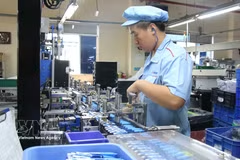
Standard Chartered has lowered the GDP growth forecast for Vietnam in 20223 from 5.4% to 5%. (Photo: VietnamPlus)
HCM City (VNA) – In its latest macro-economic updates about Vietnam, Standard Chartered has lowered the country’s 2023 GDP growth to 5.0% year on year from the previous 5.4%.
The revised forecast would require Q4 growth of 7.0% year on year which may still be challenging, the bank said.
It maintained robust 2024 GDP growth forecast of 6.7% for the country, with 6.2% in the first half and 6.9% in the second half.
According to the report, macro indicators show a tentative improvement. Trade has yet to signal a clear rebound in manufacturing. However, domestic recovery continues and is likely to strengthen further, with a robust retail sales.
The construction and accommodation sectors maintained strong growth year to date, and manufacturing has started to expand. The external outlook is improving with the current account surplus rising to 3.5% of GDP in 2024 and from 2.0% in 2023.
The inflation forecast for 2023 is revised up to 3.4% year on year from 2.8% previously. The Q4 inflation rate is forecast to reach 4.3% (from 2.7%) and likely to rise higher next year. Inflation may result in a search-for-yield behaviour and increased financial instability risks. Notably, education, housing, food, transport costs have been major contributors to the recent inflation drive.
 Standard Chartered forecast the USD/VND exchange rate will stand at 24,500 VND by the end of 2023. (Photo: VietnamPlus)
“The medium-term outlook remains promising given Vietnam’s economic openness and stability. To reinvigorate FDI inflows, Vietnam needs to resume rapid GDP growth and develop its infrastructure,” said Tim Leelahapan, Economist of Thailand and Vietnam, Standard Chartered.
Standard Chartered also believed that the State Bank of Vietnam will not cut interest rates further.
It said investment flows have accelerated in recent quarters. The USD/VND exchange rate will reach 24,500 VND by the end of 2023 and 23,500 VND by the end of 2024, compared to the previous predictions of 23,400 VND and 23,000 VND.
“The property market may require further liquidity support, as measures so far appear to have only reduced short-term repayment pressure. Low interest rates, new project approvals, and a pick-up in buyer sentiment could help the market,” said Leelahaphan.
Earlier, the United Overseas Bank (UOB)’s Global Economics & Market Research Unit has cut the full-year growth forecast for Vietnam to 5% from the earlier 5.2%.
Michael Kokalari, a chartered financial analyst (CFA) and Chief Economist at Ho Chi Minh City-based VinaCapital, forecast that Vietnam’s GDP will likely grow by less than 5% in 2023 due to lower demand for “Made in Vietnam” products.
“We expect Vietnam’s GDP growth to rebound to 6.5% next year, driven by a recovery in exports, which will in-turn be closely accompanied by a rebound in Vietnam’s manufacturing sector output from flat growth in 2023 to 8-9% in 2024, versus the sector’s 12% long-term average growth, pre-COVID.”
 The State Bank of Vietnam is forecast to not further reduce interest rates. (Photo: VietnamPlus)
“Our optimism for a manufacturing-driven recovery of Vietnam’s GDP growth in 2024 stems from an analysis of the cause of the sector’s problems in 2023, which was an over-accumulation of inventories by US retailers and other consumer firms in 2022,” he explained.
Inventories surged by more than 20% year on year in late-2022, because firms over-ordered during the COVID supply-chain disruptions of 2021, and because expectations of a post-COVID spending boom did not materialise.
Instead of purchasing more products when COVID lockdowns were lifted, consumers splurged on services such as travelling and eating out. Consequently, US firms have been working through this excess inventory throughout 2023, with inventory depletion at the fastest pace in almost 10 years. This has been the main factor weighing on Vietnam’s exports and manufacturing output this year. However, a plethora of anecdotal and high-frequency economic data in the US and in Vietnam indicates that this phenomenon is now coming to an end. The data formed the basis for the belief that orders and output from factories in Vietnam are now recovering, he said./.