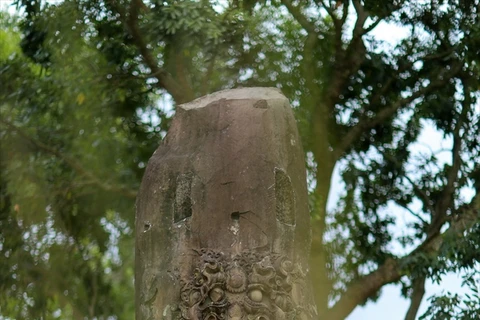
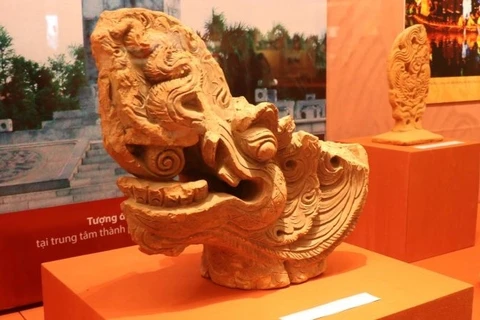
A close view of the stone lion statues at the Ba Tam temple. (Photo: Vietnam Pictorial)
 Hanoi (VNA) - A pair of stone lion statues at Ba Tam pagoda-temple complex is a symbol of the pinnacle of stone carving technique during the Ly Dynasty, showing the skillfulness and high aesthetic sense of artisans.
The site is a well-known relic of Hanoi associated with the life and career of Nguyen Phi Y Lan (Empress Mother Linh Nhan).
Hallmarks in the history of the Ly Dynasty were partly attributed by Nguyen Phi Y Lan - a talented woman who replaced the king as regent to look after the country. She was the pride of the nation in the resistance war against invaders of China’s Tang Dynasty, as well as in the cause of building a strong country in terms of politics, economy, culture, and expanding Buddhism in peacetime.
Construction of the complex was initiated by Empress Mother Y Lan and inaugurated in March 1115.
Located next to Highway 5 with high traffic flows, the complex still retains the quietness of a spiritual place.
From afar, the complex stands out with the pure bronze statue of Empress Mother Linh Nhan Y Lan which is 9.1m high and weighs 30 tonnes. Behind it is an embossment made of green stone covering an area of 140 sq.m.
Entering the gate is a space bearing the impression of Ly Dynasty style with a floating pavilion and a pair of dragon statues which were restored in 2000.
 The Ba Tam pagoda-temple complex in Duong Xa commune in Hanoi’s outlying district of Gia Lam. (Photo: Vietnam Pictorial)
 The Ba Tam temple is a place dedicated to Nguyen Phi Y Lan. It was built in the Ly Dynasty style with 72 gates, the oldest type in Vietnam.
It is also frequented by visitors as it is home to two national treasures which are a pair of stone lion statues and a gilded wooden altar.
In particular, the pair of stone lions - the original artifacts associated with this relic since its construction - were carved very delicately from a sandstone block. With a large size of 110cm high and 140cm wide, they are solemnly placed in the pagoda’s Buddhist trinity palace.
The work shows delicate carving lines, carrying the significance of Buddhist philosophy, and at the same time, clearly shows the majesty and power of a mascot in the history of the Vietnamese fine art in the 12th century.
 Statues are made from sandstone with skillful techniques. (Photo: Vietnam Pictorial)
 Another unique feature is the mixture of round statues and embossment, a strength in the sculpture art of the Ly Dynasty.
According to Buddhism, lion is the embodiment of intellectual power, but with stars on the body, the stone lions of the Ba Tam pagoda-temple also have the meaning of carrying the moving sky.
Instead of sticking to a certain pattern, artisans really created works of art bearing contemporary hallmarks.
Such requires a convergence of wisdom, imagination, affection and craftsmanship of master artisans.
 The pair of stone lions are placed in the main compartment of the temple (Photo: Vietnam Pictorial)
 Another national treasure at the complex is gilded wooden altar dating back to the 16th century. As a unique original artifact, it represents wood carving and gilding industry of the country and the Mac Dynasty in particular.
Measuring 170cm in height and 62cm in width, it is one of the three earliest known altars in art deco style, a typical product of the traditional 16th-century lacquer art.
In addition to its artistic value, the treasure offers an insight into architectural model of the Mac Dynasty, bringing the national art back to its traditional essence./.