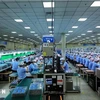
A worker wears protective clothing while working at Golden Logistic Co Ltd in the northern province of Bac Ninh (Photo courtesy of the company)
 Mandatory preventive measures among nations to contain the spread of the pandemic has resulted in disrupted trade flow and fragmented supply lines, dealing a blow to the logistics industry, which is viewed as an auxiliary for trade and commerce, enabling other industries to deliver goods and services to consumers.
Factories reducing production or suspending operations has led to a curtailment in the transportation and delivery of goods in the supply chain, greatly affecting the operation of logistics companies.
“Right from the early stages of the COVID-19 outbreak, the number of freight orders received by logistics companies in Bac Ninh fell sharply, at the same time, the delivery of goods, storage and warehousing activity is slowed and disrupted,” said Nguyen Hoai Nam, sales manager of Golden Logistic Co. Ltd. in the northern province.
“Following government guidelines on COVID-19 prevention and control, we businesses are making a continuing effort to realise the dual goal of maintaining production while ensuring work-related safety during the pandemic, prioritising workers' health,” he said.
Every stage involving transportation, warehousing, regular health check-ups for workers and drivers transporting goods in pandemic-hit areas was all in strict compliance with guidelines for disinfection and sterilisation. But this had resulted in a surge in operational costs.
Travel restrictions also led to worsening shortages of truck drivers to pick up containers, he said.
"Multiple unexpected costs have pressured logistics service providers. However, it is time both manufacturing enterprises and logistics enterprises need to work together,” Nam said.
Logistics costs in Vietnam account for about 20 percent of the goods value, which is relatively high compared to the average costs over the world.
“However, devastating consequences caused by the prolonged pandemic, together with the rising prices of warehousing and freight services, makes logistics costs continue to increase, putting great pressure on businesses,” Nam said.
Businesses also faced a significant reduction in revenue from goods exported and imported from pandemic-affected countries. Commodities shipped to Vietnam dropped dramatically, those undergoing customs clearance were strictly quarantined. Delivery time from suppliers in the Asian market and some other regions is reportedly longer.
According to statistics of the Vietnam Logistics Business Association, up to 50 per cent of enterprises providing logistics services of all types experienced a downturn in activities and revenue. Air and road transportation services were hit the hardest.
Roughly 80 percent of the association's members are micro, small and medium enterprises, thus many of them are on the brink of collapse, meaning workers are losing their jobs.
In Vietnam, infection cases were detected at large-scale industrial parks of Bac Ninh and Bac Giang, causing many disturbances in the production lines of enterprises, which inevitably placed a direct impact on logistics enterprises.
A report summarising recommendations of businesses and associations in April-May 2021 has been submitted to the Prime Minister by the Private Sector Development Research Board (Board IV), under the government’s Advisory Council for Administrative Procedure Reform and Young Presidents’ Organisation (YPO).
In the report, Board IV said amid the pandemic, manufacturing enterprises in industrial parks, logistics and transportation businesses suffered, causing economic hardship and supply chain disruption.
Exporting enterprises confronted great challenges due to worsening shortages of containers and merchant ships on a global scale, as well as skyrocketing fees.
Board IV, therefore, recommended the Government consider and direct ministries, branches and localities to simplify administrative processes or consider according to priority for import and export processes, as in the priority just applied to the export of Bac Giang lychee.
This would help businesses optimise time and costs in the domestic stages to speed up the import procedures for essential goods or accelerate the export of agricultural products and other key export commodities.
Le Duy Hiep, Chairman of the Vietnam Logistics Service Association (VLA), said in light of COVID-19 developments, in order to support logistics businesses, VLA proposed the Government grant a reduction of 50 percent on corporate income tax for 2020 as a way to support businesses to overcome hardships.
It also proposed the extension and postponement for employers’ tax payment, their contributions to the Social Insurance Fund, Unemployment Insurance and Health Insurance Fund, he said.
VLA's recommendations on tax payment extension have been approved by the Government. However, "this takes time and many procedures are required by the banks," Hiep said.
Decisions on petrol retail price reduction benefited both businesses and the whole economy, he said.
The Vietnam Maritime Administration in May last year decided to reduce the pilotage fee by 10 percent for Vietnamese shipping enterprises operating on domestic routes, as a support measure amid the COVID-19 pandemic.
Hiep said Vietnam’s logistics costs were still higher than the regional and global averages of 16-20 percent.
“We are trying to reduce the cost to equal other countries in the region, such as Thailand at 14-15 percent and Singapore at 8-10 percent,” he said.
The government targets that by 2025, the contribution of logistics services to Vietnam’s GDP will touch 5-6 percent, with the growth rate of logistics industry reaching 15-20 percent, the rate of outsourced logistics services at 50-60 percent, achieving Global Logistics Performance Index at 50 or higher.
Logistics enterprises should urgently apply IT solutions, modernising management and operation methods, use software systems and logistics optimisation platforms to cut costs and improve service quality, Hiep said.
They should promote linkages with other logistics providers and with manufacturing enterprises in order to create competitive advantages in negotiation and improve service provision capacity.
VLA would actively coordinate with localities and manufacturing companies to devise solutions promoting the transportation and circulation of goods, ensuring safety amid the pandemic, at the same time applying supportive measures such as reducing freight, storage and warehousing costs.
Trade centres and supermarkets should consider augmenting the purchase of agricultural products from farmers in pandemic-hit localities such as Bac Giang, he said./.
VNA