Hai Phong city is committed to building an enabling administration that acts decisively, dares to take the lead and assumes responsibility, while providing the best possible services to residents and the business community
Resolution 10-NQ/TW marks a significant reset of Vietnam’s foreign investment strategy, introducing broad reforms to create a more unified and effective framework for attracting foreign capital.
Vietnam's total import-export turnover in April was estimated at 94.32 billion USD, up 0.8% from the previous month and 26.7% year-on-year, according to the National Statistics Office.
Nguyen Thi Huong, Director of the National Statistics Office, said Vietnam’s solid growth in 2025 demonstrated the gradually strengthened internal capacity and resilience, providing an important springboard for 2026 and beyond.
Nearly 80% of manufacturing and processing enterprises anticipate business conditions in the third quarter to be stable or improve, according to the National Statistics Office.
These criteria assess the impact of foreign investment on economic development, considering factors such as capital, growth, operational performance, technology, tax contributions, spillover effects, and links to domestic enterprises.
Prime Minister Pham Minh Chinh attended a meeting with representatives of donors and foreign-invested enterprises in Vietnam on January 26 on the occasion of the upcoming Lunar New Year festival.
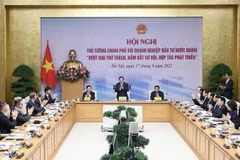
Prime Minister Pham Minh Chinh chaired a hybrid meeting with foreign-invested enterprises and business associations on September 17, during which he pledged to create favourable conditions for FDI enterprises to invest successfully and sustainably in Vietnam.
Foreign-invested enterprises in Vietnam are recovering well and focusing on production and business expansion, with disbursement reaching a record high in the first eight months of 2022, according to director of the Ministry of Planning and Investment’s Foreign Investment Agency (FIA) Do Nhat Hoang.
The inflow of foreign investment into Vietnam hit over 2.1 billion as of January 20, up 4.2 percent year-on-year, marking good signals for the country's investment attraction, the latest report from the Foreign Investment Agency (FIA) showed.
Industrial parks (IPs) in the northern province of Hung Yen are now home to 209 foreign-invested enterprises with 271 valid projects worth over 5 billion USD, according to the management board of provincial IPs.
Foreign-invested enterprises have shown optimism about the recovery of Vietnam’s economic and investment climate during a conference on supporting foreign investors to adapt to new normal business situation that took place in Ho Chi Minh City on December 17.
The People’s Committee of the capital city held a dialogue with foreign-invested enterprises in the city on October 19 to seek measures to tackle difficulties faced by foreign firms amid the COVID-19 pandemic.
The Government’s anti-corruption efforts have proven increasingly effective, helping enterprises significantly reduce informal costs, according to the Vietnam Chamber of Commerce and Industry (VCCI).
The authorities of northern Bac Ninh province always create favourable conditions for, and work to promptly remove difficulties facing foreign businesses, including those from the Republic of Korea (RoK), to effectively operate in the locality, Secretary of the provincial Party Committee Dao Hong Lan has said.
Foreign direct investment (FDI) has contributed significantly to the economic development of Nghe An province but more actions are needed to improve its efficiency and increase FDI enterprises' contribution to the State budget.
Industrial parks (IPs) and export processing zones (EPZs) in HCM City attracted investment totalling 591 million USD in the first 10 months of this year, an increase of 7.16 percent year-on-year, according to the HCM City Export Processing and Industrial Zones Authority (HEPZA).
Vietnam still managed to maintain export growth in the first 10 months of this year despite COVID-19, and exports for the year as a whole are expected to rise 3-4 percent against 2019, according to the Ministry of Industry and Trade (MoIT).