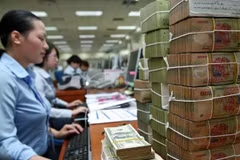
Under the new regulations, customers must use a chip-based ID card, a standard ID card, or a level-2 electronic ID for identity verification. Passports will no longer be considered valid identification documents for banking procedures.
The State Bank of Vietnam (SBV) introduced two books on the history of the Vietnamese currency and of the central bank at a press conference on April 29, to mark the 70th anniversary of the country’s banking system (May 6, 1951-2021).
KEB Hana Bank of the Republic of Korea (RoK) has become a strategic shareholder of the Joint Stock Commercial Bank for Investment and Development of Vietnam (BIDV), helping the latter to have the biggest charter capital among Vietnamese banks.
Joint Stock Commercial Bank for Foreign Trade of Vietnam (Vietcombank) reported nearly 17.6 trillion VND (757.59 million USD) in consolidated profit in the first nine months of this year, surging 50.6 percent from the same time last year and reaching 85.8 percent of the yearly plan.
Most of credit institutions have expected better business performance for the fourth quarter as well as the whole of 2019, according to a recent survey by the State Bank of Vietnam.
The State Bank of Vietnam (SBV) has warned local commercial banks to tighten control of loans that use savings books as collateral to ensure the safety of the banking system.
The State Bank of Vietnam (SBV) said it will closely monitor interest rates offered by credit institutions and take measures to strictly handle violations of the law, including cutting credit growth targets.
The Ho Chi Minh City Development Joint Stock Commercial Bank (HDBank) has reported a record pre-tax profit of 2,211 billion VND (94.26 million USD) in the first half of the year.
Tens of trillions of VND is expected to be poured into Vietnamese banks by foreign investors in 2019 and 2020 as negotiations on many deals are running smoothly.
While private joint stock banks have had some success in raising their charter capital, major banks, except for Vietcombank, are still struggling with this work.
Some experts have said when a bank is unable to have a minimum capital adequacy ratio (CAR) of 8 percent for a long time, it could be put under special control by the central bank.
Despite a draft roadmap to apply International Financial Reporting Standards 9 (IFRS 9) compulsorily in Vietnam from 2025, domestic banks should start preparations now as the complex norms have proved a major challenge for global financial institutions, experts have said.
The financial capacity of Vietnam’s credit institutions has solidified in recent years, with their charter capital reaching 578.9 trillion VND (24.85 billion USD) by the end of the first quarter 2019.
Vietnam's interbank e-payment system handled 37 million transactions worth nearly 21 quadrillion VND (898.4 billion USD) in the first quarter of the year, up 23 percent and 17.8 percent respectively compared to 2018, according to the State Bank of Vietnam (SBV).
Despite credit growth among Vietnamese credit institutions remaining low this year, experts are not concerned about the slowdown, saying it was a good sign for the economy.
The banking sector pledged to meet the capital demand for production and business, especially in five prioritised sectors, Deputy Governor of the State Bank of Vietnam (SBV) Dao Minh Tu said at a conference connecting enterprises and banks in Hanoi on April 16.
Credit institutions in Vietnam settled more than 204.4 trillion VND (8.77 billion USD) of non-performing loans (NPLs) by the end of the first quarter this year, said Nguyen Thi Hong, Deputy Governor of the State Bank of Vietnam (SBV).
Liquidity of the banking system has been plentiful again after the Lunar New Year (Tet), helping the central bank net withdraw more than 51.55 trillion VND (2.2 billion USD) in the past week.