Tarriff exemptions for Chinese, ASEAN goods

The zero percent tariff under the ASEAN-China Free Trade Agreement (ACFTA) will bring more goods from ASEAN and China to Vietnam.
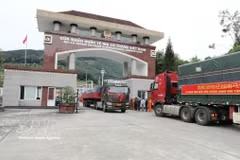
Tarriff exemptions for Chinese, ASEAN goods ảnh 1Officials check fruit imported from China at the Tan Thanh border gate in northern Lang Son province (Source: VNA)

Hanoi (VNA) - The zero percent tariff under the ASEAN-China Free Trade Agreement (ACFTA) will bring more goods from ASEAN and China to Vietnam.

This will create more competition for local products, according to experts. The Government has issued a decree on special preferential tariffs for ASEAN and Chinese products for the 2016-18 period according to commitments under the ACFTA.

Under the decree, hundreds of goods from ASEAN and China will enjoy zero percent import tax to Vietnam. The goods include vegetables, fruits, processed or preserved fish and other kinds of seafood, as well as cacao and cacao products, cereal, flour and meat.

According to the commitments at ACFTA, Vietnam will abolish tax or reduce it to zero percent for 90 percent of existing tariff lines by the end of 2018, while the remaining 10 percent of tariff lines will see it reduced by 2020.

A representative from the Vietnam Chamber of Commerce and Industry’s WTO Support Centre said the reduction of import tariffs for ASEAN and Chinese goods would create strict competition between ASEAN, Chinese goods and local products.

General Statistics Office (GSO) statistics showed that in the first nine months of this year, Vietnam had the highest import of goods from China, with total import value at 36 billion USD. Its trade deficit with China reached 21.3 billion USD, Nguoi Lao Dong newspaper reported.

Local enterprises imported from China seafood valued at 45.3 million USD, vegetables and fruit at 146.9 million USD, fabrics at 3.93 billion USD and material for textile, garments, leather and footwear industries at 1.38 billion USD, as well as computer and electronic products valued at 4.1 billion USD, machine and equipment at 6.5 billion USD and steel at 3.2 billion USD.

Nguyen The Bao, Director of the Suoi Lon Agricultural, Service, Trade and Tourism Cooperative in southern Dong Nai province, said mango growers studied supply at home and also in neighbouring countries to make plans accordingly on production, trading and competition.

Depending on the prevailing situation, Vietnamese mangos were exported to Thailand, Cambodia and vice versa. Meanwhile, after many years of exporting mangos from Vietnam to China, the neighbouring country had begun exporting its mangos to Vietnam to compete with local products.

Nguyen Cong Thua, Chairman and General Director of the Anh Dao Agricultural Service Cooperative in the central highlands province of Lam Dong, said demand for fruit in the home market had increased, therefore there were times the market lacked supply of fruits and their import surged. As a result, in the future, local farmers would face strict competition from imported fruit products because of their small and medium production scales with high production cost, while China’s producers had large production scale with lower production cost, he said.

Meanwhile, Vietnam did not have many technical barriers for imported fruit and lacked close control for quality and food safety, which was disadvantageous for local fruit producers while competing with imported fruits, he said.

Seafood is also expected to face similar competition when the import tax reduces to zero percent under the ACFTA.-VNA
VNA

See more

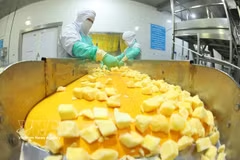
Processing frozen mangos for export in An Giang province (Photo: VNA)

Vegetable, fruit export boom hinges on technology

Pham Quoc Liem, General Director of U&I Agricultural JSC (Unifarm), said Vietnam needs chain-linked models for each key product, with clear roles for lead enterprises and clear responsibilities and benefits for stakeholders. The State should issue coordination policies and preferential credit support to build standardised raw material zones with stable productivity and quality. Research, development and commercialisation of competitive varieties will add further momentum.

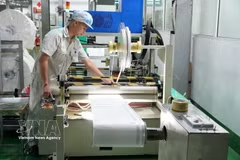
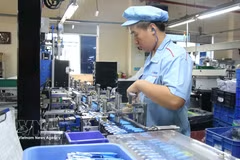
A ballpoint pen production line at Thien Long Group in Ho Chi Minh City. (Photo: VNA)

Ho Chi Minh City steps up efforts to unlock growth drivers

The municipal People's Committee has identified the year-end period as crucial to mobilising more than 1.2 quadrillion VND (46.7 billion USD) for development investment, boosting traditional and new growth drivers, and removing bottlenecks related to land, planning, site clearance, construction materials and investment procedures.

At the business networking programme between Vietnamese and Polish enterprises in Ho Chi Minh City on November 10. (Photo: sggp.org.vn)

Poland promotes trade, culinary culture in Ho Chi Minh City

The “Taste Europe!” programme is part of a series of promotional activities aimed at demonstrating that European food products represent not only high quality but also a commitment to environmental responsibility, Polish Ambassador to Vietnam Joanna Skoczek said.

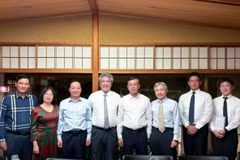
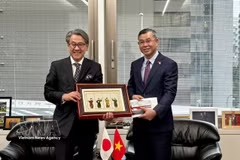
Vietnamese Minister of Finance Ngo Van Tuan (R) presents a souvenir to Chairman of the Board of Directors of the Japan Bank for International Cooperation (JBIC) Maeda Tadashi in Tokyo on November 10. (Photo: VNA)

Vietnam strengthens cooperation with Japan Bank for International Cooperation

Tuan expected JBIC to help promote investment flows from Japan into Vietnam, with priority given to large-scale projects in green energy, smart infrastructure, semiconductors and high-tech electronics, as well as projects with spillover effects that enable Vietnamese businesses to participate more deeply in global supply and value chains.

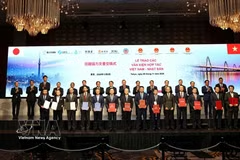
General Secretary of the Communist Party of Vietnam Central Committee and President To Lam and officials witness the exchange of cooperation documents at the Vietnam-Japan Public-Private Forum on Economic, Science and Technology Cooperation in Tokyo on November 9, 2026. (Photo: VNA)

Petrolimex steps up strategic cooperation with Japan’s ENEOS

Under the MoU, the two sides will focus on ensuring and diversifying fuel supplies to improve their responsiveness to supply chain fluctuations. They will also explore cooperation opportunities in high-quality petroleum products, petrochemicals and new energy solutions.

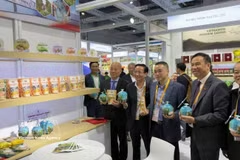
Vietnamese Consul General in Shanghai Tran Huy Hung (centre) and Vu Ba Phu (first, left), General Director of the Vietnam Trade Promotion Agency under the Ministry of Industry and Trade, visit Vietnam's trade pavilion at the 2026 China International Import Expo (CIIE). (Photo: VNA)

Vietnamese goods make strong impression at CIIE 2026

A wide range of products is on display, particularly processed fruits and vegetables, dairy products, bird's nest, coffee, tea and canned foods. Participating businesses focus on deep processing, modern packaging and strict compliance with China's food safety and hygiene standards.