Tet fruit tray, indispensible part of Vietnamese culture

The “Mam Ngu Qua” in Tet Festival represents the quintessence that Heaven and Earth bless humans.
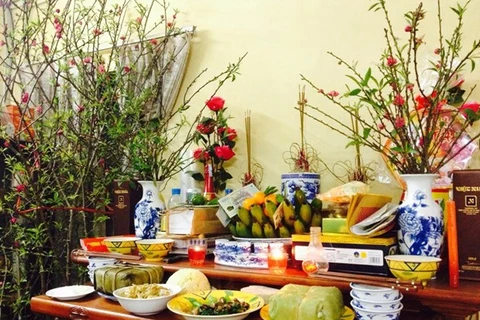
Tet fruit tray, indispensible part of Vietnamese culture ảnh 1Illustrative. (Photo: Shutterstock)

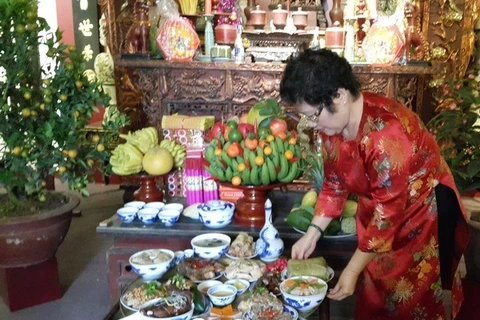
Hanoi (VNA) – A “Mam Ngu Qua” or five-fruit tray is indispensable for each Vietnamese family as among the numerous offerings that are required to decorate ancestral altars during the traditional Lunar New Year (Tet) festival.

The tray symbolises the wholeheartedness and gratitude of the present generation towards their ancestors and the Genie of the Land during Tet.

Like other popular rituals, the preparation of a five‑fruit tray for Tet has become an established convention.

During the few days just before Tet, the Vietnamese begin to buy the necessary fruits for this purpose.

A five‑fruit tray is usually composed of a hand of green bananas, a ripe pomelo (or a Buddha's hand, a shaddock), oranges, persimmons, sapodilla plums, a bunch of kumquat, and in recent years, one can add mangoes and grapes from southern Vietnam, or apples and pears from China. Although it is called a five‑fruit tray, it does not necessarily contain exactly five kinds of fruit.

Arranging fruits on the crimson, hourglass‑shaped wooden tray is really an art. One has to combine the colours and shapes of the different fruits in arranging them on the tray to make it look like a still life picture.

To ensure balance on the tray, the hand of bananas is usually put in the middle with the bananas pointing upright and the pomelo on the concave surface of the hand of bananas. Then the oranges, sapodilla plums, apples are added in the gaps between the bananas and the pomelo.

The last little gaps are filled in with little kumquats to create a full, compact tray of fruits.

In colours, the fruit‑tray presents a harmonious combination of the different colours of fruits: dark green of banana, light yellow of pomelo, deep red of persimmon, reddish yellow of orange and kumquat, light green of apple, and dark brown of sapodilla plum. To complete the picture, the fruit tray will be covered here and there with some small, fresh leaves of kumquat.

The five-fruit tray, together with horizontal lacquered boards engraved with Chinese characters, parallel sentences written on red paper, ornamental kumquat and peach trees, and popular Hang Trong and Dong Ho pictures, has transcended its material value to become a spiritual symbol, an original national product in the spiritual life of the Vietnamese.

At present, while many of the ancient spiritual values have sunk into oblivion, the custom of arranging the five‑fruit tray on the altar during the lunar New Year days is being jealously preserved as a fine legacy of Vietnam's traditional culture.

The “Mam Ngu Qua” in Tet Festival represents the quintessence that Heaven and Earth bless humans. This is one of the general perceptions of life of the Vietnamese, which is “An qua nho ke trong cay” (When taking fruit, you should think of the grower)./.
VNA

See more

The Executive Committee of the Vietnam Ao Dai Heritage Club in Laos make debut. (Photo: VNA)

Ao dai helps promote Vietnamese culture in Laos

The club operates under the Vietnam Ao Dai Heritage Club of the Vietnam Cultural Heritage Conservation Support Fund, aiming to preserve and promote the values of the Vietnamese traditional dress among the Vietnamese community in Laos.

Head of the Party Central Commitee's Commission for Information, Education and Mass Mobilisation Trinh Van Quyet (first, right) presents A prize to the winning authors and groups of authors. (Photo: VNA)

More than 50 outstanding books honoured at 8th National Book Awards

Two A prizes, the highest distinction of the awards, were granted to Lich su Vietnam bang hinh (Vietnamese History in Pictures) by Dong A and multiple authors, jointly published by the Publishing House of Hanoi National University of Education and Dong A Culture Joint Stock Company.

An Ao dai collection of Lan Huong brand is introduced at the event (Photo: VNA)

Journey to bring Vietnam’s 'Ao dai' to global fashion stage

With support from the Embassy of Vietnam in the UK, Vietnamese associations across Europe, as well as business and artistic communities, the initiative seeks to establish the 'Ao dai' brand on the world fashion map. After London, the project is expected to travel to Paris and Milan, two of the world’s leading fashion capitals, to further showcase Vietnam’s cultural identity.

Tokyo Girls Collection will launch a fashion and music festival in Vietnam. (Photo: www.sggp.org.vn)

Tokyo Girls Collection Vietnam 2026 to debut in Ho Chi Minh City

The first day of TGC Vietnam will be open to the public free of charge and focus on fashion and lifestyle experiences. Activities will include Vietnam–Japan cultural exchanges, food and shopping spaces, Harajuku-inspired check-in areas, and runway shows featuring Japan’s distinctive fashion DNA.

An art performance at the event (Photo: VNA)

Vietnamese culture promoted in France

It featured traditional melodies such as the ‘dan tinh’ (a kind of musical instrument) and 'then' singing of the Tay ethnic group, Quan ho (love duet) folk songs from Bac Ninh, as well as northern and southern Vietnamese folk music, 'cai luong' (reformed opera) excerpts and well-known songs celebrating the homeland, spring and love.

An exhibition of paintings and books titled “Vietnamese Soul on French Soil” opens on March 7 in Val-de-Marne, part of the Ile-de-France region. (Photo: VNA)

Exhibition of paintings and books celebrates Vietnamese spirit in France

More than an art exhibition, the event brought together Vietnamese intellectuals and artists living in France who, despite building successful careers abroad, have continued to maintain strong ties with the homeland. It also attracted French friends who have long-standing connections with Vietnam and hold deep affection for the country.

Ao dai (traditional long dress) and other traditional Vietnamese attire showcased at the Vietnam Festival 2026 in Osaka (Photo: VNA)

Vietnam Festival 2026 in Osaka spreads Vietnamese culture

Vietnam Festival 2026 in Japan is not only a cultural celebration rich in Vietnamese identity for the community in Japan, but also a vivid symbol of solidarity and close ties among overseas Vietnamese towards their homeland.

Chef Anna Le (in red dress) shares techniques and secrets for preparing Vietnamese vegetarian dishes using simple yet flavourful ingredients. (Photo: VNA)

Vietnamese vegetarian cuisine promoted to diplomatic community in US

In Vietnam, vegetarian food is not merely a dietary choice but also a philosophy rooted in peace, compassion, and a deep respect for nature. It reflects the Vietnamese soul - gentle yet flavourful, simple yet sophisticated. Familiar ingredients such as lotus seeds, tofu, mushrooms and fresh herbs are transformed into light, nutritious dishes that embody the essence of Vietnamese gastronomy.

A performance of Vietnamese artists at the opening ceremony of the 11th Japan-Vietnam Festival (Photo: The organising board)

Vietnam–Japan festival strengthens people-to-people ties

After more than a decade of development, the Japan-Vietnam Festival in Ho Chi Minh City has become a significant international cultural exchange event and a vivid symbol of the strong and enduring friendship between the two nations.

Visitors admire a large driftwood sculpture measuring nearly 25 metres in length and weighing around 20 tonnes, regarded as one of the most intricate works of its kind in Vietnam. (Photo: VNA)

Driftwood “museum” in middle of Tien River

What were once tree trunks lying silently beneath the muddy waters have, through his hands, become singular sculptural works, forming an unusual visitor attraction amid the waterways of southern Vietnam.

Coaches and players of the national women's U20 team discus before their training. The team will compete in the AFC U20 Women’s Asian Cup 2026 next month in Thailand. (Photo: VNA)

Vietnam women chase U20 World Cup dream

The Vietnamese women squad will compete in the AFC U20 Women’s Asian Cup 2026, the crucial World Cup qualifying tournament, from April 1-18 in Thailand. Drawn in Group A, they will face stiff competition from China, Bangladesh and the host nation.

UBD students decorate traditional Vietnamese and Bruneian motifs during a cultural exchange (Photo: VNA)

Vietnamese embassy in Brunei promotes cultural diplomacy

The Vietnamese Embassy in Brunei has partnered with Universiti Brunei Darussalam (UBD) and the Veteran Association of the Royal Brunei Armed Forces (VARBAF) to host a series of events introducing Vietnam’s traditional Tet festivities, creating a lively platform for cultural exchange while spreading the Vietnamese language and traditional handicrafts to Bruneian friends and students.