Thai media spotlights Vietnam's role in global supply chain

Thai media on December 11 posted an article highlighting Vietnam's role in a global supply chain that has been undergoing a significant transformation, marked by its increasing importance as a manufacturing hub and a source of high-demand exports.
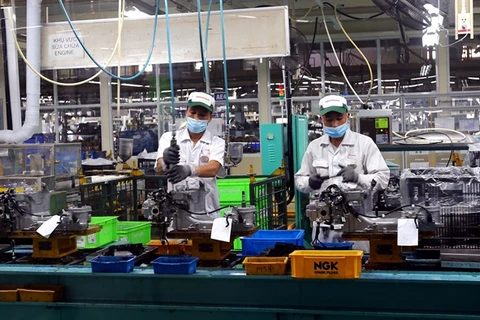
Thai media spotlights Vietnam's role in global supply chain ảnh 1A production line of a Japanese-invested firm at the Quang Minh industrial park in Hanoi (Photo:VNA)

Bangkok (VNA) – Thai media on December 11 posted an article highlighting Vietnam's role in a global supply chain that has been undergoing a significant transformation, marked by its increasing importance as a manufacturing hub and a source of high-demand exports.

According to the article, published on nationthailand.com,an English-language news website, Vietnam hasattracted more than 25 billion USD in foreign direct investment (FDI) since thebeginning of this year.

Pledges from China were the highest at 8.2 billion USDin the first 11 months, twice as much as in the same period last year. Industryexperts say the increasing FDI growth is propelling Vietnam up thevalue chain, it said.

The article cited FionNg, chief operating officer at BW Industrial, as saying that the company sees a strongsurge in leasing inquiries by more than 75% year on year. More than 40%of Vietnam's total exports are made up of high-tech relatedgoods.

This is also reflected in tenants'profile of BW Industrial, where more than 40% of its factory space taken out bytenants are from high-tech and electronics-related industries.

Lower labour cost and greaterconnectivity have made Vietnam extremely attractive to globalcompanies, according to the article.

By the end of July, Vietnam had signed16 free trade agreements with major economic partners and is also part ofthe Comprehensive and Progressive Agreement for Trans-Pacific Partnership (CTPPP) andthe Regional Comprehensive Economic Partnership (RCEP)./.
VNA

See more

Malaysia establishes ‘war room’ to ensure water security

Malaysia establishes ‘war room’ to ensure water security

The establishment of the war room reflects the Malaysian government’s commitment to shift from a reactive approach to a more proactive, data-driven one in managing national water challenges, particularly amid increasingly unpredictable weather conditions caused by global climate change

Indonesia diversifies supply sources to ensure energy security

Indonesia diversifies supply sources to ensure energy security

Indonesia is facing significant supply pressure as crude oil consumption reaches approximately 1.6 million barrels per day, much lower than the domestic production at only around 600,000 barrels per day, forcing the country to rely heavily on imports.

Indonesian-branded cosmetic and personal care products are available at supermarkets and shopping malls (Photo: VNA)

Indonesia aims to master cosmetics industry value chain

Key drivers include its large population, expanding middle class, and rapidly rising demand for beauty products, especially among young consumers. The market has reached billions of US dollars and is projected to maintain strong growth in the medium term.

The Anthropic logo is seen in this illustration taken on Mar 1, 2026. (File photo: Reuters)

Singapore warns of cyber risks from Frontier AI models

According to CSA, advanced AI models – among the most cutting-edge systems today – can significantly shorten the time needed to identify system vulnerabilities and develop exploitation tools, reducing the process from months to just hours.

Helicopter carrying eight reported missing in Indonesia

Helicopter carrying eight reported missing in Indonesia

Indonesian authorities are urgently conducting a search and rescue operation after receiving reports that a helicopter carrying eight people suddenly lost contact on the morning of April 16 in West Kalimantan on the island of Borneo.

Malaysia’s job losses surge 47% in the first quarter of 2026 (Photo: AFP)

Malaysia's layoffs rise 47% in first quarter

The report, based on figures from Malaysia’s Social Security Organisation, showed layoffs peaked in January with around 10,700 cases before easing to 7,500 in February and 5,900 in March. Despite the slowdown toward the end of the quarter, the total remained significantly higher than the roughly 16,500 layoffs recorded in the same period of 2025.