Thailand generates less marine debris

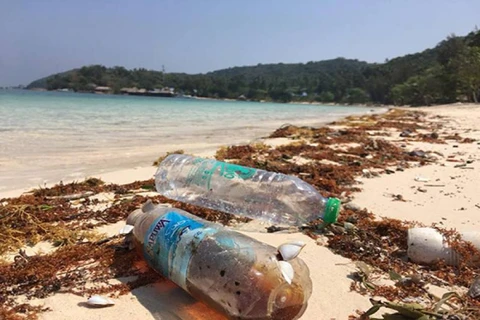
The amount of marine debris generated in Thailand has dropped to 21,700-32,600 tonnes annually, after the initial success of a project to increase the reuse and recycling of materials by 25 percent.
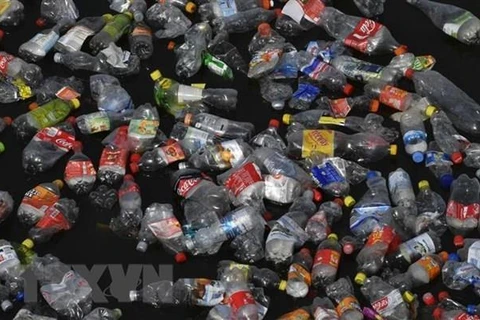
Thailand generates less marine debris ảnh 1The amount of marine debris generated in Thailand has dropped to 21,700-32,600 tonnes annually (Photo: thainews.prd.go.th)

Bangkok (NNT/VNA) - The amount of marine debris generated in Thailand has dropped to21,700-32,600 tonnes annually, after theinitial success of a project to increase the reuse and recycling of materialsby 25 percent. Plastic bags remain the largest proportion of marine debrisfound in the environment.

Thailand’s Ministry of Natural Resources and theEnvironment’s (MNRE) Permanent Secretary Jatuporn Buruspat, has revealed adownward trend in the quantity of marine debris generated in Thailand, with thevolume of marine debris washed ashore in 2018 at between 21,700-32,600 tonnes annually, which is an obvious decrease from theamount in 2016 of between 33,900-51,000 tonnes.

He said the decreasein marine debris is due to greater reuse and recycling of materials, from 15 percent to 25 percent.

In 2018, theDepartment of Marine and Coastal Resources (DMCR) conducted a study ofmicroplastic contamination in the environment caused by the degradation ofplastic debris, and its potential long-term effect on the food chain and human health. The study, conducted in 18seaside provinces, found 53 - 2,102 pieces of microplastic per square meter of beach in the dry season,with the level of concentration dropping to 0 - 974 pieces per square meter in the rainy season.

Every year thedepartment holds activities to celebrate the International Coastal Cleanup, on September 3 each year. This year, the department also held eventson September 21 in 24 seaside provinces which helped remove 230,000pieces of debris, weighing 10 tonnes in total, from themarine ecology.

Most of this debris was assorted plastics, with plastic bags at22 percent, plastic bottles at 16 percent, foam food containers at 9 percent,along with glass bottles at 5 percent, and drinking straws at 5 percent.

The MNRE permanentsecretary has stressed 350,081 pieces of debris have so far been collected thisyear, from beaches in 23 seaside provinces, weighing in total 32.83 tonnes. Thelargest proportion of this debris is plastic bags amounting to 11.71 percent,followed by foam food containers and food bags./.
VNA

See more

The forum on ASEAN's role in the Indo-Pacific region and prospects for cooperation with Argentina takes place on September 10 (Photo: VNA)

ASEAN highlights its central role in Indo-Pacific

The Ambassador of Indonesia, the country holding the rotating chairmanship of ASEAN in Argentina, stressed that maintaining peace and stability, along with an open, transparent regional environment based on mutual respect, are fundamental conditions for a peaceful, inclusive, and prosperous Indo-Pacific.

A street in Bangkok, Thailand. (Illustrative photo: Xinhua/VNA)

Thailand’s business activity shows signs of gradual recovery

As of August 31, Thailand had more than 1 million active legal entities with total registered capital of 24.13 trillion THB. The service sector accounted for the largest share, with 552,830 entities, or 54.48%, followed by wholesale and retail with 332,791 entities (32.79%) and manufacturing with 129,215 (12.73%).

Prime Minister Hun Manet (front row, centre) and Labour and Vocational Training Minister Heng Sour (front row, right) visit a garment factory in Preah Sihanouk province. MLVT (Photo: khmertimeskh.com)

Cambodia records 7,458 more enterprises in three years

A Cambodian official said that the growth should not be assessed solely by the number of newly established enterprises and facilities, but also by their contributions to investment, production, job creation and household incomes.

The ASEAN Senior Officials’ Meeting (SOM) convenes in Manila, the Philippines, on September 9. The Vietnamese delegation is led by Deputy Minister of Foreign Affairs Dang Hoang Giang (fifth, left), head of the ASEAN-Vietnam SOM.(Photo: asean.org)

Vietnam calls for stronger ASEAN unity, resilience

Deputy Minister of Foreign Affairs Dang Hoang Giang urged ASEAN to make full use of existing mechanisms to enhance dialogue, build trust and prevent risks and conflicts, particularly by strengthening the Treaty of Amity and Cooperation in Southeast Asia (TAC), the Southeast Asia Nuclear Weapon-Free Zone Treaty (SEANWFZ), and cooperation based on international law.

Timor-Leste President Jose Ramos-Horta (Photo: VNA)

Timor-Leste diversifies economy, seeks to attract investment

The President noted Timor-Leste is pursuing sustainable development, stronger regional connectivity and expanded international cooperation while seeking investment opportunities in energy, tourism and emerging economic sectors to reduce its dependence on oil and gas revenues.

Minister Counsellor Nguyen Hai Luu, Deputy Permanent Representative of Vietnam to the UN (Photo published by VNA)

Vietnam cooperates with UN to advance gender equality

Minister Counsellor Nguyen Hai Luu highlighted Vietnam’s positive achievements in promoting gender equality, noting that 13 of the 20 targets under the national strategy on gender equality had been met or exceeded by 2025.

General Secretary of the Communist Party of Vietnam Central Committee and President To Lam meets with Russian President Vladimir Putin in Moscow on September 9, 2026. (Photo: VNA)

Russian public, experts praise top Vietnamese leader’s visit

Positive reactions to General Secretary and President To Lam’s visit have reaffirmed Vietnam’s steady foreign policy amid global changes, while highlighting the enduring trust and friendship between Vietnam and Russia, which are working together to create new breakthroughs in bilateral cooperation.

Thailand eases rules for foreign enterprises

Thailand eases rules for foreign enterprises

The regulatory adjustment is part of Thailand's efforts to simplify regulations governing foreign business operations and clarify licensing requirements, while simultaneously fostering economic development and enhancing the country's international competitiveness.