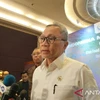
Thailand intensifies AI policy to transform economy

Thailand’s Ministry of Higher Education, Science, Research and Innovation (MHESI) is introducing its "MHESI for AI" policy, aiming to empower Thais to use artificial intelligence for national development.

Thailand intensifies AI policy to transform economy (Photo: bangkokpost.com)

Bangkok (VNA) - Thailand’s Ministry of Higher Education, Science, Research and Innovation (MHESI) is introducing its "MHESI for AI" policy, aiming to empower Thais to use artificial intelligence for national development.

MHESI Minister Supamas Isarabhakdi said the main obstacles for AI development in Thailand are a shortage of skilled workers and a lack of AI applications.

The ministry's policy integrates AI into university curricula, ensuring students and university personnel are literate about AI and able to use it effectively.

The policy adheres to ethical considerations about AI, she said.

The policy will be an engine to support universities transitioning to "Education 6.0" that integrates advanced tech in the learning process, preparing students for the challenges of the 21st century, according to the ministry.

The ministry wants to use AI technology to foster the economic and social development of the country, said Supamas.

The MHESI for AI policy has three main focus areas.

The first is AI for lifelong learning by developing AI teachers and coaches who will create platforms supporting lifelong learning for all stages of life. This initiative aims to provide the necessary skills, starting with English language proficiency for careers, creating a workforce to support the AI industries.

As Thailand has low English proficiency compared with other Southeast Asian countries, the ministry plans to enhance English learning efficiency through AI tools that support various teaching methods.

Moreover, AI will be utilised to simulate teachers or tutors for out-of-classroom learning based on individual interests, facilitating rapid skill development according to personal needs.

The second is AI workforce development by developing AI professionals and establishing AI infrastructure for Thai education and the labour market.

This includes programmes like promoting an understanding of AI at elementary, high school and vocational levels, developing international intellectual property innovations, and establishing an AI workforce for educational institutions. It also includes offering AI degree programmes and AI projects for public servants. The aim is to provide AI professionals, AI engineers, and IT professionals or other vocations with AI tool skills -- covering 30,000 people within three years.

The third is on AI innovation to drive the economy by providing the full support of AI innovation.

The ministry will expedite support for the practical application of AI innovation, especially in the business sector, through mechanisms such as innovation support from agencies within the ministry. It has a national AI development plan for 2022-2027, covering five strategies.

The first strategy focuses on creating understanding and awareness of ethical considerations. This strategy involves essential laws and regulations governing AI. The second is a focus on AI infrastructure development by increasing AI investment by 10% annually. The third involves AI workforce development, aimed at producing 30,000 AI professionals. The fourth focuses on R&D in AI by creating 100 AI innovations that could impact the economy by 48 billion THB (1.3 billion USD). The fifth focuses on supporting AI business and AI usage in 600 organisations nationwide./.

VNA

See more

A resident checks a landslide-hit location in Mejenang, Cilacap, Central Java, on November 14. (Photo: Antara)

Indonesia: Households evacuated after Cilacap landslide

The landslide in Indonesia's Central Java has killed three persons while 20 people are still reported missing. The incident damaged eight houses, caused a two-meter-deep subsidence and left a 25-metre-long crack over an area of about 6.5 hectares, affecting 46 residents of 17 households.

Malaysian Minister of Investment, Trade and Industry Zafrul Abdul Aziz. (Photo: spanarboy.com)

Malaysia aims to become Southeast Asia’s AI, EV hub

Malaysia is shifting into high gear as it positions itself to become Southeast Asia’s leading hub for smart, sustainable mobility, powered by breakthroughs in electric vehicles (EVs), artificial intelligence (AI) and advanced manufacturing.

TAT launches 'Trusted Thailand' symbol to boost international confidence in Thai tourism (Photo: nationthailand.com)

Thailand launches tourism initiative to boost international confidence

TAT Governor Thapanee Kiatphaibool explained that recent negative news had affected Thailand’s image, especially among Chinese tourists. The 'Trusted Thailand' initiative aims to rebuild trust, emphasising Thailand's commitment to providing high-quality, safe travel experiences.

 Singapore proposed guidelines to manage AI risks in financial sector

Singapore proposed guidelines to manage AI risks in financial sector

To enhance oversight and risk management, financial institutions will need to establish clear processes for identifying AI usage across the organisation, maintain accurate and up-to-date AI inventories, and conduct risk materiality assessments that consider impact, complexity and reliance, it said.

Malaysian Minister of Home Affairs Saifuddin Nasution Ismail (Photo: nst.com.my)

Malaysia adopts AI to bolster national security ecosystem

Malaysia must embrace the technology to remain competitive. The move aligns with AI-based security direction to address modern threats such as cross-border crime, digital fraud, human trafficking, and increasingly complex cyberattacks

Earthquakes rattle parts of Southeast Asia

Earthquakes rattle parts of Southeast Asia

A 4.9-magnitude quake struck near Kengpoun village in Viengxay district, Houaphanh province, at 23:26 on November 12. The epicentre, located close to the border with Vietnam, was about 10 kilometers deep. No significant damage or widespread impact has been reported so far.

Aether Fuels founder and chief executive Conor Madigan speaking at the signing ceremony for the Project Beacon facility, which will be located on Pulau Bukom. (Photo: straitstimes.com)

Singapore promotes production of sustainable aviation fuel

Climate technology start-up Aether Fuels and Aster on November 11 signed a cooperation agreement to develop the Project Beacon facility which is expected to produce up to 50 barrels a day – or 2,000 tonnes of fuel annually – when completed in 2028.

The joint rehearsal of the military and police forces takes place on the morning of November 12 at Thatluang Square in Vientiane (Photo: VNA)

Laos gets ready for parade marking 50th National Day

The joint rehearsal featured multiple marching formations representing exemplary units from the Lao army and police, showcasing their discipline, determination, and readiness for the grand parade on the upcoming National Day.

People walk in flood waters in the southern province of Narathiwat (Photo: XINHUA)

Severe flooding reported in central Thailand

Using images from the Sentinel-1C satellite taken on November 11, GISTDA identified widespread inundation in low-lying and residential areas, with water levels reaching at least 50cm in many locations, severely disrupting transport and daily life.

Illustrative image (Photo: bangkokpost.com)

Thailand launches initiative to raise quality of life

The Thai Ministry of Interior has recently launched an urgent initiative titled "Mahadthai Thum Thun Thee (Interior Ministry expedites now): Action 5", with an aim to deliver swift improvements to people’s living conditions through five key measures.