Thailand’s election commission sets date for Senate race applications

The Election Commission (EC) of Thailand announced on May 13 that the application period for candidates to run in the next Senate election has been set for May 20-24.

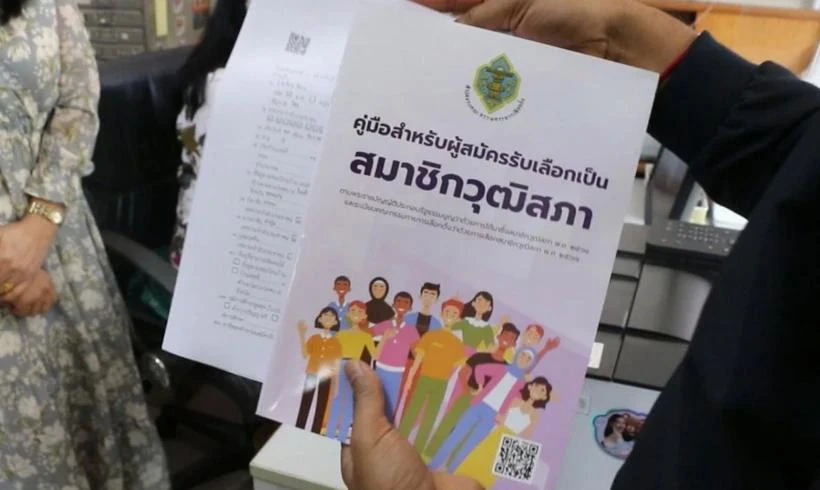
An official gives a senator candidate handbook and an application form to a woman applying for the senate election at Khon Kaen's registration office in Muang district on May 10. (Photo: Bangkokpost.com)

Bangkok (VNA) – The Election Commission (EC) of Thailand announced on May 13 that the application period for candidates to run in the next Senate election has been set for May 20-24.

The Senate election process started after the five-year tenure of the 250 senators installed by the National Council for Peace and Order (NCPO) ended on May 10.

According to Thailand's 2017 charter, the new Senate will comprise 200 members from 20 professions who will not be directly elected by the public. The applicants will vote in three stages, starting with intra-professional groups and then inter-groups at the district level.

From May 11, candidates can get the forms and documents to fill out to introduce themselves and certify their knowledge and experience to run in the election at Bangkok's district offices and provincial registration offices nationwide between 8.30 am and 4.30 pm every day.

Candidates are only allowed to introduce themselves to other candidates with A4-sized posters and are not allowed to make it public. Candidates are also not allowed to give media interviews.

Successful applicants from various professions who emerge from the district-level polls will go on to cast inter-group votes at the provincial and national levels.

The intra-elections at the district level will take place on June 9, followed by inter-elections at the provincial level on June 16. The final inter-group election at the national level will be held on June 26.

The election results will be announced on July 2.

Unlike the outgoing Senate, the new one will not be allowed to co-elect a prime minister but will retain their power to scrutinise the government, and endorse legislative bills and appointments to independent agencies./.

VNA

See more

The opening ceremony of the 48th ASEAN Summit in Cebu, the Philippines, on May 8, 2026 (Photo: VNA)

ASEAN enhances fight against cybercrime, online scams

In a statement issued by the ASEAN Chair on May 9, the regional bloc welcomed ongoing initiatives aimed at enhancing cross-border cooperation, building cybersecurity capacity, and improving protection and assistance for victims and survivors of online scams.

The newborn pygmy hippopotamus “Nong Moo Daeng” at Nakhon Ratchasima Zoo (Photo: pattayamail.com)

Thailand: Nakhon Ratchasima Zoo debuts newborn pygmy hippo

The name “Nong Moo Daeng” received the highest number of votes among five shortlisted names, securing its place as the calf’s official name. The result indicates strong public engagement and growing interest in wildlife cared for by the national zoo network.

Illustrative image (Photo: straitstimes.com)

Malaysia to tighten EV imports

The Malaysian Ministry of Investment, Trade and Industry issued a circular to car importers with new regulations that effectively increase the minimum retail price of fully imported EVs and also increase the minimum power output for such models.

E-commerce giant Amazon cuts jobs in Singapore

E-commerce giant Amazon cuts jobs in Singapore

The move marks a change in direction for Amazon.sg, which launched in 2019 to provide Singapore customers with a localised storefront offering local currency and payment options, Singapore-specific deals and Prime membership benefits.

Illustrative photo (Photo: freemalaysiatoday.com)

Malaysia maintains growth momentum in first quarter of 2026

BNM said domestic investment activity will be driven by progress in multi-year projects in both the public and private sectors, implementation of new smaller-scale public projects, strong realisation of approved investments, and the continued rollout of national master plans.