A customer shops for goods online using Tiki. (Photo: VNA)
 Hanoi (VNA) - The Government should impose strict punishments on the trade of counterfeit goods on e-commerce platforms, participants said at a conference held in Hanoi on April 18.
Dang Hoang An, Deputy Minister of Industry and Trade, said e-commerce in Vietnam has seen strong growth of 25 to 30 percent a year. In 2018, the growth rate reached 30 percent with total revenue of more than 8 billion USD. In the digital economy, the revenue through e-commerce channels was five times higher than that of average GDP growth.
“However, the issue of fake goods and violations of intellectual property rights has become more common with the spread of online shopping sites,” An said.
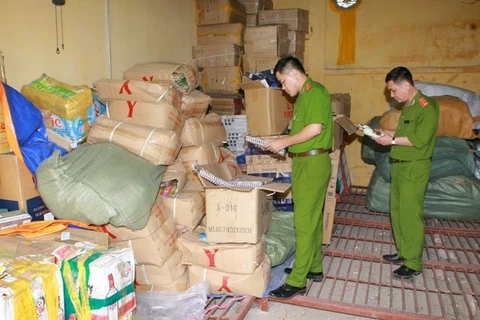
Authorities handled more than 1.2 million violations of fake goods appearing online with total amount of 92 trillion VND since 2015.
He said the Government and the National Steering Committee for Smuggling, Trade Fraud and Counterfeited Goods (National Steering Committee 389) have taken drastic measures in resolving the issue.
However, he said that current shortcomings were partly due to the legal framework. The regulations on administrative punishments in e-commerce (Decree 52) were issued 6 years ago and have not been updated for this new business type. The current regulations require authorities to determine the transaction behaviour and physical money transfer to have a basis for handling. Meanwhile goods sold on the e-commerce market are diversified. It is difficult to control transaction time and identify sellers and buyers as they could use a fake address and name.
“If the legal framework is not updated with stronger punishments, the issue cannot be resolved, causing State budget losses and affecting customers,” he added.
Sharing the ideas, Tran Huu Linh, director of Vietnam Directorate of Market Surveillance, said e-commerce has become a place to buy fake goods.
E-commerce websites or social networks are only intermediaries between buyers and sellers. All products from cosmetics, functional foods, clothing to even prohibited items such as weapons are sold on the platforms.
Moreover, most delivery firms do not have invoices and they become transport firms for fake goods. Especially with e-payment, it is very difficult for authorities to find sellers and buyers because of bank regulations. Meanwhile, e-commerce floors do not have effective tools to control the process.
“We are facing difficulties in inspection and supervision of e-commerce activities. The supervision should have co-ordination among different agencies such as information and technology, customs and tax,” Linh said.
He also suggested completing legal regulations relating to fake goods and intellectual property violations online.
Nguyen Huu Tuan, head of the e-commerce management division of MoIT’s Vietnam eCommerce and Digital Economy Agency proposed stipulating responsibilities for e-commerce websites to prevent counterfeit goods.
The agency would pay more attention to review and classify e-commerce websites to better manage the market. “We would build a system to receive complaints online and send them to authorities for handling as well as providing warnings to customers,” he said.
Nguyen Nhu Quynh, Deputy Chief Inspector of the Ministry of Science and Technology agreed, saying that the perception of enterprises should be changed.
“Enterprises have to understand that doing business in infringing intellectual property on websites is a violation of the law. They would be held responsible for the domain name if authorities determine the behaviour,” Quynh said.
At the meeting, five big e-commerce platforms - Adayroi.com, Lazada.vn, Sendo.vn, Shopee.vn and Tiki.vn - signed an agreement to prevent counterfeit goods on their platforms.
Accordingly, they would take responsibility in preventing counterfeit goods and committed not to sell fake goods towards the sustainable development of e-commerce.-VNA