U.S. Treasury Secretary Steven T. Mnuchin shakes hands with Chinese Minister of Commerce Zhong Shan in Shanghai in July. (Photo: AFP/VNA)
 Hanoi (VNA) - Below is a recap of ten of the year’s most consequential headlines impacting consumers, investors and financial markets worldwide chosen by the Vietnam News Agency.
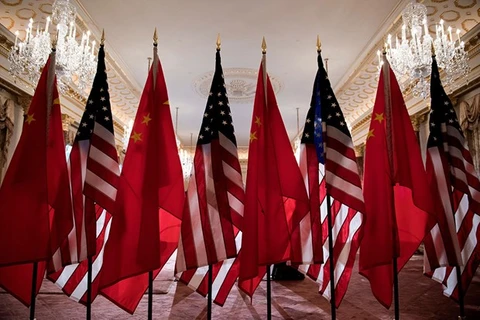
US – China trade war cools down
The US and China announced on December 13 they had reached agreement on their phase-one trade deal, a major development in the 18-month trade war. Accordingly, the US decided to suspend import taxes that were set to take effect on December 15 covering 160 billion USD worth of Chinese products. Trump also agreed to halve its 15-percent tariff on 120 billion USD worth of Chinese imports. In exchange for tariff relief, China committed to increasing its purchases of US farm goods.
US – China trade tensions have caused volatility on stock markets for months, and pushed the global economy closer to a severe slowdown.
FED cuts interest rate for first time in 11 years
The Federal Reserve (FED) lowered the benchmark Federal Funds rate by 0.25 percentage points on July 31 to stimulate economic growth in the first reduction since the financial crisis in 2008. The FED continued to cut its interest rate in September and October and then kept the interest rates unchanged at between 1.5-1.75 percent until the end of the year helped the US economy maintain stable momentum. The FED’s rate cuts also resulted in higher stock and gold prices and a weaker greenback. Following the FED, many central banks around the world, including the Bank of Japan (BoJ) and European Central Bank (ECB), slashed interest rates further to shore up their economies.
Oil-price shock comes in September
Brent crude oil price jumped 19.5 percent to 71.95 USD per barrel to reach its highest rate since the 1991 Gulf War following drone strikes on two Saudi Arabian oil facilities that removed about 5 percent of global oil supplies. The price of crude oil has risen higher than the end of 2018 as a result of the Organisation of the Petroleum Exporting Countries (OPEC) and allies’ decision to deepen oil output cuts and new progress in the US – China negotiations at the end of 2019.
Chinese yuan breaches key level of 7 to US Dollar
The Chinese yuan weakened below the key level of 7 to the US dollar for the first time in a decade on August 5 following US President Donald Trump’s announcement of a new 10 percent tariff on 300 billion USD worth of Chinese goods from September 1. The US then labelled China a currency manipulator in the context of the escalating trade war between the two nations. Although China said it would not use its currency as a tool to cope with external disturbances such as trade disputes, many countries worried that a trade war could possibly spill into currency. The US had criticised China for creating unfair competition and a trade surplus by devaluating its currency.
Negotiations for RCEP wraps up
The ten member states of the Association of the Southeast Asian Nations (ASEAN) and Australia, China, Japan, New Zealand and the Republic of Korea completed negotiations for the Regional Comprehensive Economic Partnership (RCEP) on November 4. This is an important milestone in the participating countries’ global economic integration process in the context that trade protectionism is hampering globalisation progress. The RCEP is expected to be a new-generation trade agreement, which is more flexible and is able to reflect the modern development of global trade.
Facebook’s Libra plan appears to be in big trouble
Facebook on June 18 announced a plan to issue a digital currency called Libra in mid-2020, cherishing its ambition to shake up the world’s banking system that allows cheaper transaction costs and enhances trust. However, the plan faced opposition from central banks and governments who worried the currency could affect global financial-monetary stability. Besides, Libra also challenges the roles of the US dollar while posing challenges to the fight against money laundering, tax invasion and cyber crimes, among others.
Boeing suspends production of 737 Max aircraft
US aircraft manufacturer Boeing announced on December 16 that it would halt production of the 737 Max aircraft from January 2020. The decision comes after aviation authorities grounded the planes following two fatal crashes of Lion Air and Ethiopian Airlines that killed 346 people. 737 Max order cancellations not only affected Boeing’s revenue but also aircraft-part suppliers, airlines and financial institutions globally as well as the US economy.
 A 737 Max aircraft in Washington, the US (Photo: AFP/VNA)
 Giant tech corporations face hefty fines
Facebook Inc in July agreed to pay a record-breaking 5 billion USD fine to resolve a government probe into how the company lost control over massive troves of personal data and mishandled its communications with users in 2018. This is a prime example of the tightened management and investigation of giant tech corporations such as Facebook, Google, Amazon and Apple in the fields of personal data protection and monopoly prevention. In March, the European Commission fined search giant Google 1.69 billion USD for illegally misusing its dominant position in the market for brokering online search adverts. The European Union also opened a formal antitrust investigation to assess whether Amazon’s use of sensitive data from independent retailers who sell on its marketplace is in breach of EU competition rules.
Forest fires cause irreversible damage
Forest fires raged in many parts of the world, from South America, the US to Europe, Asia and Oceania. Fires in the Amazon rainforest – the planet’s ‘green lungs’ - not only devastated the environment and biodiversity but also burned away economic benefits worth some 8.2 billion USD. Meanwhile, bush fires in Australia burnt destroyed 700 houses, at least 3 million hectares of forest, and decimated 20 percent of the country’s forest coverage.
World join hands to fight against plastic waste
Some 180 countries on May 10 agreed to adjust the 1989 Basel Convention in a move to tighten the management of plastic waste trading. The amendment will make the global trade in plastic waste more transparent and better regulated, protecting humans and the environment./.
VNA