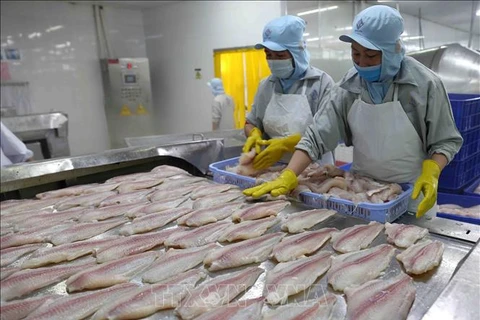
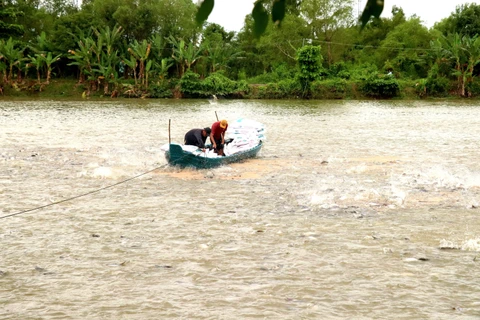
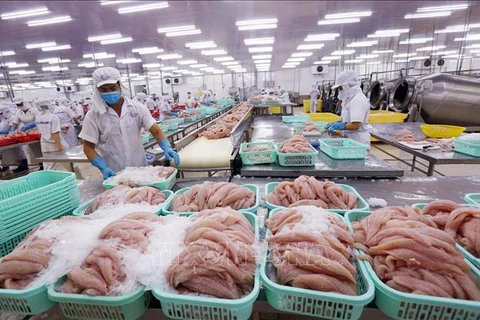
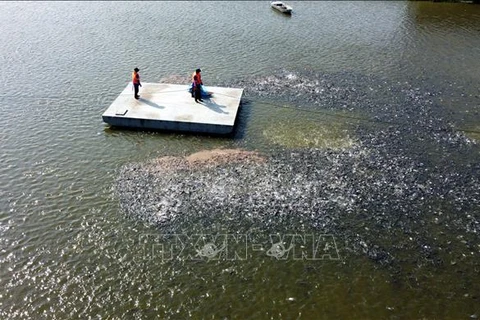
At a tra fish farm in An Giang (Photo: VNA)
 An Giang (VNA) – Vietnam’s tra fish export value is estimated at 1.8 billion USD this year, equal to only 75% of the figure last year, said Deputy Minister of Agriculture and Rural Development Phung Duc Tien.
Speaking at a conference to review the tra fish industry’s performance in 2023 held by the Ministry of Agriculture and Rural Development (MARD) and the An Giang provincial People’s Committee on December 15, Tien said that because of inflation and political instability in the world, Vietnam’s tra fish industry has faced difficulties.
In 2023, the country has about 5,700 ha of tra fish farming and an estimated output of 1.61 million tonnes.
However, tra fish markets are expected to recover, particularly from the second quarter of next year.
It is expected that tra fish production will see a year-on-year increase of 2.8% and the harvested output in the first and second quarters of 2024 will meet demand for processing and export.
Next year, Vietnam targets to achieve a commercial tra fish output of 1.7 million tonnes and an export turnover of 2 billion USD.
To this end, localities in the Mekong Delta, especially An Giang and Dong Thap provinces, and tra fish processing and exporting businesses need to focus on improving the quality of breed. They also need to do research and developing deeply-processed products, diversifying products to meet different market segments, and ready-made products, the deputy minister said.
Tien also emphasised the need to effectively utilise byproducts and waste sludge to produce organic fertiliser.
He urged for strengthened linkage in production to minimize risks, and reduce production costs. Growers were encouraged to make their farming certified to increase the value of their products, and deploy electronic traceability systems from farms, and processing plants to export establishments.
In particular, tra fish production and processing enterprises need to pay attention to expanding the domestic market, targeting canteens in industrial parks and schools while seeking new markets, and implementing certification regulations for products, particularly those for Muslim markets.
At the conference, participants agreed that Vietnam's tra fish industry has declined recently due to political instability and global inflation, causing falling demand for aquacultural products, which resulted in difficulties for exports and large inventories.
In addition, neighbouring countries have increased their tra fish production and reduced their imports from Vietnam.
 Deputy Minister of Agriculture and Rural Development Phung Duc Tien chairs the event. (Photo: VNA)
 Meanwhile, Vietnamese tra fish products are still monotonous, value-added products account for a small proportion, so they have not created great competitiveness and commercial value.
In addition, the breeds, commercial farming, and feed account for 70-80% of the production costs. Some breed production facilities do not strictly control the broodstock during the breed production process and some facilities have not complied with the deadline for using broodstock. Some businesses have yet to pay attention to building trademarks for product lines. Instead, they still prefer to compete with low prices rather than with high-quality products./.