Traditional Tet food offerings to ancestors

During the Lunar New Year (Tet) festival, each ethnic group in Vietnam has its own culinary specialties that reflect the culture of their people and are used as offerings to worship their ancestors.
Traditional Tet food offerings to ancestors ảnh 1Food offerings to ancestors in Hue on Lunar New Year's Day. (Photo: VNA)

Hanoi (VNA) – During the Lunar New Year (Tet) festival, each ethnic group in Vietnam has its own culinary specialties that reflect the culture of their people and are used as offerings to worship their ancestors.

Most Kinh (Vietnamese ethnic majority) people start preparations a month before the festival.

Many people usually cook nine dishes: banh chung (square sticky rice cake), dua hanh (pickled onions), gio nac (boiled lean pork sausage) and gio thu (boiled pork head sausage), thit dong (frozen meat), nem ran (spring rolls), canh mang (bamboo shoot soup), canh bong tha (dried pig skin soup), boiled chicken, and che kho (sweet green bean paste).

These carefully cooked traditional dishes are put on the home altar to worship their ancestors during Tet festival.

Of all the dishes, banh chung is the soul of Tet, reflecting the quintessence of heaven and earth through the skilled hands of humans. To make the cake, the most fragrant and fibrous sticky rice are chosen and the cakes often have pork, green beans, dried onions and pepper in the centre.

The cakes are often eaten with pickled onion because its sour and light peppery flavour helps digestion. Meanwhile, gio nac and gio thu have remained on the offering food tray at Tet from the past to the present.

Nem (spring rolls) is a popular dish in the north that always has a place on a Tet food tray because it is so flavourful and healthy. It is made out of minced pork, carrots, wood ear fungus, green-bean sprouts, bean glass noodles and other ingredients. The fried rolls are then dipped into a bowl of sauce of mixed fish sauce, sugar, lemon or vinegar, chili and minced garlic.

The Tet food tray of northerners never lacks a big bowl of canh mang kho (dried bamboo shoot soup).

Ethnic groups, such as the Mong, Thai, Muong, Tay, Nung, Dao, and Co Tu, have their own New Year dishes. 

For the Mong, their Tet tray should include dishes such as pork, wine, round cakes made from glutinous rice and maize cakes.

Fried fish is the specific dish of the Thai. They believe the stream deity will protect them from danger.

The Nung group often made banh khao from dried glutinous rice powder, minced pork fat and sugar to worship their ancestors. The elderly said the sweet fat in the cake would prevent unlucky happenings in the New Year.

Meanwhile, the Co Tu in Tay Nguyen (the Central Highlands) make their own wine known as ruou Ta Vat and ruou can to welcome Tet. All visitors at New Year are invited to enjoy these wines.

Each Dao household has its own thit lon chua (sour pork), locally known as o sui, in New Year holidays. Ingredients include pork, salt, and cool rice. The dish should be eaten with la lot (wild lolot leaves) and la prang lau (a kind of wild leaf), and dipped in a bowl of mixed lemon and chili. 

The Tay welcome Lunar New Year with a roast piglet. They often choose local piglets with small bones, firm and lean meat weighing from 20kg to 30kg. People often put mac mat (a kind of wild leaf and fruit) mixed with spices in the pig’s belly and cover the skin with honey. They then roast it on charcoal for three hours until well done. The food is dipped in a sweet and fragrant sauce gotten from the pig’s belly./.
VNA

See more

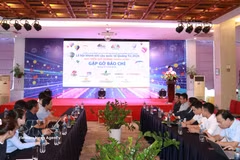
An overview of the press conference on the event (Photo: VNA)

Quang Tri to host International Hot Air Balloon Festival 2026

To be held at Giai phong (Liberation) Square in Quang Tri ward and the Hien Luong-Ben Hai special national relic site, the event will be a highlight of the 2026 Festival for Peace. It will bring together around 70 domestic and international pilots and technicians.

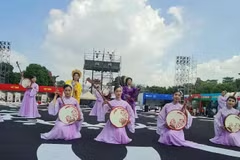
Hanoi will organise a series of cultural activities from November 21-24 to mark Vietnam Culture Day 2026 - Illustrative image (Photo: tapchikinhtetaichinh.vn)

Hanoi to mark Vietnam Culture Day with series of activities

Hanoi will organise a series of cultural activities from November 21-24 to mark Vietnam Culture Day 2026. The activities will take place around Hoan Kiem Lake and at several locations across the capital city, aiming to honour national cultural values and promote community participation in heritage preservation.

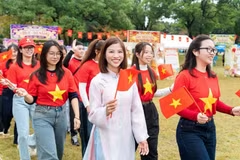
A parade showcasing the solidarity and strength of the Vietnamese community in Japan’s Kyushu region. (Source: qdnd.vn)

Woman suggests inspiring creativity to promote Vietnamese culture in Japan

Vietnamese everyday culture still has considerable untapped potential. For example, introducing Vietnamese cuisine should also convey the stories of family meals, care among family members and the knowledge and skills behind traditional products. Contemporary Vietnamese life should likewise receive greater attention to portray a country that preserves its traditions while constantly evolving and innovating.

Tourists visit Ban Gioc Waterfall in Cao Bang province (Photo: VNA)

Vietnamese, Chinese localities agree to build border marker square

Dam Thuy commune in Vietnam’s Cao Bang province and Daxin county in China’s Guangxi Zhuang Autonomous Region have agreed to jointly build a border marker square in the area encompassing former Markers No. 53, No. 835 and No. 835/1, within the Ban Gioc (Vietnam) – Detian (China) Waterfall Scenic Area.

A procession for the Nhan Tower Buddha relic box (Photo: VNA)

Nghe An puts 1,400-year-old Buddhist relic on display

The national treasure, a pure gold box with intricate patterns, was unearthed in 1986 at the Thap Nhan relic site in Nam Dan, now Kim Lien commune. Bricks found there carry the date “Trinh Quan luc nien,” or 632 AD during the Tang Dynasty, a key clue for dating both the site and the box’s historical context.

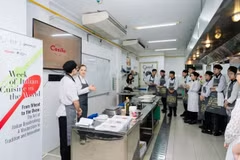
A workshop held at Pegasus International College in collaboration with Molino Casillo as part of Italian Cuisine Week 2025. (Photo courtesy of the organiser)

11th Italian Cuisine Week underway in Hanoi

Launched in 2016 by Italy’s Ministry of Foreign Affairs and International Cooperation, the Week of Italian Cuisine in the World is an annual global initiative showcasing the country’s culinary excellence and deep cultural roots.

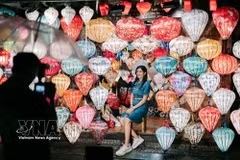
Lanterns, once a traditional handicraft closely associated with Hoi An, have become one of the most recognisable symbols of the heritage destination. (Photo: VNA)

Hoi An International Lantern Festival to promote heritage and cultural exchange

The festival, to be held at Hoai River Square and other venues across the ancient town, is organised by the Da Nang Department of Culture, Sports and Tourism under the direction of the municipal People’s Committee, with the participation of 12 cities from China, Japan, the Republic of Korea, Thailand, Indonesia, the Philippines, Laos and Singapore.

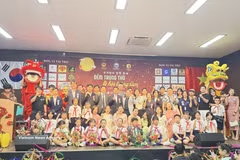
Participants pose for a photo at the 2026 Mid-Autumn Festival for overseas Vietnamese in the Republic of Korea (Photo: vNA)

Vietnamese families, language and community key to preserving national identity abroad

Preserving national identity starts at home, from Vietnamese conversation, stories about grandparents and ancestors, to Lunar New Year (Tet) and Mid-Autumn celebrations and traditional customs. Affection, filial piety, sharing and mutual aid keep members tied to one another and to the homeland, said Le Thuong, Chair of the Vietnamese Association in Japan’s Kansai region and Director of the Centre for Vietnamese Studies.

During the Ok Om Bok Festival, alongside rituals such as floating lanterns and moon worship, the Ngo boat race is always the most eagerly anticipated event among the Khmer community. (Illustrative photo: VNA)

First Vietnam Culture Festival 2026 to take place from November 23-27

Featuring the flow of Vietnamese culture from its origins to the future, the festival will create a vibrant cultural space where the past, present and future converge. It will highlight values shaped over thousands of years of history and demonstrate how these are preserved, passed down and creatively developed in contemporary life.

A performance by Thang Long Water Puppet Theatre. Photo: VNA

Water puppetry: from Vietnamese village ponds to UNESCO recognition

Vietnam is taking steps towards realising its ambition of bringing water puppetry, one of the country's distinctive cultural treasures, to the international stage, following the Government's approval in principle of the preparation of a scientific dossier seeking UNESCO recognition for the art form as an outstanding intangible cultural heritage. This marks a strategic move in preserving and promoting Vietnamese cultural identity amid deeper international integration.