Traditional tuong theatre must be preserved

Vietnam should publish books, video of tuong (classic drama), and host forums, talks, symposiums and shows at schools for students in order to preserve and promote traditional theatre.
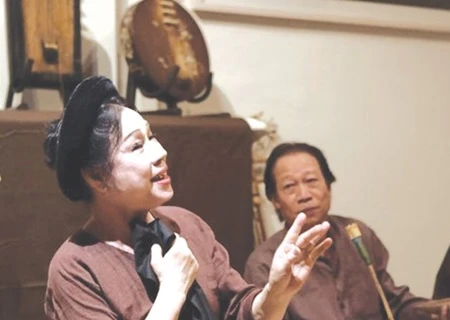
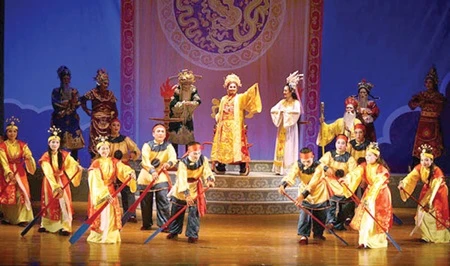
Traditional tuong theatre must be preserved ảnh 1A tuong performance (Source: VNA)

Vietnam should publish books, video of tuong (classic drama), and host forums, talks, symposiums and shows at schools for students in order to preserve and promote traditional theatre that has existed for thousands of years, said Chua Soo Pong, a researcher of traditional art performance from Singapore and member of International Theatre Institute, in a talk with Vietnamese artists in Da Nang.

Chua, who was an invitee to the performance of 23 traditional operas of noted author Tong Phuoc Pho last month, said the young generation should be educated and learn about the ancient theatre.

"Bring students to performances. Students at junior secondary schools should learn and be educated about the ancient theatre," Chua said.

"Authors should write short plays and adopt stories that young audience are familiar with such as Cinderella, Snow White or short stories in line with contemporary society stories," he said.

"Students at junior secondary schools can learn some easy gestures of tuong within 25 minutes. Do not give them a too long or complicated course of tuong at school," he suggested.

He said artists from Tuong Theatre should come to schools and demonstrate for students and let them repeat the gestures.

Chua, who was born in Jakarta and grew up in Singapore, said many countries in Asia have revived ancient theatre including Malaysia with mak yong; Indonesia with wayang wong; and khon in Thailand.

He said mak yong, an old theatre art in Malaysia from 300 years ago, was not seen much since 1970s when people found it boring and too long (around 12 hours per performance).

However, the play was re-written with shorter and new stories including A Midsummer Night's Dream of William Shakespeare, Chua said, adding that the art was recognised as an intangible heritage by UNESCO in 2003.

In Indonesia, students in age groups of 6 to 18 were educated with wayang wong theatre from 900 years ago.

In Thailand, students could do khon, a 400-year-old performance, after 12 days study at school. Fourteen schools in Thailand included the performance in curriculum and the plays were performed in the street for all people.

Chua said tuong in Vietnam had a longer history in comparison to other theatres in Southeast Asian region, and it's a really beautiful performance.

"Tuong writers should make a short performance for children at school. They (students) need quick and short time study with tuong, maybe 30 minutes a week," he suggested.

"They may learn one or two gestures from tuong artists in the classroom. They can learn the art from video clips, internet and read books. We should organise public shows for them and invite friends, parents and relatives to the show," he said, adding that the students' performance could play abroad as a worldwide promotion and introduction.

He said it's a way to promote cultural heritage through traditional theatre as it relates to language, history, dance and music.

Chua said most of the theatrical arts in the region are similar, but tuong is extraordinary.

"I came to Vietnam in 1993 and had studied for a long time kabuki, a theatre in Japan, Chinese Opera and other theatrical performance in ASEAN countries. But I found that tuong's movement is very beautiful with strong gestures, singing, music, and drums that keep time with singing," Chua said.

"You should preserve the ancient art by educating the young generation approaching tuong with street performance and children's shows in public."

Da Nang has been the first city in Vietnam demonstrating tuong performance at public stage for local people and tourists on Sundays.

Audiences can have a chance to explore characters' costumes, make-up and the history of tuong or even learn a bit of the gestures.

The city's Nguyen Hien Dinh Theatre is a destination to tourists with two performances a week.

Last month, tuong Xu Quang (Quang Nam's classic drama) was recognised as part of the National Intangible Heritage.

The city has preserved a collection of 204 classical tuong scripts, written in Han Chinese and Vietnamese ideographic characters (Nom), and published between 1802 and 1845.-VNA
VNA

See more

Delegates at the launch ceremony of the photography contest “Global Eyes on Da Nang” at APEC Park on September 10 (Photo: VNA.)

Photo contest highlights Da Nang through international eyes

Speaking at the launch ceremony, Nguyen Thi Anh Thi, Vice Chairwoman of the municipal People’s Committee and head of the contest’s organising committee, said the competition aims to showcase diverse perspectives from the foreign community, diplomatic missions, international organisations, press agencies, professional and amateur photographers, and visitors.

The Vietnamese delegation attends the 46th session of the World Heritage Committee in July 2024. (Photo: VNA)

Hanoi to host Asia-Pacific dialogue on heritage, authenticity

The event aims to provide an international scientific forum for further research, exchanges and discussions on authenticity in world heritage conservation, in close connection with the outstanding universal value, integrity and cultural values of heritage elements.

Materials on President Ho Chi Minh are on display as part of the series of events honouring President Ho Chi Minh in Kunming, China (Photo published by VNA)

President Ho Chi Minh relic site opens exhibition in China marking 76 years of diplomatic ties

The centerpiece exhibition features more than 100 documents, materials and photos, some made public for the first time. It highlights President Ho Chi Minh’s life, career and revolutionary activities in China and his close ties with Chinese revolutionaries, intellectuals and people, underscoring the formation, cultivation and continuation of Vietnam-China friendship across periods.

Deputy Prime Minister Pham Thi Thanh Tra delivers a speech at the ceremony in Hanoi on September 9 to see off the Vietnamese sports delegation to the 20th Asian Games (ASIAD 20) in Japan. (Photo: VNA)

Vietnamese sports delegation leaves for ASIAD 20 in Japan

The Vietnamese delegation comprises 496 members, including athletes, coaches, experts, officials, doctors and medical staff. The teams will depart in several groups depending on their competition schedules, with the largest group expected to leave on September 16. The squad has set a target of winning at least four gold medals at ASIAD 20.

A performance by the Ruby’s Dance Crew at a celebration of Vietnam's National Day in Hong Kong (Photo: VNA)

Artist helps Vietnamese culture shine in Hong Kong

Teaching traditional dance and songs to children growing up overseas has never been easy. Differences in living environments and ways of thinking, together with pronunciation influenced by the local language, mean that the children need more time to grasp rhythms and pronounce Vietnamese correctly.

A musical performance at the Vietnamese Cultural Festival in Asahikawa, Hokkaido (Photo: VNA)

Vietnamese Cultural Festival brings people together in Japan

Over the two days, the festival featured a range of cultural, artistic and community activities, including a Japanese speech contest for Vietnamese participants, quizzes on Japanese law, culture and history, a Japanese karaoke contest, art performances and Yosakoi exchanges.

Vietnamese Consul General in Perth Pham Hai Anh delivers the opening remarks at the festival. (Photo: VNA)

Vietnamese Lantern Festival connects cultures in Darwin

This year’s festival showcased the waterways, boats and monkey bridges of the Mekong Delta, along with handicrafts made from coconut leaves, bringing the distinctive character of Vietnam’s southern region to life through decorations, interactive activities and artistic performances.

Top 6 contestants of 73rd Miss World pageant (Photo: VNA)

Miss World 2026 promotes Vietnamese culture, tourism

On September 4-5 alone, Khanh Hoa welcomed around 95,000 visitors staying overnight, including approximately 38,000 international visitors, highlighting the event’s considerable appeal and the province’s image as a safe, attractive and welcoming destination.

UNESCO Director-General Khaled El-Enany (Photo published by VNA)

UNESCO, countries welcome Vietnam-led cultural initiative

UNESCO Director-General Khaled El-Enany hailed the UN General Assembly’s proclamation of the International Decade of Culture for Sustainable Development (2027–2036), thanking Vietnam for promoting the initiative, as well as all co-sponsoring countries, members of the core group and the Group of Friends for Culture at the UN for their support.