Unique features of Gau Tao Festival of Mong people in Hoang Su Phi

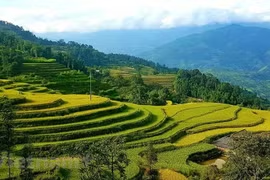
Gau Tao Festival is one of the most important festivals of the Mong ethnic minority people in Ta Su Choong commune in Hoang Su Phi district of the northernmost province of Ha Giang. It is held annually in September when paddy fields turn golden ripe, a highlight to attract tourists to the locality.
Unique features of Gau Tao Festival of Mong people in Hoang Su Phi ảnh 1Men of the Mong ethnic group show a khen (panpipe) performamce. (Photo: VNA)

Hanoi (VNA) - Gau Tao Festival is one of the most important festivals of the Mong ethnic minority people in Ta Su Choong commune in Hoang Su Phi district of the northernmost province of Ha Giang. It is held annually in September when paddy fields turn golden ripe, a highlight to attract tourists to the locality.

The Mong people account for nearly 23% of Ha Giang province’s population, residing mainly in the mountainous districts of Quan Ba, Yen Minh, Dong Van and Meo Vac.

The Mong group has an abundant and diverse spiritual life, creating a cultural tradition with unique features.

The Gau Tao festival originated from an old custom of the Mong ethnic minority people in Sa Pa. When a couple couldn’t have a child after years of marriage, the husband climbed up a hill, made offerings to the god of the mountain and begged for his support to have a child. After the couple gave birth to a child, they invited relatives and villagers to a big ceremony to thank the god for his support. This ceremony was held again by the family every three or five years. The ceremony gradually became a community festival held annually to pray for peace, prosperity, and good luck for the whole village.

The festival is held to pray for good weather and abundant crops. It also provides a chance for the elders to gather and wish each other longevity and bless their descendants with luck and health; and for girls and boys to make a date and pray for happiness all year around.

It is also an occasion for Mong people who live, work or study far from home to reunite with their families and welcome the New Year before enter a new cultivation and livestock breeding season.

The Gau Tao festival is usually organised between the first day and the 15th day of the first lunar month.

However, tourists can join the festive atmosphere of the Gau Tao Festival in September in the mountainous district of Hoang Su Phi, in western Ha Giang province.

Hoang Duc Tan, Vice Chairman of the People’s Committee of Hoang Su Phi district, said the Gau Tao Festival of the Mong group in Ta Su Choong commune is held as a highlight to attract visitors to Hoang Su Phi.

They organise the festival in early September as the rice fields turn golden brown, opening up the tourism programme named “Going through heritage areas of Hoang Su Phi terraced paddy fields.”

On the festival day, all activities of the Mong people take place around a Neu tree (bamboo pole) which is set up on flat ground on the mountain. The Mong people believe that the Neu tree serves as a bridge to link them with gods. To prepare for the festival, the villagers select a fine, straight bamboo tree to make a Neu tree and tie two ribbons of black and red linen on its top with the hope of receiving luck.

The ritual part of the festival is quite simple but very solemn. The patriarch of the festival offers incense and goes around the tree six times before about ten people carrying umbrellas also walk around it and sing their traditional songs. Then, boys both dance and perform on pan-pipes and all exchange with each other best wishes.

The festival also has many interesting activities, such as the pan-pipe dance, singing, and swinging which fascinate the locals, especially young people. After participating in folk games, they often separate into small groups to talk with each other or take a stroll together on the hill. At the festival, a lot of traditional foods of the Mong group, like Thang co and Pho chua are sold in small stalls to serve the locals and tourists./.

VNA

See more

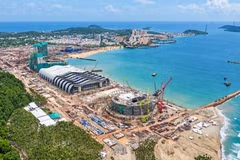
Construction on APEC Phu Quoc Multi-purpose Performance Hall (Photo published by VNA)

APEC 2027: Inside the making of Asia’s landmark theatre

One year in, Sun Group’s APEC Phu Quoc Multi-purpose Performance Hall is taking shape as one of Asia’s largest theatres. It boasts 54,680 sq.m of floor area, 17,250 sq.m of roof, six above-ground floors plus a basement, and 4,030 seats, larger than Hollywood’s Dolby Theatre, the Oscars venue.

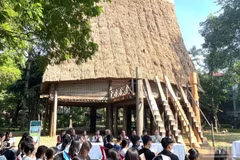
Visitors will enjoy free admission to the Vietnam Museum of Ethnology on Vietnam Culture Day (November 24). (Photo: nhandan.vn)

Free admission to museums, historical sites, national parks on Vietnam Culture Day

Organisations and individuals will be entitled to free admission every year on November 24 to eight museums: the Museum of Oceanography, the Vietnam Museum of Ethnology, the Museum of the Cultures of Vietnam’s Ethnic Groups, the Vietnam National Museum of History, the Vietnam National Fine Arts Museum, the Yersin Museum, the Vietnamese Women's Museum and the Vietnam Military History Museum, as well as the Independence Palace historical site.

Vietnamese Consul General in Perth Pham Hai Anh (Photo published by VNA)

Vietnamese community in Australia seen as bridge for bilateral ties

Vietnamese identity and life in Australia are complementary rather than separate. The more successful overseas Vietnamese became in Australia, the greater their ability to contribute to their homeland and bilateral ties, said Vietnamese Consul General in Perth Pham Hai Anh.

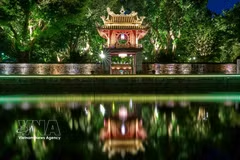
Van Lake within the Temple of Literature (Photo: VNA)

UNESCO Representative: Quoc Tu Giam offers inspiration for new approaches to education

UNESCO Representative to Vietnam Jonathan Wallace Baker said one of the things that stands out in Vietnam is the deep and enduring respect for education, learning and scholarship. Van Mieu –Quoc Tu Giam is a remarkable expression of that tradition, reminding that knowledge, talent and ethical responsibility have long been closely connected in Vietnamese society.

A highlight of the programme is the participation of 950 students in performances staged within the Temple of Literature complex (Photo: VNA)

950 years of Quoc Tu Giam: Continuing Vietnam’s enduring tradition of learning

Through evocative images of students of the Quoc Tu Giam, alongside performances by students and artists, the programme vividly recreated the journey of Vietnam’s scholarly tradition, from the era of the imperial examinations to the spirit of learning in contemporary society. It also helped bring the cultural values of Thang Long-Hanoi to life today.

Students pose for a photo at the ceremony (Photo published by VNA)

Mother tongue connects Vietnamese community in Belarus

Vietnamese language education in Belarus not only helps younger generations take pride in their heritage and better understand and appreciate traditional culture, but also serves as a bridge for promoting Vietnamese culture among international friends.

General Secretary of the Communist Party of Vietnam Central Committee and President To Lam (fourth from left, first row) and his spouse, Ngo Phuong Ly, attend the Vietnam-Japan Friendship Concert in Kanagawa Prefecture on November 10 evening. (Photo: VNA)

Vietnam-Japan Friendship Concert fosters cultural cooperation

In his welcoming remarks, Vietnamese Ambassador to Japan Pham Quang Hieu said the concert brought together talented musicians from the Vietnam National Symphony Orchestra and artists who are current or former members of renowned Japanese orchestras, including the NHK Symphony Orchestra, Tokyo Metropolitan Symphony Orchestra, New Japan Philharmonic and Kanagawa Philharmonic.

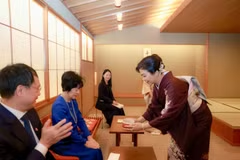
Madame Ngo Phuong Ly offers the first bowl of tea to Akiko Santo, former President of the House of Councillors of Japan. (Photo published by VNA)

Top Vietnamese leader’s spouse experiences traditional Japanese culture

After learning about the history of the tea ceremony, Madame Ly was invited to enjoy traditional sweets and tea, and then to try preparing tea herself. She respectfully offered the first bowl of tea to Akiko Santo, former President of the House of Councillors of Japan and the oldest guest present.

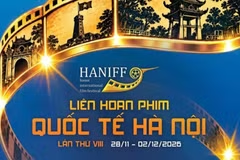
The 8th Hanoi International Film Festival (HANIFF VIII) is scheduled for November 28 to December 2, 2026. (Photo: the organising board)

Hanoi Int’l Film Festival 2026 to connect cinema, heritage, tourism

According to organisers, five public screening venues will be set up in Ba Dinh, Hoan Kiem, Dong Anh, Son Tay and Cau Giay, combining film screenings with art performances and exchanges with audiences. The initiative aims to expand access to films and bring cinematic works closer to local residents.