The person who chairs the ceremony must be a family leader (father or mother) or the one who plays an important role in the local community (an elder villager, village leader, or head of a clan) (Source: VNA)
 It is a ceremony praying for rain in around the fifth lunar month, demonstrating a harmonious behaviour towards the nature. It usually takes place in late summer, when rice plants start to produce ears and maize begins to grow up.
Ha Nhi people earn their living mainly from agriculture, especially rice farming on terraced fields, so they attach great importance to the worship of agricultural deities, especially the god of water - the god of rain.
Unlike “Kho Gia Gia” - a traditional festival that prays for bumper crops, takes place every three years on a large scale, and features many rites worshiping the gods of land, water, forest, and trees, the rainy season festival of Ha Nhi people is held on only one day to worship the god of rain, which is also a typical practice of persons engaging in agriculture.
Luong Van Thiet, a researcher of folk culture from the Vietnam Museum of Ethnology, said the praying-for-rain ceremony traditionally takes place in the hottest month of summer, which is June, since terraced fields need a large volume of water at that time so that rice can ripen.
Ha Nhi people believe that a praying-for-rain ceremony is necessary to have good weather for farming, he said, adding that it shows human’s harmonious behaviour towards the nature.
On the festival day, almost all families get up early to prepare offerings to the god and then bring the items to one of the best rice fields in the village to perform rituals.
 A tray of offerings Ha Nhi people prepare for the praying-for-rain ceremony (Source: VNA)
 The ceremony lasts from the morning, when the sun has already risen, to before noon as Ha Nhi people believe that gods can hear their prayers during this period of time.
After that, each member of the clan eats a bit of the offerings with the hope of gaining good luck.
Many villages of the Ha Nhi ethnic minority in mountainous areas of Dien Bien, Lai Chau, and Lao Cai provinces still maintain their rainy season festival. However, some changes have been made to the festival nowadays.
Thiet said today’s praying-for-rain rituals are not as complex as in the past while participants have also become more diverse and some offerings have also changed. However, the ceremony still has its solemnity maintained and reflects people’s respect for gods.
 Rituals in the rainy season festival are held at different sites to pray for good health and bumper crops (Source: VNA)
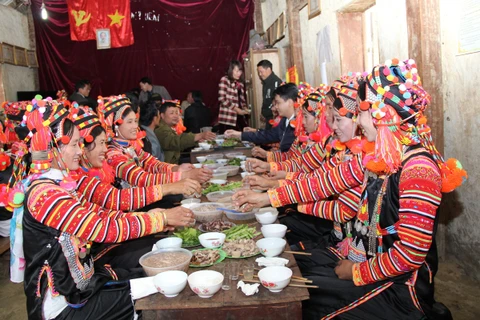
 In particular, the rainy season festival is also an occasion for family reunion. From the afternoon until midnight, villagers visit one another and join parties, helping to strengthen neighbourliness and solidarity in the community.
Nowadays, the festival is held in four days, during which people are off from work and share joy with one another. Rituals are conducted mainly on the first day while festive activities on the following days.
In the last couple of years, due to the COVID-19 pandemic, local people have organised the festival in a shorter period of time and on a smaller scale, with many sports and cultural activities omitted.
With its special features, the rainy season festival - “De Khu Cha” - is a unique custom of the Ha Nhi people, contributing a precious asset to the cultural heritage treasure of Vietnam./.
VNA