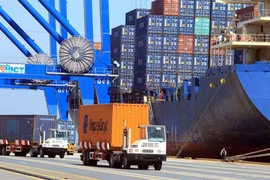
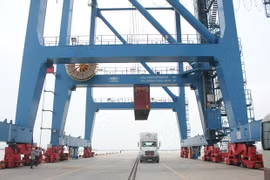
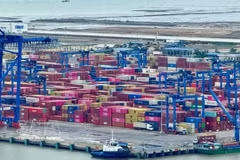
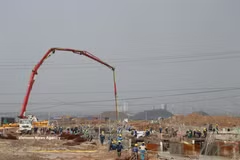
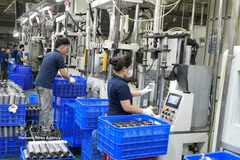
Vietnam’s exports via Hai Phong port (Photo: VNA)
Hanoi (VNA) – Danish enterprises are increasing their investment in Vietnam as the country’s star rises as a key hub for tech manufacturing in the region.
According to the article “What’s luring Danish companies to Vietnam?” on dw.com, the number of Danish firms injecting capital into Vietnam is double the number of other Northern European companies.
Denmark has emerged as a leading investor in Vietnam after its toy Giant LEGO committed 1 billion USD to build its first factory in the Southeast Asian nation. The plan is to develop the company’s first carbon-neutral plant in a predominantly green industrial zone operated by the Vietnam Singapore Industrial Park Joint Venture Company Limited (VSIP) in Binh Duong province of southern Vietnam.
Since the EU-Vietnam Free Trade Agreement (EVFTA) came into force in August 2020, the EU’s trade and investment in Vietnam has boomed, with trade revenue surging 14.3% to 63.6 billion USD in 2021.
In the first half of this year, import-export revenue between Vietnam and the EU rose 15% year-on-year, while the former’s trade surplus increasing nearly 40%.
Besides becoming an important hub for high-end manufacturing with tech giants like Apple and Samsung announcing an expansion in the country, Vietnam is investing big in renewable energies as part of efforts to realise its net-zero carbon emissions by 2050.
Vietnam has posted the fastest growth of renewable energy production in Southeast Asia.
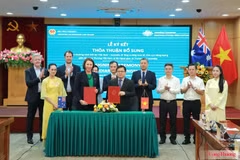
Denmark’s largest energy firm, Orsted, has committed to investing up to 13.6 billion USD into a 3.9-gigawatt wind farm zone in the central provinces of Binh Thuan and Ninh Thuan. Orsted also signed an agreement with PetroVietnam’s subsidiary to cooperate in several renewable energy projects.
Why Vietnam
Head of the trade department at the Danish Embassy in Hanoi Troels Jakobsen said Vietnam and Demark have enjoyed close ties so Vietnam has always been a major investment destination for Danish companies.
He added that more and more firms are working to diversity their supply chain, and “here Vietnam is very high on the shortlist for Danish companies that wish to expand in Asia”.
In early August, the Vietnamese Embassy in Denmark published a Vietnamese-language handbook for businesses about the Scandinavian market. Days later, a Danish agri-food delegation visited Vietnam to boost sectorial ties.
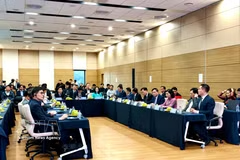
The embassy also organized a forum on Vietnam's digital and green transformation this month, while the Vietnam-Denmark Business Forum took place in Copenhagen on September 5.
Meanwhile, Trinh Nguyen, a senior economist covering Emerging Asia at French corporate and investment bank Natizis, said Vietnam has rapidly climbed the value-added ladder, and is fast becoming a key hub for tech manufacturing.
US tech giant Apple announced that it will begin the manufacture of its Apple Watch and MacBook products in Vietnam. Meanwhile, Samsung from the Republic of Korea has been the largest foreign investors and exporter of Vietnam for a couple of years.
According to a report from the World Bank, Vietnam’s economy has been on strong recovery despite high inflation rate in the world.
Industrial production is recovering well, with the Purchasing Managers’ Index (PMI) escalating from 51.2% in July to 52.7% in August
Energy is the key
According to the article, Danish firms attraction to Vietnam is the country’s drive towards renewable energy.
Lina Hansen, Denmark's state secretary for trade and global sustainability, noted that energy is a key determining factor for investment in Vietnam.
Vietnam is currently among the world's top ten producers of solar power, generating more than 11% of its electricity needs from solar. With a 3,260-kilometer coastline, it is also investing heavily in wind power.
 Danish firms attraction to Vietnam is the country’s drive towards renewable energy. (Photo: VNA)
Presently, Vietnam has solar and wind capacity of around 16.6 GW and 0.6 GW, respectively, but the government wants to increase their joint capacity to 20GW by 2030.
Sebastian Hald Buhl, country manager of Orsted, said that Vietnam has world-class natural advantages for offshore wind.
“With 3,000 kilometers of coastline, shallow water depths and high consistent wind speeds, Vietnam offers excellent conditions to develop reliable and cost competitive offshore wind projects”./.