Hanoi (VNA) – This year marks the 25th anniversary of the Vietnam-China land border treaty and 15 years since the signing of three legal documents on the land border between the two countries.
The three legal documents are the protocol on border demarcation and marker planting, the agreement on border management regulations, and the other on border gates and regulations on the management of border gates.
This historic achievements have laid the legal and political foundation for the two countries to maintain a peaceful and stable environment for economic development, ensuring security and defence, and meeting the aspirations of their people.
With the aim of establishing a clear border between the two countries, from 1974 to 1979, they conducted negotiations on border and territorial issues three times, yet failed to achieve results due to differences in their stances and opinions.
After normalising their relations, since October 1992, the two sides had negotiated for the fourth time. In October 1993, they reached the agreement on the basic principles on the settlement of border and territorial issues, and agreed to take the 1887 and 1895 Franco-Qing Conventions and other documents and maps on border demarcation and marker planting as a basis for redefining the Vietnam-China border.
On December 30, 1999 in Hanoi, the Vietnam-China land border treaty (referred to as the 1999 treaty) was signed, laying an important foundation for building a border of peace, friendship and long-term stability between the two countries.
However, the treaty only defined the border in writing and on maps. In order to clearly define the border, the two sides need to demarcate and plant markers, translating the border in the treaty and on maps into the one on the ground.
By the end of 2008, the border demarcation and marker planting work had been basically completed, with the exact border length of 1,449.566 km, with 1,970 markers installed, including 1,548 main and 422 auxiliary ones.
The two countries share a border line running through the seven provinces of Dien Bien, Lai Chau, Lao Cai, Ha Giang, Cao Bang, Lang Son and Quang Ninh of Vietnam, and Yunnan province and the Guangxi Zhuang Autonomous Region of China.
After completing border demarcation and marker planting, in order to cooperate in protecting and managing the border, representatives of the two governments signed the three legal documents in Beijing (China) in 2009.
On July 14, 2010, the documents began to take effect, and the two countries have officially managed the land border in line with them since then.
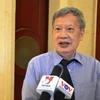
Dr. Tran Cong Truc, former head of the Government Border Committee, who once directly participated in the border negotiations, said Vietnam and China have resolved border and territorial issues through peaceful negotiations and in accordance with the principles of international law, and international treaties or practices, for the legitimate rights and interests of each side, to jointly handle disagreements and disputes in line with the reached legal principles.
"It can be said that this achievement is a valuable contribution to international practice, and an inseparable part of the Public International Law, to resolve national border and territorial disputes", Truc said.
Associate Professor, Dr. Nguyen Hong Thao, former Vice Chairman of the National Border Committee under the Ministry of Foreign Affairs, said the completion of the land border demarcation and marker planting vividly demonstrates the comprehensive strategic cooperative partnership between Vietnam and China, positively contributing to peace, stability and development in the region.
Over the past 25 years, the two countries have made tireless efforts to maintain a peaceful and stable border, contributing to promoting cooperation and maintaining the positive development momentum of the bilateral relations.
They have also proven that the 1999 Treaty, the completion of the border demarcation and marker planting, and the implementation of the three legal documents were a success of great historical significance, opening up a new page in the relationship between the two countries.
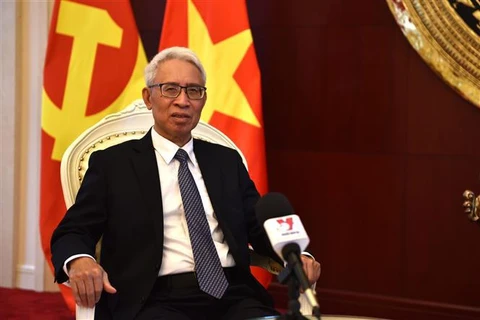
In an interview granted to the press on August 15, Chinese Ambassador to Vietnam Xiong Bo said with the effective implementation of the treaty, people of both nations living along the shared borderline have stabilised their lives, coexisted harmoniously and had close bonds.
The China-Vietnam border has become one of the world’s most peaceful, stable, and harmonious border areas, with vibrant trade exchanges and people-to-people interactions, said Xiong.
The diplomat recalled then Party General Secretary Nguyen Phu Trong’s trip to the Huu Nghi (Friendship) - Youyi Guan international border gate in August 2023, during which the leader stressed that in the world, there is only one border area here where the border gate is named with the two words “Huu Nghi”, making it unique globally. This vividly reflects the friendly exchanges at the border area between the two countries, he said, adding that it is a peaceful and secure border area that both countries can truly be proud of.
According to a report of the National Border Committee, over the past years, the peaceful and stable border has contributed to promoting cooperation and development in the border area, as well as border trade.
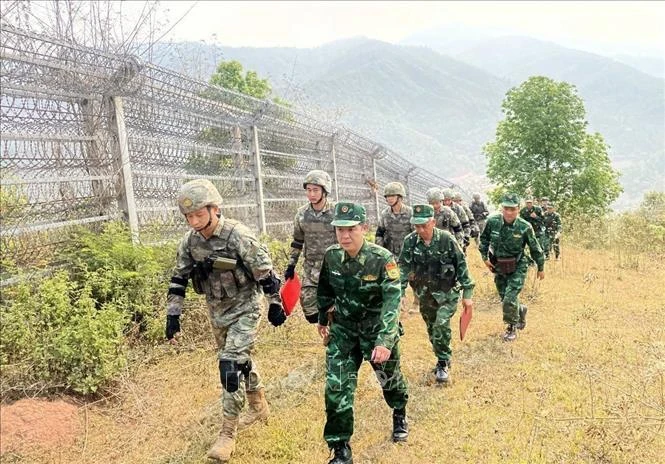
Friendly exchange activities between border management forces of the two countries have been carried out actively. Defence, border guard and people-to-people diplomacy has been enhanced with diverse forms and rich contents. Since 2010, there have been eight border defence friendship exchanges, and three friendship border exchanges.
At the local level, 67 pairs of border residential areas have set up twinning relationships, while local cooperation mechanisms have been organised periodically and flexibly.
Le Hoai Trung, Secretary of the Communist Party of Vietnam Central Committee and head of its Commission for External Relations, said he believes that with such achievements, the two countries will work together to create major directions and changes, turning the peaceful and stable border into the one of cooperation and solid development, taking into account current trends in the region and the world today.
“We will continue to actively coordinate with the Chinese side to make greater efforts, contributing to building the Vietnam - China land border into the one of peace, stability and friendship, cooperation and development, spurring socio-economic development, for peace, prosperity and happiness of the two countries’ people, especially border residents,” he said./.