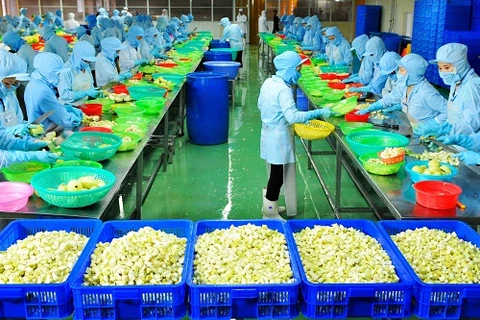
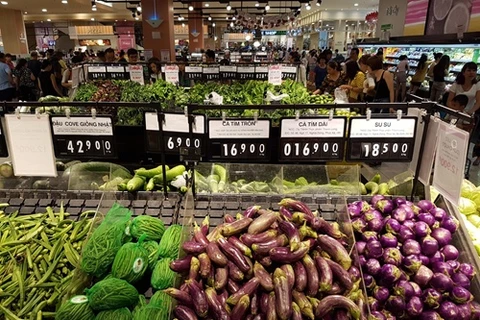
Vietnam’s exporters have promoted vegetable and fruit exports to both traditional and new markets (Photo: cafef.vn)
 Hanoi (VNA) – The export value of domestic fruits and vegetables is expected to reach 2.5 billion USD this year, surpassing the value of rice exports for the first time, the Ministry of Agriculture and Rural Development (MARD) announced.
The Ministry said the vegetable and fruit industry grew from exporting 235 million USD to 36 markets in 2005 to exporting 1.8 billion USD to 60 markets in 2015.
The export value in 2015 reached a record high 1.8 billion USD, 123 per cent higher than in 2014.
Vietnam’s exporters have promoted vegetable and fruit exports to both traditional and new markets, including markets with strict rules, such as the US, European Union (EU), Japan, the Republic of Korea, Canada, Australia and New Zealand.
Fruit producers in the Mekong Delta region are now producing fruit products using good agricultural practices (GAP) to meet export market requirements, the Ministry said.
Many production models have been implemented and certified for rambutan and green-skin pomelo in Ben Tre Province, Nam Roi pomelo in Vinh Long Province, Vinh Kim star-apple, Hoa Loc mango and pineapple in Tien Giang Province and mango in Dong Thap Province, VietGAP and GlobalGAP said.
Vietnam has emphasized rice exports for many years. But fruit exports are in demand on the world market, so the nation should promote fruit exports in the future, Deputy Minister of Agriculture and Rural Development Le Quoc Doanh said.
The Mekong Delta region has had a total annual output of 3.18 million tonnes of fruits for local consumption and export, the ministry reported. Key fruit products include dragon fruit, mango, rambutan, durian, star apple, pomelo, longan, orange and tangerine mainly from Tien Giang, Vinh Long, Soc Trang, Ben Tre, Dong Thap and Hau Giang provinces.
Since 2000, farmers in the region have applied modern science and technology to produce fruit products, increase output, improve quality and establish regions specialising in fruit production.
But Vietnam’s fruit products still face many technical barriers in export markets, an official of MARD’s Plant Protection Department said.
Hoang Trung, head of the department, said countries have different climates resulting in different plant structures. So a generalized plant quarantine protocol is not possible.
There are also technical barriers to import safe vegetable and fruit products and to protect local production, Trung said. Reducing tariffs during international integration increased technical barriers for quarantine and food safety.
It also takes an average of 3-4 years, or up to 10 years, for each kind of fruit to be approved for an import licence to just one country, Trung said.
The quality and safety of fresh fruit remain challenges for vegetable and fruit exporting, especially in strict markets such as the US, Japan, Australia and New Zealand. Production of vegetable and fruit products for export must meet VietGAP and Global GAP standards.
Quality control is vital to increase fruit and vegetable exports, Trung said. Vegetable and fruit producers should also follow import regulations closely to create favourable conditions for local vegetable and fruit products to enter export markets.-VNA