Vietnam, Japan cooperate in cartography

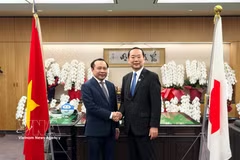
The Vietnam Department of Survey and Mapping (VDSM) and the Geospatial Information Authority of Japan (GSI) exchanged a Memorandum of Understanding (MoU) on March 11 in Hanoi to commit to collaborative efforts.
The Vietnam Department of Survey and Mapping (VDSM) and the GeospatialInformation Authority of Japan (GSI) exchanged a Memorandum ofUnderstanding (MoU) on March 11 in Hanoi to commit to collaborativeefforts.

Speaking at the ceremony, DeputyMinister of Natural Resources and Environment Nguyen Linh Ngochighlighted the long history of cooperation between Vietnam and Japan invarious fields, including natural resources and environmental issues.

Pledging to create conducive conditions, Ngocexpressed his hope that it will pave the way for beneficial experienceexchange in cartography as well as tighter partnerships between the twonations.

The VDSM and GSI have worked closely and produced positive outcomes in recent years, said VDSM Director Phan Duc Hieu.

Since 2010, the GSI has been supporting the VDSM in professionaltraining for personnel, enabling Vietnam to take part in thefinalisation of Global Map Version 1 and 2 by the United NationsCartographic Section, he added.

For his part,GSI Deputy Director-General Masaki Murakami stressed Japan’s willingnessto share experience and information with Vietnam and expressed hisconfidence in the bright future of their bilateral cooperation.

Both sides agreed to focus on establishing a legal framework forcartography and a geospatial database, developing fundamentalinfrastructures for surveying services and the Global NavigationSatellite System (GNSS), building the National Spatial DataInfrastructure (NSDI) and using geospatial information to reduce theimpact of natural disasters.-VNA
See more

Associate Professor Dang Duc Huy (left) poses for a photo with Canadian Governor General Louise Arbour. (Photo: VNA)

Overseas Vietnamese intellectuals drive innovation

Overseas Vietnamese scientists do not have to return to Vietnam for long-term work to make an impact. They can contribute by joining collaborative research teams, sharing analytical techniques, facilitating access to modern equipment, and linking Vietnam with international labs and universities.

The Better Choice Awards 2026 Gala is a key activity in response to the National Innovation Day 2026 (Photo: qdnd.vn)

Better Choice Awards 2026 honours innovative Vietnamese businesses, tech products

The fourth edition of the awards featured a complete restructuring into four award tracks: Innovative Choice Awards, Smart Choice Awards, Car Choice Awards and the newly introduced Nation Builders Awards. The latter honours businesses contributing to national development by building infrastructure, energy systems and technological capacity for the national economy.

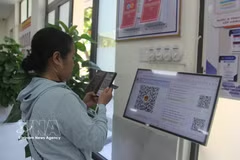
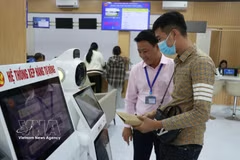
A resident scans a QR code to get a queue number at the public administrative service centre in Hoa Xuan ward, Da Nang city (Photo: VNA)

Localities apply AI, data to drive practical digital transformation

In the central province of Quang Tri, an AI-powered “People’s Assistant” is being piloted from October 1 to 31 at the provincial Public Administration Service Centre and the centres of this kind in Dong Thuan and Dong Ha wards. The system provides information on procedures, required documents, forms and fees, while also supporting declaration and preliminary checks.

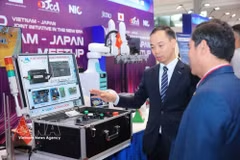
Science, technology and innovation products on display. (Photo: VNA)

Businesses must be at heart of innovation: Deputy PM

“Businesses must be placed at the centre of this process,” he said, noting that enterprises understand market demand, formulate practical requirements, invest resources, adopt and master technologies, organise production and bring products to consumers.

The Vietnamese Ministry of Public Security's delegation holds a discussion with representatives of the WIPO's Advisory Committee on Enforcement. (Photo: VNA)

WIPO innovation report viewed through Resolution 57 perspective

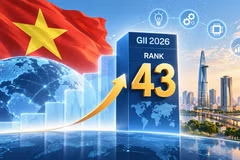
He said the GII 2026 results should be viewed in the broader context of Vietnam’s implementation of Resolution No. 57-NQ/TW, which identifies science and technology, innovation and national digital transformation as key breakthroughs and major drivers for developing modern productive forces and enhancing economic competitiveness.

Minister of Science and Technology Vu Hai Quan (left) meets with Japanese Minister of Internal Affairs and Communications Fujii Hisayuki (Photo: VNA)

Vietnam, Japan expand cooperation in strategic technology fields

Meeting with Japanese Minister of Education, Culture, Sports, Science and Technology Seki Yoshihiro on October 2, Minister of Science and Technology Vu Hai Quan proposed the Japanese side continue providing postgraduate scholarships, particularly at master's and doctoral levels in strategic technological sectors, facilitate exchanges among students and researchers, and maintain support for the Vietnam Japan University (VJU).

Minister of Science and Technology Vu Hai Quan (second, right) witnesses Director of the Posts and Telecommunications Institute of Technology Dang Hoai Bac presenting the Vietnamese-learning app to representatives of the Vietnamese Embassy in the Republic of Korea. (Photo: VNA)

Vietnamese-learning app presented to community in RoK

The initiative aims to support language learning among children growing up in more than 100,000 Vietnamese-Korean multicultural families, while helping preserve Vietnamese cultural identity and strengthen their ties with their homeland.

Prof. Dr. Nguyen Ngoc Diep (R), Director of the Australia-Vietnam Strategic Technologies Centre, introduces strategic technology products to delegates at the forum. (Photo: VNA)

Strategic technologies expand space for Vietnam - Australia cooperation

Vietnamese Deputy Minister of Science and Technology Tran Trung Tinh said that amid global uncertainties, strategic technologies are becoming a decisive driver of national competitiveness and sustainable development. Vietnam has identified science, technology, innovation and digital transformation as key strategic breakthroughs.

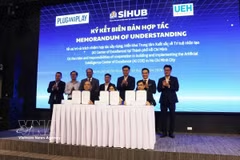
The signing ceremony of an MoU on the roles and responsibilities of cooperation in building and implementing the Artificial Intelligence Centre of Excellence (AI COE) in Ho Chi Minh City (Photo: VNA)

AI Centre of Excellence developed in Ho Chi Minh City

Under the MoU, the AI COE is envisioned as a platform bringing together the State, academia and businesses to promote research, incubation, startup acceleration and the practical application of AI in Ho Chi Minh City.

Vietnam accelerates innovation to boost growth, competitiveness

Vietnam accelerates innovation to boost growth, competitiveness

By 2030, Vietnam aims to rank among the world’s top 40 in the GII; raise total social investment in R&D to at least 2% of GDP, with non-State funding accounting for over 60%; increase international scientific publications by an average of 10% annually; and raise the number of patent applications and granted patents by an average of 16-18% annually.

Vietnamese Minister of Science and Technology Vu Hai Quan (right) and RoK Minister of Trade, Industry and Resources Kim Jung Kwan at their meeting on September 30 (Photo: vnexpress.net)

Vietnam seeks RoK help on nuclear power, AI

The Korean Ministry of Trade, Industry and Resources (MOTIR) was urged to share practical lessons from its nuclear sector with Vietnam, including institutional and policy frameworks governing the roles of policymaking and regulatory agencies, advanced nuclear power technology, experience in building a domestic nuclear supply chain, and long-term workforce training through specialised courses, hands-on work and staff exchanges.