Vietnam-Japan friendship opera to be staged in Tokyo in November

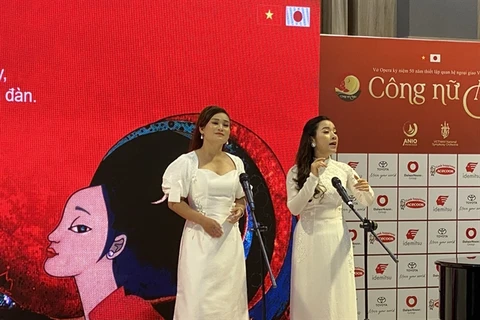
The Princess Anio opera project, which began in 2020 to mark the 50th anniversary of the Vietnam-Japan diplomatic relations, is scheduled to hit the stage at the Showa Women's University in Tokyo on November 4, heard a press conference on July 11.
Vietnam-Japan friendship opera to be staged in Tokyo in November ảnh 1The Princess Anio opera project, which began in 2020 to mark the 50th anniversary of the Vietnam-Japan diplomatic relations, is scheduled to hit the stage in Tokyo on November 4. (Source: anio-opera.com)
Tokyo (VNA) - The Princess Anio opera project,which began in 2020 to mark the 50th anniversary of the Vietnam-Japan diplomaticrelations, is scheduled to hit the stage at the Showa Women's University inTokyo on November 4, heard a press conference on July 11.

The opera is based on a real love story between Japanese merchant Araki Sotaroand Princess Ngoc Hoa (called Princess Anio by Japanese) in Hoi An, Vietnam,during the trading era of the Shuinsen in the early 17th century. Vietnamese singersDao To Loan and Bui Thi Trang (female soprano) play the princess, while two Japanese male tenors, Kobori Yusuke and YamamitoKohei, take the role of her lover.

Addressing the press conference in Tokyo, Vietnamese Ambassador toJapan Pham Quang Hieu said the opera is a perfect combination of Vietnamese andJapanese musical culture and its staging on the anniversary occasion reflectsthe close friendship and people-to-people exchanges between the two nations.

Hieu stressed that closeness and intimacy are a foundationfor strengthening the countries’ bilateral friendship and a premise for furtherdevelopment of their extensive strategic partnership in the future.

Director general of the project Honna Tetsugi, music director and chiefconductor of the Vietnam National Symphony Orchestra, said that the opera usesboth Vietnamese and Japanese.

He emphasised that it is a result of a very hard workprocess./.
VNA

See more

Vietnam’s Consul General in Osaka Nguyen Truong Son speaks at the 9th Vietnam cultural festival in Osaka on April 19, 2026. (Photo: VNA)

Vietnam cultural festival in Osaka draws tens of thousands of attendees

Saito Naoki, Mayor of Ikuno Ward – where the event took place, expressed his pleasure at the rapid growth of the Vietnamese community in the area. He praised such cultural festivals for helping Vietnamese residents maintain their traditions while fostering mutual understanding and closer ties with Japanese locals.

Urawadee Sriphiromya, Thai Ambassador to Vietnam (third from left); Camila Polo Florez, Colombodian Ambassador to Vietnam (C); and Saadi Salama, Ambassador of Palestine to Vietnam (fifth from left), experience indigenous coffee culture in a coffee garden in Dak Lak. (Photo: doanhnghiepkinhtexanh.vn)

World Coffee Heritage Forum: A dialogue connecting coffee culture, knowledge

The recognition of "The knowledge of coffee cultivation and processing in Dak Lak” as a National Intangible Cultural Heritage marks an important milestone. It affirms the value of indigenous knowledge, creative labour, and the harmonious connection between local livelihoods, culture and nature in the Central Highlands.

The artwork "Harvest Day" by Doan Thi Thu Huong. (Photo: cand.com.vn)

Vietnam to join Venice Art Biennale with first national showcase

As Vietnam makes its debut at the Biennale, the exhibition “Vietnam: Art in a Global Flow” does not seek to assert its position through scale or grand statements, but rather opens up a space for meaningful artistic dialogue - an invitation to listen to subtle voices, contemplate in stillness, and reflect on the capacity to nurture sustained creative energy in a dynamic and ever-evolving art world.

Viet Youth Readiness Hub debuts at the event (Photo: VNA)

Vietnamese Canadian youth hub launched to fight mother tongue erosion

The Viet Youth Readiness Hub is seen as a dedicated platform to connect, support, and empower Vietnamese-Canadian youth. It aims to emerge as a central force to host social events, advance heritage education, foster exchange and integration among young Vietnamese in Canada.

At the event “Vietnamese Language in the heart of Kyushu, Japan” (Photo: VNA)

Vietnamese in Japan revive mother tongue among young generations

While the number of Vietnamese-origin children in Japan is surging, opportunities to actually speak Vietnamese in daily life are vanishing fast. Many children can understand the language but default to Japanese in response, gradually relegating their mother tongue to a secondary role, sometimes even treating it as a “second foreign language” inside their own houses.

A tribute to Hung Kings in Ho Chi Minh City (Photo: VNA)

Hung Kings’ Commemoration Day 2026 to spread sacred values, foster national unity

Following the merger of Phu Tho, Vinh Phuc, and Hoa Binh provinces into the new Phu Tho province last year, the Hung Kings Temple Festival has taken on heightened significance. It now serves not only as a tribute to the ancestral homeland but also a unified cultural platform that extends sacred ancestral values to Vietnamese communities at home and abroad.

A traditional art performance at Bach Ma temple in Hanoi (Photo: VNA)

Traditional arts hold untapped economic power

Traditional arts embody deep aesthetic values, worldviews, and national identity, shaping the country’s distinctive “aesthetic identity” and foundational cultural tastes

A performance at the opening ceremony of the Hung Kings Temple Festival and the 2026 Ancestral Land Culture and Tourism Week on late April 17 (Photo: VNA)

Hung Kings Temple Festival, associated tourism week kick off

The annual festival serves as a major national cultural event, offering an opportunity for people across Vietnam and overseas Vietnamese communities to pay tribute to their ancestors, express gratitude, and strengthen the great national solidarity.

A ritual at Hue Nam Temple Festival (Photo: VNA)

Hue Nam Temple Festival: From imperial relic to distinctive cultural celebration in Hue

Historically known as Ngoc Tran Son Tu, the temple was renamed Hue Nam during the reign of King Dong Khanh in the late 19th century, symbolising royal gratitude to the Mother Goddess. It is also the only temple in Hue that harmoniously combines royal ceremonial elements with folk religious practices, creating a distinctive blend of court ritual and popular belief.