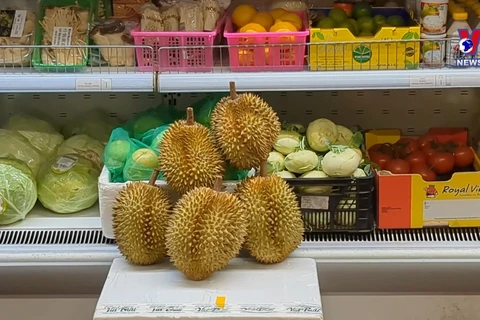
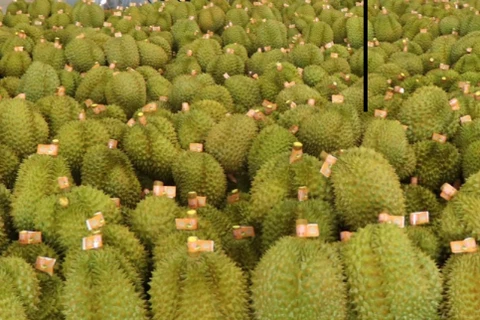
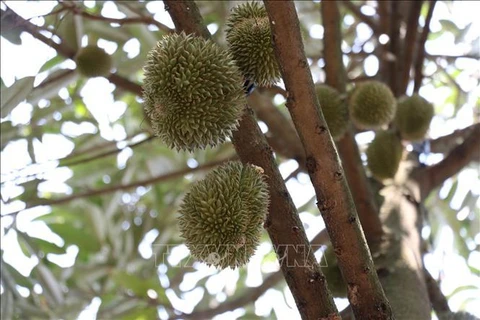
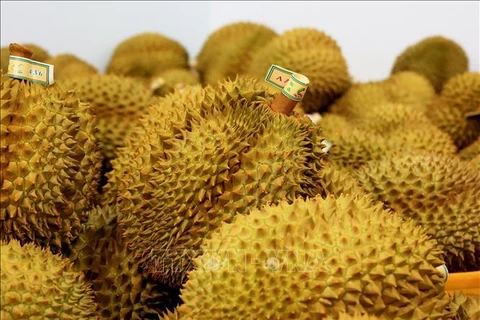
Harvesting durian in Dong Nai province. In the first eight months of 2023, the durian export value reached nearly 1.2 billion USD. (Photo: VNA)
 If the durian industry, as well as other commodities, wants to develop sustainably, they must reorganise the structure from the production stage to consumption, Hoan said.
This means fostering cooperation between enterprises and farmers from the selection of durian varieties for production, rather than just engaging in purchasing activities. They need to transition from a business relationship to a cooperative one.
The minister also suggested that growing areas must register a code to plant durian according to standards. Moreover, it is essential to foster a close connection among businesses, cooperatives, and farmers.
They must understand that sustainable development is not only for durian trees but also for businesses and farmers, as they will participate in the sustainable durian supply chain.
Nguyen Quoc Toan, Director of MARD’s Centre for Digital Transformation and Agricultural Statistics, acknowledged that the durian industry has expanded rapidly in recent years. Therefore, it's crucial to establish a policy framework and appropriate standards for sustainable development.
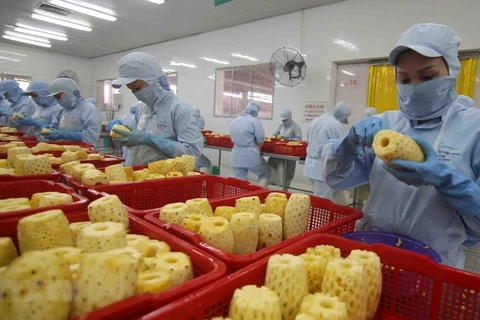
In addition to fresh durian products, the industry needs to develop processed products and also come up with specific plans for the development of durian growing areas nationwide, Toan said.
To achieve sustainable development of the durian industry, several key bottlenecks must be addressed, including rapid growth, unfair competition in purchasing durians, processing infrastructure, quality management, and establishing connections among farmers, traders, and exporters; and the creation of standard processes, according to Toan.
Furthermore, Toan urged localities and enterprises to focus on frozen durian products for export thanks to the potential of these products.
He also recommended expanding business to other markets through new-generation free trade agreements (FTAs). At present, Vietnam is involved in numerous FTAs such as CPTPP, EVFTA, RCEP, as well as significant communities like ASEAN and the Eurasian Economic Union. This provides opportunities for the durian industry to boost exports.
According to Nguyen Thi Thai Thanh, chairwoman of Ban Me Green Farm Joint Stock Company, a major challenge in the durian industry is the lack of consistency in the linkage between production and consumption.
The durian industry lacks a tight bond between cooperatives, farmers, and businesses. Thus, if durian prices soar, farmers might refrain from selling durians to businesses offering lower prices than previously agreed upon. This leads to instability in the industry’s operations. At the same time, cooperatives have not truly maximised their role in the linkage chain, Thanh noted.
Nguyen Hoai Duong, Director of Dak Lak province's Department of Agriculture and Rural Development, said that in the past two years, durian prices have risen following the signing of the protocol on plant quarantine requirements for official durian exports to China between Vietnam and China. This has greatly motivated the growth of the durian industry, substantially raising the income of farmers and the profits of businesses within the durian supply chain.
If the Vietnamese durian industry wants to achieve sustainable production and business, all stakeholders in the value chain must collaborate closely, Duong said. This means that farmers, businesses, localities with growing areas, State management agencies, and scientists should unite in developing the industry.
Nong Ngoc Trung, Chairman of Golden Field Company in Lang Son province which specialises in processing agricultural products for export to China, said that to export Vietnamese durian to China, businesses must cooperate with each other in accessing this market instead of competing on price.
Trung suggested that the Vietnam Durian Association should engage potential businesses to join the production chain and introduce more Vietnamese durians to the global market.
Vu Duc Con, Deputy Director of the Department of Agriculture and Rural Development and Chairman of the Dak Lak Durian Association, proposed that for sustainable durian development, the Ministry of Agriculture and Rural Development should issue decrees and circulars that guide the grant and management of codes for growing areas, as opposed to the current technical documents.
Con highlighted that the export value of Vietnamese durian rose from 29.2 million USD in 2016 to 420 million USD in 2022. In the first eight months of 2023, it reached nearly 1.2 billion USD, which is three times the value for the entirety of 2022.
Exports are projected to reach 1.5 billion USD for the entire year, predominantly comprising fresh and frozen durian, which is 3.5 times the 2022 value. The primary export destinations are China, Japan, and Australia.
As of August 2023, Vietnam boasts 422 coded durian growing areas and 153 coded packaging facilities that meet the export market's requirements.
Specifically, in Dak Lak, durian production has surged between 2016 and 2023, from over 30,000 tonnes to about 190,000 tonnes, growing at roughly 30% annually. Of this, the output from coded growing areas is around 47,300 tonnes, representing 25%. Dak Lak currently has the second-highest durian output nationwide, following Tien Giang.
The Dak Lak Department of Industry and Trade reported that the province's durian exports to the Chinese market in 2022 amounted to about 11.7 million USD.
For 2023, the province's durian exports are projected to be around 40,000 to 45,000 tonnes, generating approximately 150-160 million USD. Vietnam is currently home to more than 112,000 hectares of durian cultivation. This area has expanded swiftly in recent years, with notable concentrations in the Central Highlands (about 47%), Mekong Delta (around 30%), Southeast region (roughly 19%), and several other localities./.
VNA