Vietnam needs to better sovereign credit ratings: ministry

As Vietnam has become a middle-income country and will gradually depend more on foreign commercial loans, the improvement of the sovereign credit ratings will help the Government, businesses, and financial and credit institutions be more cost-effective when mobilising loans or issuing bonds to international capital markets, according to the Ministry of Finance.
Vietnam needs to better sovereign credit ratings: ministry ảnh 1Vietnam becomes an attractive destination to foreign investors (Photo: VNA)

Hanoi (VNA) - As Vietnam has become a middle-income country and will gradually depend more on foreign commercial loans, the improvement of the sovereign credit ratings will help the Government, businesses, and financial and credit institutions be more cost-effective when mobilising loans or issuing bonds to international capital markets, according to the Ministry of Finance.

On this basis, the ministry has coordinated with relevant agencies to build the National Credit Rating Improvement Project for the 2021-2030 period to be submitted to the Prime Minister for consideration and approval.

The ministry said that in the coming time, sustainable development will continue to be a trend covering the world, and digital economy, circular economy, green growth are the development models chosen by many countries.

In Vietnam, after 35 years of Doi moi (Renewal), a peaceful environment, political stability, and ensured macro-balances are still favourable factors, creating confidence of the business community and people. With the investment environment improved, Vietnam becomes an attractive destination for foreign investors.

However, the economy still sees several expectations and latent risks, including the risk of falling behind and being stuck in the middle-income trap; low science, technology, productivity and competitiveness; large economic openness; and weak resilience.

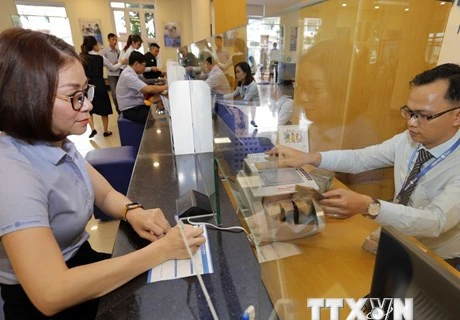
Vietnam needs to better sovereign credit ratings: ministry ảnh 2Illustrative image (Photo: VNA)

Therefore, the project’s overall goal is that by 2030, Vietnam is a developing country with modern industry and high middle income, which has an increasingly complete, effective governance institutions; a strongly developing economy on the basis of science and technology in association with improving efficiency in foreign affairs and international integration, continuing to better the investment environment, increasing Vietnam's position and reputation in the international arena, creating favourable conditions to raise the national credit rating to Investment level, and contributing to reducing capital mobilisation costs and national credit risk.

The project also aims for an annual GDP grow rate of 7 percent, GDP per capita of about 7,500 USD (current price) by 2030, and total social investment of 33-35 percent of GDP.

The Vietnamese Government has officially cooperated with all three largest international credit rating agencies, namely Moody's Investors Service (Moody's), S&P Global Ratings (S&P) and Fitch Ratings (Fitch). The effectiveness of the national credit rating, the credit coefficient and outlook have been continuously improved from 2013 to 2021. Specifically, the sovereign credit rating has increased from B2 to Ba3 according to Moody's, from BB- to BB according to S&P's assessment, and from B+ to BB according to Fitch's assessment.

The Ministry of Finance said that the sovereign credit rating is a factor determining the cost of capital mobilisation in international financial markets. This is even more significant when Vietnam becomes a middle-income country, whose source of ODA has to gradually decrease to the end, and must rely more on foreign preferential and commercial loans in international capital markets./.
VNA

See more

Workers process fruit for export at the Chanh Thu factory in Cho Lach commune, Vinh Long province. (Photo: VNA)

Vietnam works to maintain edge in key agricultural market

According to Le Hang, Deputy Secretary-General of the Vietnam Association of Seafood Exporters and Producers (VASEP), China and Hong Kong (China) remained bright spots for Vietnam’s aquatic exports in July, with revenue exceeding 267 million USD, up 24.7% year-on-year.

An estimated 6,300 workers are needed by the semiconductor industry in Bac Giang province during the 2025-2030 period. (Photo: VNA)

India's semiconductor strategy complementary to Vietnam's chip sector: expert

Sudhanshu Mittal, Director of Engineering Solutions at the National Association of Software and Service Companies (Nasscom) of India, noted that during the state visit to India by General Secretary of the Communist Party of Vietnam Central Committee and President To Lam in May, the two countries signed a number of cooperation agreements, with semiconductors identified as a priority area alongside artificial intelligence (AI), cybersecurity, and advanced technologies.

At the working session between Vietnamese Minister of Finance Ngo Van Tuan (right) and RMIT University’s Vice-Chancellor and President Professor Alec Cameron in Sydney on August 10 (Photo: tapchikinhtetaichinh.vn)

Vietnam, Australia seek to expand investment in rice value chain

During General Secretary of the Communist Party of Vietnam Central Committee and President To Lam’s state visit to Australia from August 9-12, Vietnamese Minister of Finance Ngo Van Tuan, authorised by the General Secretary and President, held working sessions with SunRice Group CEO Paul Serra and RMIT University’s Vice-Chancellor and President Professor Alec Cameron in Sydney on August 10.

Students practice microcontroller programming at the Vietnam-Korea College of Technology in Bac Ninh province (Photo: VNA)

Vietnam – one of most attractive destinations for leading US semiconductor companies: expert

Vietnam has built a solid semiconductor and electronics industry before joining ITSI, attracting major US semiconductor companies. Intel Products Vietnam is one of Intel's largest assembly and testing facilities worldwide, while chip design companies such as Synopsys, Cadence, Marvell and Qualcomm have established engineering and research centres in the Southeast Asian country.

Lawmakers on August 9 discuss a draft law amending and supplementing a number of articles of the Law on the State Bank of Vietnam, the Law on Anti-Money Laundering and the Law on Credit Institutions. (Photo: VNA)

Lawmakers discuss measures to ensure banking system safety, support digital economy

The draft law sets out provisions to control conflicts of interest when commercial banks act as agents managing collateral for corporate bonds. In this regard, Deputy Le Van The of Ninh Binh province said he supported the move, noting that it could provide a more professional approach to collateral management and help strengthen investor confidence if properly regulated.

A company in Da Nang operates a customer relationship management system supported by AI chatbots. (Photo: VNA)

AI drives rise of sleepless enterprises in Vietnam

The concept of a sleepless enterprise does not necessarily mean making employees stay on the job all the time. Instead, it's about building intelligent systems that can respond to customers, process transactions, monitor operations, analyse data and flag risks continuously.

Head of the Vietnam Trade Office in Australia Tran Thi Thanh My (Photo: VNA)

Vietnam, Australia eye 20 bln USD trade target

The head of the Vietnam Trade Office in Australia hoped that the visit by Party General Secretary and State President To Lam will mark a new milestone, opening the door for firms on both sides to forge stronger links and launch concrete cooperation agendas, helping hit that 20 billion USD trade goal sooner rather than later.

Phu Quoc pepper products, granted three stars under the OCOP programme in An Giang province, are displayed at an exhibition of outstanding OCOP products from the Mekong Delta. (Photo: VNA)

Phu Quoc leverages OCOP programme to take local specialities global

Better known as one of Vietnam’s premier island destinations, Phu Quoc is leveraging its “One Commune, One Product” (OCOP) programme to transform traditional specialities into internationally recognised products, integrating local agriculture, food processing and tourism to promote sustainable economic growth.