Vietnam needs to create a rice brand: experts

Developing a national brand name is an urgent need for improving the competitiveness of Vietnamese rice, heard a recent conference in HCM City.
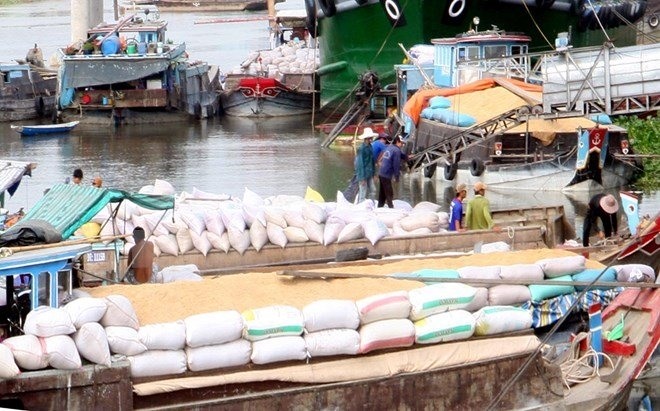
Vietnam needs to create a rice brand: experts ảnh 1Illustrative image (Photo: vietnamnet.vn)

HCM City (VNA) - Developing a national brand name is an urgent need for improving the competitiveness of Vietnamese rice, heard a recent conference in HCM City.

The fourth rice symposium, organised by Vietnam Economic Times with support from Bayer Vietnam and titled “How to enhance Vietnam rice quality and brand positioning to meet market needs” gathered more than 150 experts and officials from Government agencies and representatives of rice trading companies. 

Experts told the conference that Vietnamese rice has been exported to over 80 markets including Southeast Asia, the US, Japan, Africa, and the Middle East.

But in recent years exports were not stable and were diminishing due to the lack of clear plans to develop global trademarks for its rice.

Dao The Anh, Director of the Centre for Agrarian Systems Research and Development, told the conference that without national brands, Vietnamese rice was often packaged with the name of exporting companies or importing countries. 

Even in the domestic market, Vietnamese rice varieties are less competitive than those imported from neigbouring countries, according to Anh.

Some companies have started to build their own brands, but these are yet to become well-known. 

It is now imperative to have a national brand name.

Huynh Van Nghiep, Deputy Director of the Mekong Delta Rice Research Institution, said the advantage of low labour costs no longer existed. 

Production costs kept increasing while rice prices were down due to problems related to quality and trademark.

Besides ensuring quality, expanding the distribution system and improving packaging, Vietnam should also develop a national brand name for rice, he stressed.

The gathered experts agreed that the brand name for Vietnamese rice must be based on quality.

Anh said Vietnamese rice quality was not uniform because there were many varieties of paddy.

"In the Mekong region alone there are 100 varieties," he pointed out.

He admitted it was very difficult to manage a national trademark with many kinds of paddy, citing the examples of Thailand, whose rice trademark is just for two varieties, and India, for whom it is only for basmati. 

Speaking about how to create Vietnamese rice brand names, Kohei Sakata, general director of Bayer Vietnam said: “The missing part now, from my perspective, is to really make sure that the quality is as high as required in other markets. We also need to ensure equal quality across different farms and sectors. So in order to achieve high quality at an equal level in many places, the value chain needs to be close to each other.” 

Nghiep said it was a big challenge to develop a national brand for Vietnamese rice. 

It needs co-operation among various sectors and companies and a clear plan, according to Nghiep.

He suggested having national standards for each rice category, saying from that there would be studies to develop them.

Various rice strains should be planted in different areas with different technologies to produce rice of quality that meets international standards, he said. 

Food hygiene standards should also be created, he added.

Along with these, the experts said, there should be co-operation among companies to avoid small scale of production.

This year Vietnam has been facing many challenges and heightened concerns over the Mekong Delta’s future due to an extremely severe drought which resulted in higher salinity levels in the delta as seawater intruded unusually deep into rivers.-VNA

VNA

See more

Illustrative image (Photo: VNA)

German media group releases Vietnam outlook report 2026

The Germany-based international media group specialising in economic, financial and political coverage of emerging markets IntelliNews on January 11 published its annual Vietnam Outlook report 2026, highlighting prospects for economic growth and what problems lie in store.

PM Pham Minh Chinh speaks at the meeting (Photo: VNA)

PM pushes five strategic breakthroughs to fuel digital economy

Addressing the first meeting of the National Steering Committee on Data linked virtually with all 34 cities and provinces nationwide, PM Pham Minh Chinh, who is also head of the committee, stressed that the Party’s policies and guidelines and the State’s laws have long articulated a strategic vision for data development. He cited Resolution No. 57-NQ/TW and the recently enacted Law on Data, both of which designate data as a “new means of production” and a strategic resource that must be transformed into high-value assets.

A customer conducts transactions at the Vietnam Joint Stock Commercial Bank for Industry and Trade (VietinBank). (Photo: VNA)

Central bank aims for 15% credit growth in 2026

In 2026, monetary policy will continue to be implemented in a proactive, flexible, timely and effective manner to help stabilise the macroeconomy, keep inflation under control, support economic growth and advance the restructuring of banks under compulsory transfer.

Vietnam is emerging as a preferred destination for many foreign enterprises (Photo: hanoimoi.vn)

Vietnam emerges as bright spot of growth, trusted and responsible partner

Despite a volatile global environment, Vietnam recorded solid gains in 2025. With flexible and proactive policies under the leadership of the Communist Party of Vietnam and the Government, all 15 key socio-economic targets were met or exceeded, while GDP expanded by about 8.02%, surpassing expectations.

An image of a Vietnamese game. CIS region has potential for gaming developers from Viet Nam. (Photo: Courtesy of cellphones.com.vn_

CIS: Opportunity for game developers in Vietnam

The CIS region, which includes Eastern Europe and Central Asia, has potential for gaming developers from Vietnam as this market displays user behaviour patterns that are highly favourable for mobile gaming growth, particularly around major holiday periods.

Banks, including MB Bank, have issued alerts about scams conducted via social media platforms such as Zalo and Facebook, where criminals impersonate acquaintances. (Photo: The Courtesy of MBBank)

Financial scams surge ahead of Tet

As the Lunar New Year (Tet) approaches, financial and banking scams in Vietnam are showing a sharp upward trend, prompting banks and law enforcement agencies to issue repeated warnings.

Hai Phong targets 4.3 billion USD in FDI in 2026 (Photo: VNA)

Hai Phong city targets 4.3 billion USD in FDI in 2026

Hai Phong’s investment appeal is underpinned by a rapidly expanding development space, including the Southern Coastal Economic Zone covering more than 20,000 hectares, a planned free trade zone, deep-water ports at Lach Huyen, and 12 industrial parks newly established in 2025.

The relocation of check-in counters aims to better meet the travel needs of residents and visitors. (Photo: VNA)

Vietjet shifts domestic check-in at Tan Son Nhat from January 13

During the recent New Year 2026 holiday peak, Vietjet added 380 flights, equivalent to nearly 78,000 additional seats, on many key domestic routes linking Hanoi and Ho Chi Minh City with destinations such as Vinh, Thanh Hoa, Hai Phong, Da Nang, Phu Quoc, Nha Trang and Da Lat.

Commercial banks are providing approximately 88% of total green credit outstanding in Vietnam. (Photo: nhandan.vn)

Capital sources expanded for sustainable growth

According to the State Bank of Vietnam (SBV), by the end of November 2025, outstanding green credit was estimated at around 750 trillion VND (28.55 billion USD), with an average growth rate exceeding that of overall credit in the economy.

Customers select goods at a supermarket. (Photo: VNA)

Retail market expands sharply, sustainability challenges persist

According to a report on recently released by the Ministry of Industry and Trade’s Agency for Domestic Market Surveillance and Development, the size of the market reached more than 7 quadrillion VND (about 266 billion USD) in 2025, up around 10% compared with 2024.