Vietnam, Thailand discuss ways for promoting bilateral trade

Vietnam and Thailand held the fourth meeting of their Joint Trade Committee in Bangkok on April 20, working out orientations, measures, and action plans to soon raise bilateral trade to 25 billion USD.
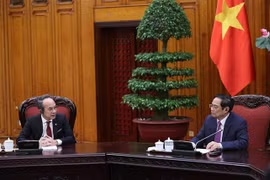
Vietnam, Thailand discuss ways for promoting bilateral trade ảnh 1Vietnam and Thailand are striving for 25 billion USD in bilateral trade. (Photo: VNA)
Bangkok (VNA) –Vietnam and Thailand held the fourth meeting of their Joint Trade Committee inBangkok on April 20, working out orientations, measures, and action plansto soon raise bilateral trade to 25 billion USD.

In his opening remarks, ThaiDeputy Prime Minister and Minister of Commerce Jurin Laksanawisit affirmed his countryviews Vietnam as a partner of leading importance in Southeast Asia, and that itattaches importance to bolstering economic and trade ties with Vietnam.

He highlighted the increasein the two-way trade, thanking the Vietnamese Government and agencies for creating optimal conditions for enterprises and organisations of Thailand.

Apart from the proposalslisted in the meeting’s minutes, he asked Vietnam to create favourableconditions for goods to be transited under the agreements signed within theGreater Mekong Subregion and ASEAN frameworks, chicken and some fruits ofThailand licensed, and pharmaceuticals registered.

He also called for expandinglabour cooperation under the memorandum of understanding between the twocountries’ labour ministries.

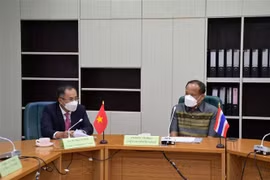
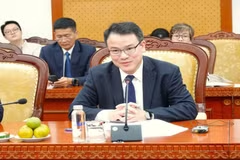
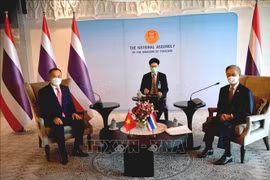
Vietnam, Thailand discuss ways for promoting bilateral trade ảnh 2The fourth meeting of the Vietnam - Thailand Joint Trade Committee in Bangkok on April 20 (Photo: VNA)
Vietnamese Minister of Industryand Trade Nguyen Hong Dien said the initiatives, measures, and concrete actionsdevised at the meeting will create new impulses for bilateral economic andtrade relations, along with the countries’ coordination within ASEAN and othermultilateral and regional cooperation frameworks.

The two sides reviewedcooperation outcomes and shortcomings in trade and relevant areas since thethird meeting held in 2018.

They applauded the positivegrowth in bilateral trade which stood at 18.8 billion USD in 2021, up 17.9percent year on year despite impacts of the COVID-19 pandemic.

The officials agreed to actively coordinate and facilitate import and exportactivities between the two countries towards a mutually beneficial and more balanced trade. Theyalso identified ways for strengthening links in agriculture, transportconnectivity, and investment.

Vietnam and Thailand agreed to boost coordination andmutual support at sub-regional, regional, and multilateral mechanisms likeASEAN, Asia-Pacific Economic Cooperation (APEC), the Asia - Europe Meeting (ASEM), theAyeyawady-Chao Phraya-Mekong Economic Cooperation Strategy (ACMECS), the Mekong - Lancang Cooperation, the WorldTrade Organisation (WTO).

To ease the pandemic’s impacts onregional economies, they also agreed to tighten cooperation in implementing andupgrading the ASEAN Trade in Goods Agreement (ATIGA) and ASEAN Plus free tradeagreements, with a focus on measures for facilitating trade, removing non-tariffbarriers, and enhancing transparency so as to ensure uninterrupted goods flowsand consolidate intra-ASEAN trade and regional supply chains, thereby contributingto post-pandemic regional economic recovery.

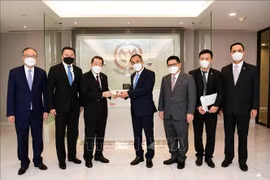
Vietnam, Thailand discuss ways for promoting bilateral trade ảnh 3Minister of Industry and Trade Nguyen Hong Dien (Photo: VNA)
Talking to the Vietnam NewsAgency, Minister Dien said both countries are determined to developincreasingly extensive, effective, and substantive relations on the basis ofmutual respect and understanding, and win-win cooperation at all levels andin all fields.

Thailand is the largesttrade partner and export market of Vietnam in ASEAN, and also ranks ninth among the foreign investors in Vietnam which, in turn, is the second biggest trade partnerof Thailand in the bloc.

The two sides are dynamiceconomies in the Asia-Pacific region and boast much potential for further steppingup their trade and partnerships in relevant aspects, including energy,transport, logistics, finance, banking, agriculture, and investment. Both arealso members of many free trade agreements (FTAs), including the Regional ComprehensiveEconomic Partnership (RCEP).

Given this, they are holdingmajor opportunities for reinforcing ties within regional supply chains andproduction networks so as to effectively tap into FTAs, according to Dien./.
VNA

See more

VietinBank’s LDR is around 92.8%, according to estimates by the ACB Securities Company based on data as of June 30. (Photo: VNA)

Banks with sufficient funding base to benefit from new safety ratio policy

The new policy, which will take effect early next month, raises the loan-to-deposit ratio (LDR) cap to 95% from the current 85%, while starting a phased transition towards Basel III liquidity standards, including by introducing a liquidity coverage ratio (LCR) and net stable funding ratio (NSFR).

The daily reference exchange rate is set at 25,652 VND/USD on November 17. (Photo: VNA)

Reference exchange rate edges higher

With the current trading band of +/- 5%, the ceiling rate applicable for commercial banks during the day is 26,935 VND/USD, and the floor rate 24,369 VND/USD.

Manufacturing materials for solar cell production at JA Solar Vietnam Co., Ltd., a Hong Kong (China)-invested enterprise in the Quang Chau Industrial Park, Bac Ninh city (Photo: VNA)

Vietnam, China widen economic, trade cooperation space

General Secretary of the Communist Party of Vietnam Central Committee and President To Lam’s trip to China for the 33rd APEC Economic Leaders’ Week and bilateral engagements is expected to add new momentum, including deeper economic connectivity, broader trade, investment and supply chain links, and a more balanced, substantive economic relationship that matches both sides’ potential.

The sidewalks on Hung Vuong street in Quang Tri province are under renovation. (Photo: VNA)

Quang Tri approves 103 priority projects for investment during 2026–2030

The 103 projects are categorised into seven fields, comprising energy; logistics; tourism, services, and trade; green and high-tech agriculture; industry, industrial zones, and production infrastructure; urban development and commercial housing; and healthcare, wellness, and resort services.

Workers make clothes for export to the Japanese market at Hung Viet Garment Company in Hung Yen province (Photo: VNA)

Vietnam’s textile-garment firms striving to achieve export targets, sustain employment

To achieve the annual target, textile and garment businesses are jointly implementing several core tasks, including diversifying export markets and partners, developing the supporting industries for raw materials and accessories to establish integrated supply chains, investing in technological innovation linked to AI, stepping up high-quality workforce training, promoting green transformation based on circular economy models, and building brands in both domestic and international markets.

Minister of Public Security General Luong Tam Quang (R) receives Choo Hyeong Wook, President and CEO of the Republic of Korea’s SK Innovation in Hanoi on November 16. (Photo: VNA)

Vietnam promotes international cooperation in energy, high technology

Minister of Public Security General Luong Tam Quang called on the RoK's SK Innovation to share experience and work with Vietnamese partners in developing clean and renewable energy, hydrogen, liquefied natural gas, energy storage technologies and carbon emission reduction solutions.

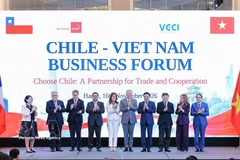
Delegates pose for a photo at the Chile-Vietnam Business Forum in Hanoi on November 16 (Photo: VNA)

Vietnam, Chile seek to expand trade ties

Chilean President José Antonio Kast pointed to potential for cooperation in agriculture and food, and called for stronger technical cooperation, better market access and closer links in innovation, technology, services and sustainable development.

Production of footwear for export at Lefaso Tra Vinh Industrial Investment and Production Joint Stock Company, Tra Cu commune, Vinh Long province (Illustrative image. Source: VNA)

VEFTA implementation requires exporters to restructure supply chains: Experts

Under VEFTA, tariff reductions to zero will be meaningless for Vietnam’s key export sectors, including textiles and garments, footwear, and agricultural and aquatic products, if goods are found to contain banned chemicals, violate rules of origin or lack transparency regarding their carbon footprints.