Vietnam to host Asia Pacific IT Alliance Awards 2019

Vietnam will host the Asia Pacific IT Alliance (APICTA) Awards in 2019, said Minister of Information and Communication Truong Minh Tuan on May 14.
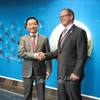
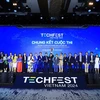
Vietnam to host Asia Pacific IT Alliance Awards 2019 ảnh 1At the working session between the Ministry of Information and Communication and a delegation from the APICTA. (Photo: VNA)

Hanoi (VNA) – Vietnam will host the Asia Pacific IT Alliance (APICTA)Awards in 2019, said Minister of Information and Communication Truong Minh Tuanon May 14.

In a meeting with a delegation from the APICTA led by Chairman Stan Singh, MinisterTuan stressed that hosting the event will allow Vietnam to popularise its ITand communication development and introduce Vietnamese images, people andeconomic potential to international friends.

He said the Ministry of Information and Communication supports the VietnamSoftware and IT Service Association (VINASA) to join the APICTA whileencouraging other IT and communication associations and businesses’ involvementin the APICTA’s activities.

According to the e-government survey 2016 conducted by the United Nations,Vietnam was ranked 89th out of 193 countries and territoriesworldwide and sixth among Southeast Asian nations in the e-governmentdevelopment index.

Seeing IT as a basis for economic development, the Vietnamese Government has usedspecial policies to lure investment in software production and IT productmanufacturing, software services and digital products, he said.

Tuan underlined that the development and application of IT has been implementedto improve the business climate, national competitive capacity, e-governmentand to build smart urban areas.

The APICTA is an alliance of national IT organisations representing theirrespective economy to build, enhance a network to promote IT, promotetechnology innovations, capability and adoption and encourage the developmentof indigenous IT solutions to the global market.

APICTA’s 16 member-economies include Australia, Bangladesh, Brunei, China, HongKong (China), Indonesia, Japan, Macao (China), Malaysia,Myanmar, Pakistan, Singapore, Sri Lanka, Thailand, Taiwan (China) and Vietnam.

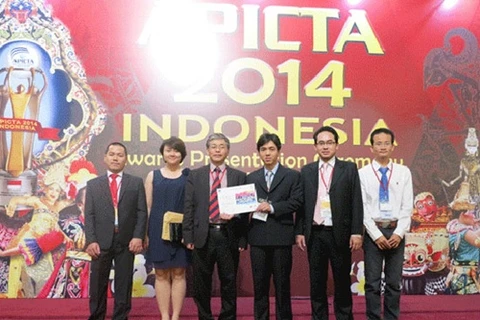
In 2016, Vietnam participated in the APICTA. The VINASA brought the bestVietnamese IT products and services to the APICTA awards two years ago.

The APICTA 2018 awards will be held in China’s Guangzhou province inOctober.-VNA
VNA

See more

Sorting fish prior to transport for distribution. (Photo: VNA)

Fishermen keep pace with digital technology

Across central coastal provinces, authorities have introduced policies to restructure fleets, reduce vessel numbers, and support fishermen in transitioning to more sustainable livelihoods. Provinces such as Dak Lak and Gia Lai have earmarked nearly 1 trillion VND to support occupational changes and decommission inefficient vessels, while others including Nghe An, Quang Tri, Hue, and Quang Ngai are implementing roadmaps to phase out thousands of underqualified boats.

Phuc Loi ward in Hanoi has launched the “Digital Literacy for All” movement, forming support teams to help residents install applications such as iHanoi and eTax. (Photo: VNA)

Hanoi advances technological innovation in key economic sectors

The municipal People's Committee recently issued Plan No. 109/KH-UBND on technological innovation in key economic sectors through 2035, which serves as both a catalyst and a strategic move to systematise, elevate and reinforce the capital’s leading role in the digital era.

General Secretary of the Communist Party of Vietnam (CPV) Central Committee and State President To Lam (first, right, front row) listens to a presentation about the China-ASEAN AI Application Cooperation Centre (Photo: VNA)

Top Vietnamese leader visits China–ASEAN AI Application Cooperation Centre

The China–ASEAN AI Application Cooperation Centre, jointly established by the Guangxi Zhuang Autonomous Region and ASEAN countries, aims to promote inclusive and mutually beneficial development of AI globally. It is regarded as a flagship project in advancing the “Digital Silk Road” initiative in Nanning.

A view of the 224th session of the UNESCO Executive Board in Paris. (Photo: VNA)

UNESCO extends recognition of 2 Category II science centres in Vietnam

The continued operation and enhancement of the two Category II centres under UNESCO’s auspices reflect Vietnam’s policy of positioning science, technology and innovation as key drivers of development, while closely linking scientific advancement with deeper and more substantive international integration in the current context.

China–ASEAN Artificial Intelligence Application Cooperation Centre deeply integrates future technologies with distinctive ASEAN cultural characteristics. (Photo: VNA)

China–ASEAN AI cooperation centre drives regional tech cooperation

With strong policy support and growing participation from businesses and research institutions, the China–ASEAN Artificial Intelligence (AI) Application Cooperation Centre is expected to act as a digital bridge, promoting technological integration and opening new avenues for Vietnam–China cooperation in the digital era.

Politburo member and Chairman of the Party Central Committee’s Organisation Commission Nguyen Duy Ngoc (ninth, left) and the Vietnamese delegation pose for a group photo with leaders of the Zhongguancun Science Park and Beijing city. (Photo: VNA)

Vietnam, China step up cooperation in science, technology, innovation

Politburo member and Chairman of the Party Central Committee’s Organisation Commission Nguyen Duy Ngoc, who also serves as Standing Deputy Head of the Central Steering Committee for the Development of Science, Technology, Innovation and Digital Transformation, toured the park’s exhibition area and was briefed on the formation and development of Zhongguancun, along with Beijing’s achievements in science, technology and innovation.

A technician from Viettel Bac Ninh examines equipment at a 5G base transceiver station. (Photo: VNA)

Bac Ninh accelerates development of 5G, data infrastructure

In the first quarter, Bac Ninh’s telecommunications infrastructure continued to develop in a synchronous manner. All communes have been connected to dedicated data transmission networks, and 100% of the population is covered by mobile services.

Illustrative photo (Photo: VNA)

An Giang identifies key tasks in science-technology development

The priorities focus on four pillars: science and technology, innovation, digital transformation, and real-world applications to boost socio-economic development. These are expected to create breakthroughs in governance, production, and daily life.

Illustrative image (Photo: VNA)

Vietnam Research Excellence Fellowship for 2026-2030 approved

Under the Vietnam Research Excellence Fellowship (VREF) for the 2026–2030 period, PhD students are identified as a core research force directly contributing to breakthroughs in sci-tech and innovation. Investing in top-tier doctoral candidates is more than workforce development, but a high-stakes strategic bet to forge a cohort of world-class scientists and technologists who can power Vietnam’s long-term economic ambitions.