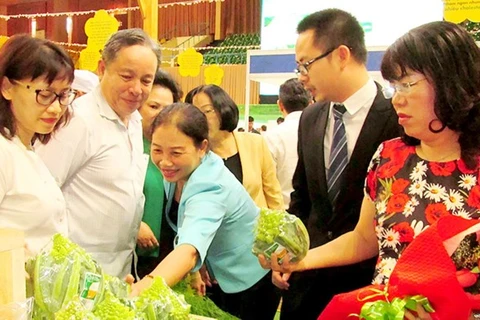
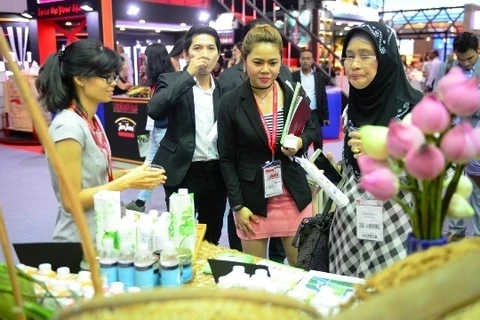
Vietnamese business executives meet their foreign counterparts at a business matching event on the sidelines of the Thaifex expo in Bangkok last week (Photo: VNA)
 HCM City (VNS/VNA) - Vietnam needs to focus on increasing businesses’ awareness of registering for and protecting geographical indication (GI) for their products and the advantages GI brings, according to experts.
Speaking at a seminar on connecting businesses in ASEAN member countries organised by the High Quality Vietnamese Goods Business Association on the sidelines of the Thaifex expo in Bangkok last week, Pascal Billaud, CEO of Thailand’s Central Food Retail Group and Asian GI ambassador to the UN, said Thailand has educated people about the impacts and benefits of GI.
They are regularly updated on GI, ways to protect GI products and preserving and sustaining local eco-systems so that GI products can continue to be produced in that particular area or region, he said.
He said GI is very important to farmers and they need to register their produce for GI protection with relevant agencies.
Origin-linked registration also substantially increases the price of the final product, he said.
A kilogramme of Cambodia’s Kampot black pepper fetches 15 USD against 6 USD for Thai pepper and only $5.04 for Vietnamese pepper, he said.
This means Vietnam has not done well in exploiting GI and other benefits, he said.
According to experts, GI provides consumers with information about the origin of a product and its unique characteristics such as taste, colour, texture, and quality, and so they are willing to pay higher prices.
Thirty leading Vietnamese food and beverage companies, who are members of the High Quality Vietnamese Goods Business Association, showcased organic and other food meeting global standards and GI-protected products at the expo in Bangkok from May 29 to June 2.
At a business matching event, Huynh Nguyen Khang Duy, import-export director at Pham Nghia Food JSC of Can Tho, said: “This is the first time we showcase our products (clown knife-fish-based products) abroad.”
Vietnam mainly exports tra and basa and clown-knife fish costs more than them.
Many customers from Australia, Japan, Thailand and Malaysia were interested in his company’s products, Duy said.
“We hope to take our boneless clown-knife fish and clown-knife fish paste products to Hong Kong and Japan.
“We are also working to obtain Halal certification for export to the Middle East."
CP (Thailand) wants to distribute his products in the Thai market, he said.
"I think if we want to take our products to the world or region, we also need to have capable and prestigious partners."
Le Thanh Diem, head of Tan Sang Food Powder Company’s sales division, said: "Before the business matching event, I surveyed the prices of products and found that our prices are appropriate.”
Thai companies sought assurances her company could supply large volumes, she said.
Norachai Ratanabanchuen, assistant to the deputy general director of CP Foods, said he had held discussions with four Vietnamese firms.
While Vietnamese goods are of rather good quality, to be able to enter the CP distribution system, products must meet many quality standards, including HACCP and ISO.
Vietnam and Thailand have many similar products, but Vietnamese suppliers can still compete, he said, citing the example of basa fish, which his company imports from Vietnam.
If Vietnamese firms continue to maintain good quality, comply with standards, and have reasonable prices, they can compete with their Thai counterparts, he said.-VNS/VNA
VNA