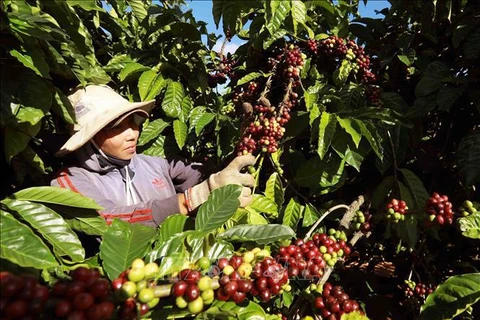
Vietnamese agro-forestry-fisheries products conquer global market: A 30-year success story

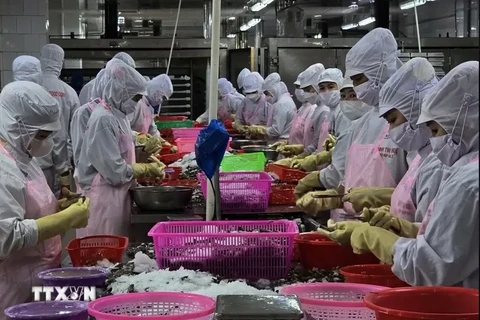
Vietnamese agro-forestry-fisheries products have secured a strong foothold in over 190 countries and territories worldwide, heard a ceremony in Hanoi on August 30 marking the remarkable 30-year journey of the National Agro-Forestry-Fishery Quality, Processing and Market Development Authority (NAFIQPM).

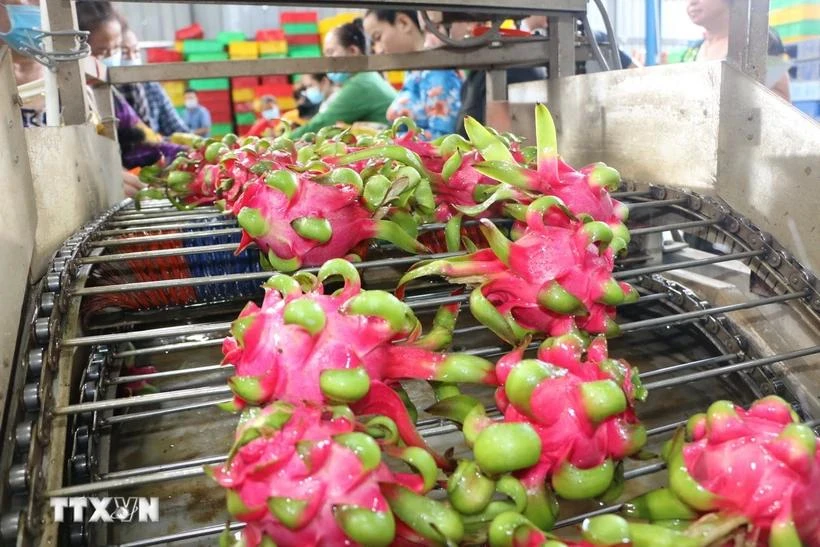
Dragon fruit cleaning line for export (Photo: VNA)

Hanoi (VNA) – Vietnamese agro-forestry-fisheries products have secured a strong foothold in over 190 countries and territories worldwide, heard a ceremony in Hanoi on August 30 marking the remarkable 30-year journey of the National Agro-Forestry-Fishery Quality, Processing and Market Development Authority (NAFIQPM).

With export turnover hitting over 53 billion USD in 2023 and a staggering 40.08 billion USD in the first eight months of this year alone, the industry's growth shows no signs of slowing with a steadily rising number of products conquering stringent markets.

Speaking at the event, Minister of Agriculture and Rural Development Le Minh Hoan underlined the critical role of people - the key players in the ecosystem of food production, processing, and distribution.

He tasked the NAFIQPM with prioritiaing hygiene, safety, and quality throughout the supply chain.

NAFIQPM Director Nguyen Nhu Tiep said right after its establishment, the agency quickly developed a network with a Hanoi hub and six regional branches located in the key fisheries areas of Hai Phong, Da Nang, Nha Trang, Ho Chi Minh City, Can Tho and Ca Mau, equipped with a full team of inspectors, evaluators, and auditors.

It has also guided the industry in adhering to Codex guidelines - a food safety database jointly developed by the Food and Agriculture Organisation and the World Health Organisation, and the stringent requirements of export markets such as the European Union (EU), the US, and Japan.

As a result, food safety levels skyrocketed from 2016 to 2023, with 99% of establishments now meeting safety conditions (up from 91%), small-scale producers committing to food safety jumped from 72% to 92%, while food safety samples meeting standards in widespread monitoring improved from 92.4% to 97.4%.

NAFIQPM's close collaboration with the Ministries of Industry and Trade, and Foreign Affairs, and Vietnamese trade counselors abroad has also been instrumental in expanding export opportunities. By staying informed on market trends and proactively negotiating market access, NAFIQPM has bolstered the global presence of Vietnamese agricultural products.

Looking ahead, Tiep outlined NAFIQPM's focus on four key pillars, including ensuring food safety and enhancing product quality, boosting processing activities within each supply chain, actively negotiating market access and expansion, promoting brand development and strengthening communication to increase market presence both domestically and internationally./.
VNA

See more

Ahmad Haikal Hasan, Head of the Halal Product Assurance Organising Agency (BPJPH) of Indonesia, speaks at the seminar (Photo: VNA)

Indonesia ready to cooperate with Vietnam in halal sector

Ahmad Haikal Hasan, Head of the Halal Product Assurance Organising Agency (BPJPH) of Indonesia, described Vietnam as a “potential supplier” of halal products with the capacity to play a larger role in the market, particularly in the fast-moving consumer goods (FMCG) sector. He revealed a plan to visit Vietnam next week to discuss the country’s progress in the global halal industry.

Delegates perform the opening ceremony. (Photo: VNA)

Thailand Week 2026 opens in Hanoi

The event brings together more than 100 companies, including Thai enterprises and Vietnamese importers, across about 120 booths. It features a wide range of Thai products aligned with consumer trends in Vietnam, including food and beverages, health and beauty, mother-and-baby and pet products, fashion and jewellery, household goods and tourism services.

Illustrative image (Photo: VNA)

Vietnam remains Singapore’s third-largest seafood supplier in 2025

Data released by the Accounting and Corporate Regulatory Authority of Singapore (ACRA) show that Singapore spent 125.5 million SGD (97.7 million USD) importing seafood from Vietnam last year, up 10.7% year on year, accounting for 10.3% of the city-state’s total seafood import market.

Workers assemble mobile phone components at Diem Thuy Industrial Park in the northern province of Thai Nguyen. (Photo: VNA)

Electronics exports surpass 107 billion USD in 2025

With an export turnover of 107.75 billion USD in 2025, computers, electronic products and components not only maintained their position as Vietnam’s largest export by value, but also contributed more than half of the overall increase in the country’s export turnover in 2025.

Experts said that Vietnam’s economic outlook continues to be underpinned by stable foreign direct investment inflows and public investment, which is playing an important role in driving growth. (Photo: thoibaotaichinh.vn)

Foreign investors maintain strong confidence in Vietnam’s market

Looking ahead to 2026, prospects remain bright as manufacturing, economic growth and foreign investment in Vietnam are expected to stay robust, with the country forecast to post the highest growth rate in the region this year, according to Adam Sitkoff, Executive Director of the American Chamber of Commerce (AmCham) in Vietnam.

Toy production at a Hong Kong-invested factory (Photo: VNA)

Vietnam targets deeper market penetration in Hong Kong in 2026

Vietnam-Hong Kong trade hit 62.3 billion USD in the first 11 months of 2025, soaring 73.1% annually. Vietnamese exports to Hong Kong amounted to 36.8 billion USD, a 90.6% hike, ranking fourth among Hong Kong’s import sources, while imports from Hong Kong stood at 25.5 billion USD, up 52.9% and ranking third.

Vietnam’s start-up market enters restructuring phase

Vietnam’s start-up market enters restructuring phase

In 2026, venture capital inflows into Vietnam’s start-up ecosystem are expected to recover gradually, though in a more selective manner. VinVentures forecasts that capital will focus on start-ups that have survived the rigorous screening of 2024–2025, possess clear business models, strong commercialisation capacity, and the ability to generate real cash flows.